Overview
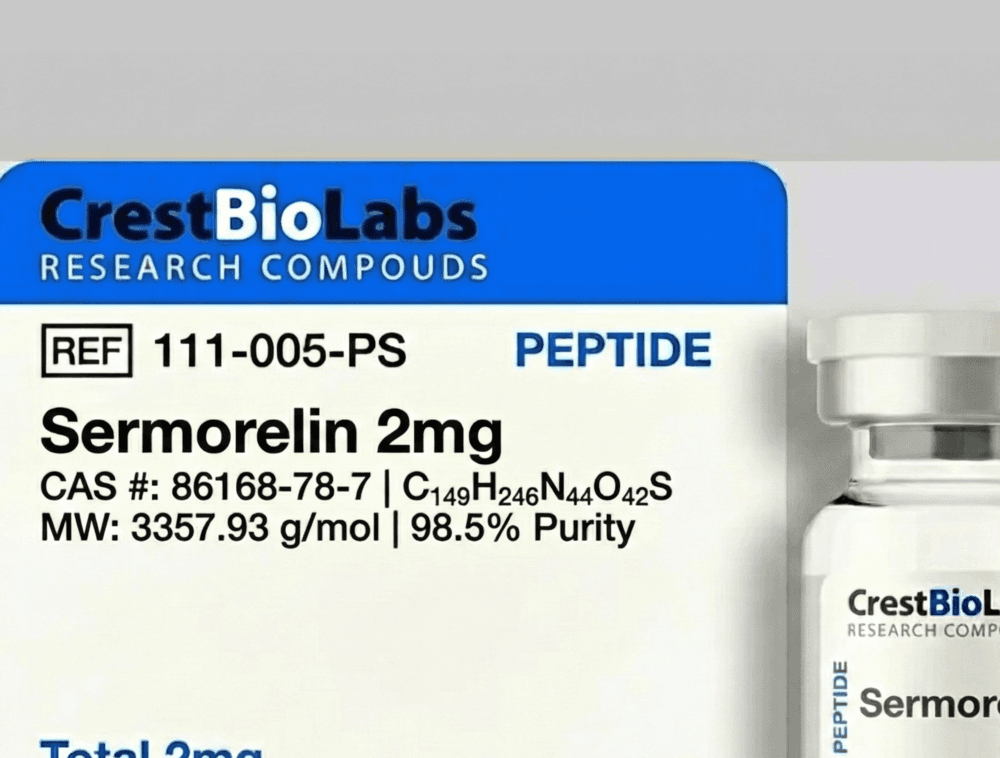
Sermorelin is a synthetic peptide corresponding to the first 29 amino acids of the endogenous 44-amino acid growth hormone-releasing hormone (GHRH). Unlike CJC-1295 No DAC, sermorelin retains the native amino acid sequence of GRF(1-29) without stabilizing substitutions. It represents the minimal biologically active fragment of GHRH, as the first 29 residues have been demonstrated to retain full receptor binding and activation capacity at the GHRH receptor (GHRHR).
The history of sermorelin is directly linked to the discovery and characterization of GHRH itself. Following the isolation and sequencing of GHRH from pancreatic tumors in 1982 by the laboratories of Guillemin and Vale, structure-activity studies established that progressive truncation from the C-terminus to residue 29 retained full biological potency, while further truncation resulted in progressive loss of activity. This finding established GRF(1-29) as the minimal active fragment and led to the synthesis of sermorelin as a research and diagnostic tool.
Sermorelin has been extensively characterized in the scientific literature over more than four decades. Early studies focused on its use as a diagnostic tool for assessing pituitary somatotroph function, as the GH response to GHRH receptor stimulation provides information about the functional integrity of the somatotropic axis. This diagnostic application demonstrated the utility of the peptide in experimental systems and generated a substantial body of published data on GHRH receptor pharmacology.
As a research tool, sermorelin serves as the reference native-sequence GHRH agonist against which stabilized analogs such as CJC-1295 No DAC are compared. Its unmodified sequence makes it valuable for studies that require the native receptor-ligand interaction without confounding effects of amino acid substitutions. However, its susceptibility to rapid enzymatic degradation (primarily by DPP-IV at the Ala2-Asp3 bond) limits its utility in studies requiring sustained GHRH receptor stimulation.
The peptide has been employed in a wide range of research applications, including pituitary cell culture studies, GHRH receptor binding and signaling assays, investigations of GH pulsatility, and studies of the interplay between GHRH and somatostatin pathways. Its well-characterized pharmacology and the availability of extensive published data make it an essential tool in neuroendocrinology research.
Sermorelin's significance in the field of peptide research also extends to its role in validating key concepts in receptor pharmacology. Studies using sermorelin and its derivatives have contributed to the understanding of GHRH receptor desensitization, internalization, and downregulation, processes that are fundamental to the regulation of hormonal signaling systems.
The contrast between sermorelin (native sequence, rapid degradation) and CJC-1295 No DAC (stabilized sequence, extended activity) illustrates a fundamental principle of peptide medicinal chemistry: the trade-off between native receptor interactions and metabolic stability, and how strategic amino acid substitutions can shift this balance for specific research applications.
Chemical Classification
Sermorelin is classified as a synthetic GHRH receptor agonist peptide with the native GRF(1-29) sequence. It belongs to the family of hypothalamic releasing hormones and specifically to the GHRH peptide class. As a native-sequence peptide, it serves as the reference standard for GHRH receptor pharmacology studies.
Chemically, sermorelin is a 29-amino acid linear peptide with an amidated C-terminus and a molecular weight of 3357.93 Da. It is a basic peptide with a net positive charge at physiological pH. The peptide contains the full complement of natural L-amino acids without any non-natural residue substitutions, chemical modifications, or cyclization elements.
Within the classification of neuroendocrine peptides, sermorelin occupies a unique position as both a truncated endogenous hormone fragment and a fully synthetic research compound. Its classification as a native-sequence GHRH analog distinguishes it from stabilized analogs (CJC-1295 No DAC) and from non-GHRH growth hormone secretagogues (ipamorelin, GHRP-6).
Structural Information
Sermorelin is a 29-amino acid linear peptide with a molecular weight of 3357.93 Da and an amidated C-terminus. The peptide contains 149 carbon, 246 hydrogen, 44 nitrogen, 42 oxygen, and 1 sulfur atom, with the sulfur contributed by the methionine residue at position 27.
The three-dimensional structure of sermorelin, like other GHRH peptides, is characterized by an amphipathic alpha-helix that is stabilized in membrane-mimetic environments but less structured in pure aqueous solution. NMR studies have shown that residues 6-29 form a well-defined alpha-helix in the presence of detergent micelles or organic co-solvents, while the N-terminal segment (residues 1-5) remains relatively flexible.
The amphipathic character of the helix, with hydrophobic residues (Ile5, Phe6, Leu14, Leu22, Leu23, Ile26, Met27) aligned along one helical face and hydrophilic residues (Asp3, Asn8, Ser9, Arg11, Lys12, Gln16, Arg20, Lys21, Asp25, Ser28, Arg29) on the opposite face, is critical for receptor interaction. The hydrophobic face is proposed to insert into a complementary groove on the GHRH receptor extracellular domain.
The Ala2-Asp3 peptide bond is the primary site of DPP-IV cleavage, which constitutes the major pathway of enzymatic inactivation. The free N-terminal Tyr1-Ala2 dipeptide allows DPP-IV access, and the L-alanine at position 2 provides the structural requirements for DPP-IV substrate recognition. The methionine at position 27 introduces a site of potential oxidative degradation. The asparagine at position 8 is susceptible to deamidation. These three vulnerabilities (positions 2, 8, and 27) are precisely the sites addressed by the stabilizing substitutions in CJC-1295 No DAC.
Mechanism of Action
Sermorelin activates the GHRH receptor (GHRHR) through the same molecular mechanism as CJC-1295 No DAC, as both peptides bind to the same receptor and initiate the same signaling cascade. The distinction lies in sermorelin's native sequence, which provides the unmodified receptor-ligand interaction, and its rapid susceptibility to enzymatic degradation, which limits the duration of receptor activation.
The GHRHR is a class B GPCR that couples primarily to Gs. Upon sermorelin binding, the receptor undergoes a conformational change that promotes GDP-GTP exchange on the Gsα subunit. The activated Gsα-GTP complex stimulates adenylyl cyclase, elevating intracellular cAMP. PKA, activated by cAMP, phosphorylates L-type calcium channels (promoting calcium influx), CREB (promoting GH gene transcription), and components of the exocytic secretory machinery (promoting GH granule release).
The rapid degradation of sermorelin by DPP-IV in biological systems means that receptor activation is transient. This transient activation pattern more closely mimics the physiological pulsatile release of GHRH from hypothalamic neurons, making sermorelin a valuable research tool for studying the effects of pulsatile versus sustained GHRH receptor stimulation on somatotroph function.
Sermorelin-induced GHRHR activation also engages secondary signaling pathways, including PLC-mediated IP3 production and MAPK pathway activation. The crosstalk between these pathways and the canonical Gs-cAMP-PKA cascade contributes to the full spectrum of somatotroph responses, including acute GH secretion, GH gene transcription, somatotroph proliferation, and receptor desensitization.
The interaction between sermorelin-activated GHRH signaling and the somatostatin inhibitory pathway is an important aspect of its mechanism. Somatostatin, released from hypothalamic neurons in an alternating pattern with GHRH, activates somatostatin receptors (SSTRs) on somatotrophs, coupling to Gi to inhibit adenylyl cyclase and reduce cAMP levels. The balance between GHRH stimulation and somatostatin inhibition determines the net GH secretory output, and this interplay can be studied using sermorelin in combination with somatostatin or its analogs.
Stability and Storage
Sermorelin's stability profile reflects its native amino acid sequence, which includes several residues susceptible to chemical and enzymatic degradation. Proper storage conditions are essential for maintaining the peptide's integrity.
Lyophilized sermorelin should be stored at -20°C or below, desiccated, and protected from light and moisture. Under these conditions, the lyophilized peptide is stable for extended periods. Storage at 2-8°C is acceptable for short-term periods (days to weeks).
Reconstituted sermorelin solutions are more susceptible to degradation than the lyophilized form. Key vulnerabilities include: methionine 27 oxidation (forming methionine sulfoxide), asparagine 8 deamidation (forming aspartate or isoaspartate), and aspartimide formation at aspartate residues. These processes are accelerated at elevated temperatures, extreme pH values, and in the presence of oxidizing agents or metal ions.
Reconstituted solutions should be stored at 4°C for short-term use (3-7 days) or frozen in aliquots at -20°C. Solution pH of 5-7 provides the best stability compromise. The inclusion of antioxidants (e.g., 0.1% ascorbic acid or low-concentration DTT) can mitigate methionine oxidation, though compatibility with the experimental system should be verified. Repeated freeze-thaw cycles should be avoided.
HPLC and mass spectrometry are the standard analytical methods for monitoring sermorelin integrity during storage.
For comprehensive storage protocols, see our Peptide Stability & Storage Guide.
Laboratory Handling
Sermorelin is supplied as a white lyophilized powder and is reconstituted by adding sterile water or bacteriostatic water along the vial wall with gentle swirling. The peptide dissolves readily, producing a clear, colorless solution.
Working concentrations for in-vitro pituitary studies are typically in the nanomolar range. Stock solutions of 0.1-1 mM are commonly prepared and stored in aliquots. Due to the peptide's susceptibility to surface adsorption at low concentrations, low-binding tubes and the inclusion of carrier protein (e.g., 0.1% BSA) may be necessary for dilute working solutions.
All handling should be performed under aseptic conditions using a laminar flow hood. Sterile filtered tips and calibrated micropipettes are essential. Researchers should prepare aliquots immediately after reconstitution to minimize freeze-thaw cycles.
For detailed reconstitution procedures, consult our Laboratory Handling Protocols.
Safety Considerations
Standard laboratory PPE (nitrile gloves, safety glasses, laboratory coat) should be worn when handling sermorelin. Handle the lyophilized powder in a ventilated area. Avoid skin and eye contact. Sermorelin is intended exclusively for in-vitro research and laboratory investigation. Follow institutional safety protocols for bioactive peptide handling.
Published Research & Literature
The following peer-reviewed publications represent key research on Sermorelin. All citations reference studies available through major scientific databases.
Characterization of a 40 residue peptide from a human pancreatic tumor that stimulates growth hormone release
Guillemin R, Brazeau P, Bohlen P, et al.
Science (1982) · DOI: 10.1126/science.6812220
A hypothalamic peptide that stimulates the release of growth hormone in vitro
Spiess J, Rivier J, Vale W.
Biochemistry (1983) · DOI: 10.1021/bi00283a001
Sermorelin: a review of its use in the diagnosis and treatment of children with growth hormone deficiency
Prakash A, Goa KL.
BioDrugs (1999) · DOI: 10.2165/00063030-199912020-00006
Structure-function studies on GHRH
Campbell RM, Scanes CG.
Growth Regulation (1992) · DOI: 10.1007/BF00058719
Growth hormone releasing hormone: discovery, regulation, and role in GH secretion
Muller EE, Locatelli V, Cocchi D.
Physiological Reviews (1999) · DOI: 10.1152/physrev.1999.79.2.511
Dipeptidyl peptidase IV (DPP-IV) degradation of growth hormone-releasing factor analogs
Frohman LA, Downs TR, Williams TC, et al.
Journal of Clinical Investigation (1986) · DOI: 10.1172/JCI112349
Related Research Resources
Research Use Only: All information on this page is provided for educational and research reference purposes.Sermorelin is sold strictly for in-vitro laboratory and research use only. It is not intended for human or animal consumption. Not a drug, dietary supplement, or food additive. Not evaluated by the FDA.