
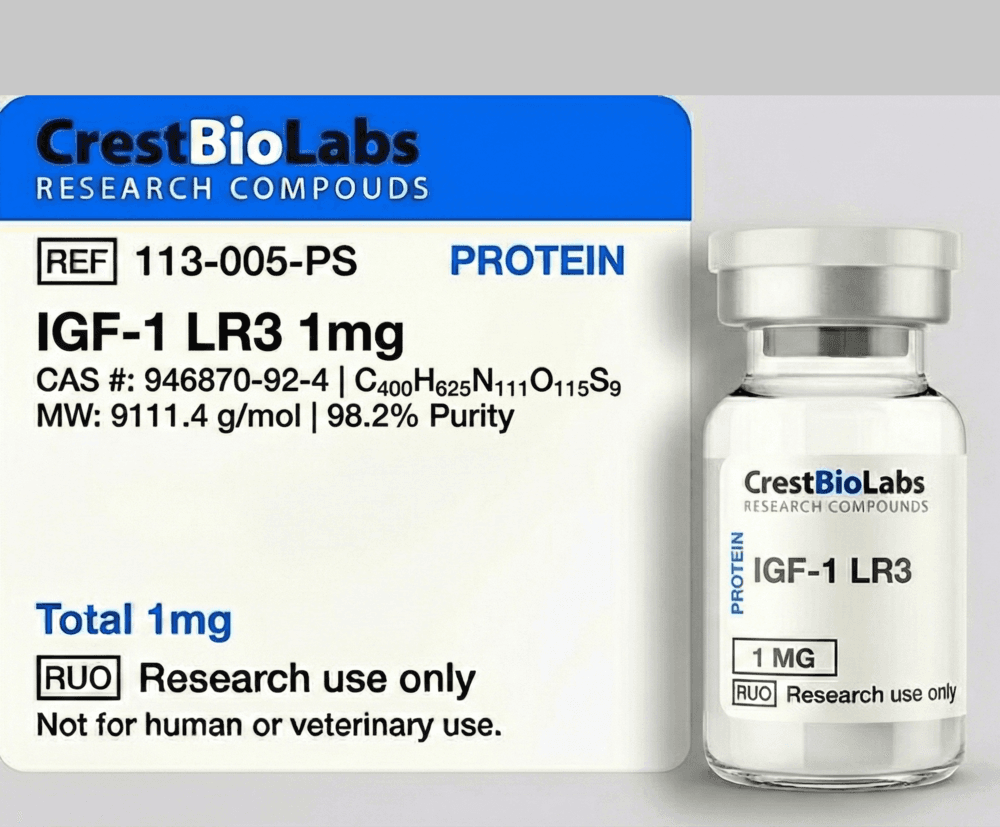
IGF-1 LR3 1mg
IGF-1 LR3 (Insulin-like Growth Factor-1 Long R3) is a modified version of IGF-1 with an extended half-life and increased potency.
Quick Reference
This product is temporarily unavailable. Join our notification list to be the first to know when it's back in stock.
About IGF-1 LR3 1mg
IGF-1 LR3 is an 83-amino acid analog of human IGF-1 comprising the complete IGF-1 sequence with a 13-amino acid extension at the N-terminus and substitution of Arg for Glu at position 3. These modifications result in reduced binding to IGF binding proteins, leading to enhanced biological activity.
Mechanism of Action
Binds the IGF-1 receptor (IGF-1R) with reduced affinity for IGF-binding proteins, leading to prolonged activation of the PI3K/Akt and MAPK/ERK pathways that promote cell proliferation, differentiation, and inhibition of apoptosis.
Research Applications
Long [Arg3] insulin-like growth factor I (IGF-I) and Des (1-...
Journal of Clinical Endocrinology & Metabolism (1994)
The insulin-like growth factor system and its pleiotropic fu...
Endocrine Reviews (2012)
Product Quick Facts
HPLC Verified
98.2% purity confirmed
COA Available
Full chromatograms & MS data
Same-Day Shipping
Orders before 2 PM EST
Cold Chain
Temperature-controlled packaging
Handling Protocol
- •Store at -20°C, desiccated
- •Reconstitute with bacteriostatic water
- •Avoid repeated freeze-thaw cycles
- •Handle under sterile conditions
Related Research
What Are Peptides?
Introduction to peptide structure, classification, and research significance.
Solid-Phase Peptide Synthesis (SPPS)
How SPPS works, Fmoc vs Boc chemistry, and modern synthesis advances.
Mass Spectrometry for Peptide Analysis
ESI-MS and MALDI-TOF methods for confirming peptide identity.
Peptide Stability & Storage Guide
Best practices for peptide storage, reconstitution, and handling.
Frequently Asked Questions About IGF-1 LR3 1mg
IGF-1 LR3 differs from native IGF-1 (70 amino acids) through two modifications: a 13-amino acid N-terminal extension peptide and the substitution of glutamic acid at position 3 with arginine (Glu3 to Arg3, hence 'R3' in the name), resulting in an 83-amino acid protein with a molecular weight of 9,111 Da compared to native IGF-1's 7,649 Da. The Arg3 substitution is the critical functional modification because position 3 falls within the IGFBP binding domain, and the charge reversal from acidic glutamate to basic arginine disrupts the electrostatic complementarity required for high-affinity IGFBP interaction. Together, these modifications reduce IGFBP binding affinity by approximately 100-fold while preserving full agonist activity at the type 1 IGF receptor (IGF-1R), creating a molecule with dramatically enhanced bioavailability in biological systems.
In biological systems, over 95% of circulating native IGF-1 is sequestered in ternary complexes with IGF binding proteins (primarily IGFBP-3) and the acid-labile subunit (ALS), meaning only a small free fraction is available to activate IGF-1R at any given time. IGF-1 LR3's dramatically reduced IGFBP affinity means it remains predominantly in the free, receptor-active form, producing a much greater effective concentration at the IGF-1R for any given total protein amount added to an experimental system. This is particularly important in cell culture research, where serum-containing media harbors significant IGFBP concentrations that would rapidly sequester native IGF-1 and attenuate its signaling. Researchers using IGF-1 LR3 can achieve consistent, reproducible IGF-1R activation without needing to account for variable IGFBP levels across different serum lots or culture conditions.
DES(1-3) IGF-1 is a truncated variant missing the first three N-terminal amino acids (Gly-Pro-Glu), which also reduces IGFBP binding but through a different structural mechanism — removal of the N-terminal tripeptide rather than charge substitution. DES(1-3) IGF-1 retains native IGF-1's 67-amino acid size and has a plasma half-life of only 20-30 minutes, similar to native IGF-1, whereas IGF-1 LR3's additional bulk and IGFBP evasion extend its half-life to 20-30 hours. In cell proliferation assays, DES(1-3) IGF-1 is approximately 10-fold more potent than native IGF-1, but IGF-1 LR3 achieves even greater sustained activation because its prolonged presence continuously stimulates the receptor. Researchers choose DES(1-3) when they need a short-acting, potent IGF-1R stimulus for acute signaling studies, and IGF-1 LR3 when sustained receptor activation or reduced dosing frequency is required.
Reconstitute the 1mg lyophilized vial in 10mM hydrochloric acid (HCl) at a concentration of 0.5-1.0 mg/mL to ensure complete solubilization, as IGF-1 LR3's isoelectric point near pH 8.4 makes it poorly soluble in neutral buffers and prone to aggregation at physiological pH. An alternative is 0.1M acetic acid, which also maintains the acidic environment needed for solubility. After dissolving, the acidic stock solution should be diluted at least 100-fold into the final experimental buffer or cell culture medium to avoid pH-mediated cellular effects, which simultaneously brings IGF-1 LR3 to typical working concentrations of 1-100 ng/mL. Never add neutral pH buffers directly to the lyophilized powder, as the protein will aggregate at the powder-liquid interface before it can dissolve, forming insoluble particulates that represent irreversible activity loss.
Native IGF-1's extremely short free half-life of 12-15 minutes is primarily determined by rapid IGFBP capture (which removes it from the free pool), renal filtration of the small 7.6 kDa protein, and IGF-1R-mediated endocytosis and lysosomal degradation. IGF-1 LR3's 100-fold reduced IGFBP binding eliminates the primary clearance sink, and its larger size (9.1 kDa vs 7.6 kDa) and altered charge profile slow renal clearance. Additionally, the N-terminal extension may partially shield protease-sensitive sites on the IGF-1 backbone from insulin-degrading enzyme (IDE) and other endopeptidases. The practical result is a molecule with sustained IGF-1R signaling kinetics that enables reduced administration frequency in research protocols.
IGF-1 LR3 binds the alpha subunit of the IGF-1 receptor tyrosine kinase, inducing autophosphorylation of the beta subunit on specific tyrosine residues (Y1131, Y1135, Y1136) that create docking sites for insulin receptor substrate (IRS) proteins and Shc adaptor proteins. IRS recruitment activates phosphoinositide 3-kinase (PI3K), which phosphorylates PIP2 to PIP3, recruiting Akt/PKB to the membrane for activation by PDK1 — this PI3K/Akt arm drives protein synthesis via mTORC1, glucose uptake via GLUT4 translocation, and cell survival via BAD phosphorylation. Simultaneously, Shc recruitment activates the Ras-Raf-MEK-ERK cascade, which drives cell proliferation through cyclin D1 transcription. Researchers can pharmacologically dissect these pathways using LY294002 (PI3K inhibitor) or U0126 (MEK inhibitor) to determine which downstream arm mediates a specific IGF-1 LR3 effect in their experimental system.
MCF-7 breast cancer cells are a standard model due to high IGF-1R expression and well-characterized proliferative responses to IGF-1R activation. C2C12 mouse myoblasts are widely used for studying IGF-1 LR3's effects on myogenic differentiation, myotube hypertrophy, and Akt/mTOR-mediated protein synthesis signaling. 3T3-L1 preadipocytes respond to IGF-1 LR3 through both IGF-1R and insulin receptor hybrid receptors, making them relevant for adipogenesis and metabolic signaling studies. For primary cell work, human skeletal muscle satellite cells, chondrocytes, and osteoblasts all express functional IGF-1R and respond robustly to IGF-1 LR3. Researchers should note that some immortalized cell lines (particularly HEK293) express relatively low IGF-1R and may require receptor overexpression constructs to achieve meaningful signaling responses.
At 9,111 Da with three disulfide bonds (C6-C48, C18-C61, C47-C52) essential for receptor binding, IGF-1 LR3 is a folded protein that can irreversibly denature under conditions that small peptides tolerate easily, including vigorous vortexing, repeated freeze-thaw cycles, room temperature exposure exceeding 30 minutes, and adsorption to untreated plastic surfaces. Always use low-binding microcentrifuge tubes and pipette tips (siliconized or polypropylene) when handling dilute solutions below 10 mcg/mL, as surface adsorption can reduce effective concentrations by 20-50% in standard labware. Unlike small peptides that can often be lyophilized and reconstituted repeatedly, IGF-1 LR3's disulfide bonds will not reform correctly after thermal denaturation, so temperature control throughout handling is critical. Prepare single-use aliquots immediately after reconstitution and flash-freeze at -80°C to maximize activity retention over long-term storage.