Overview
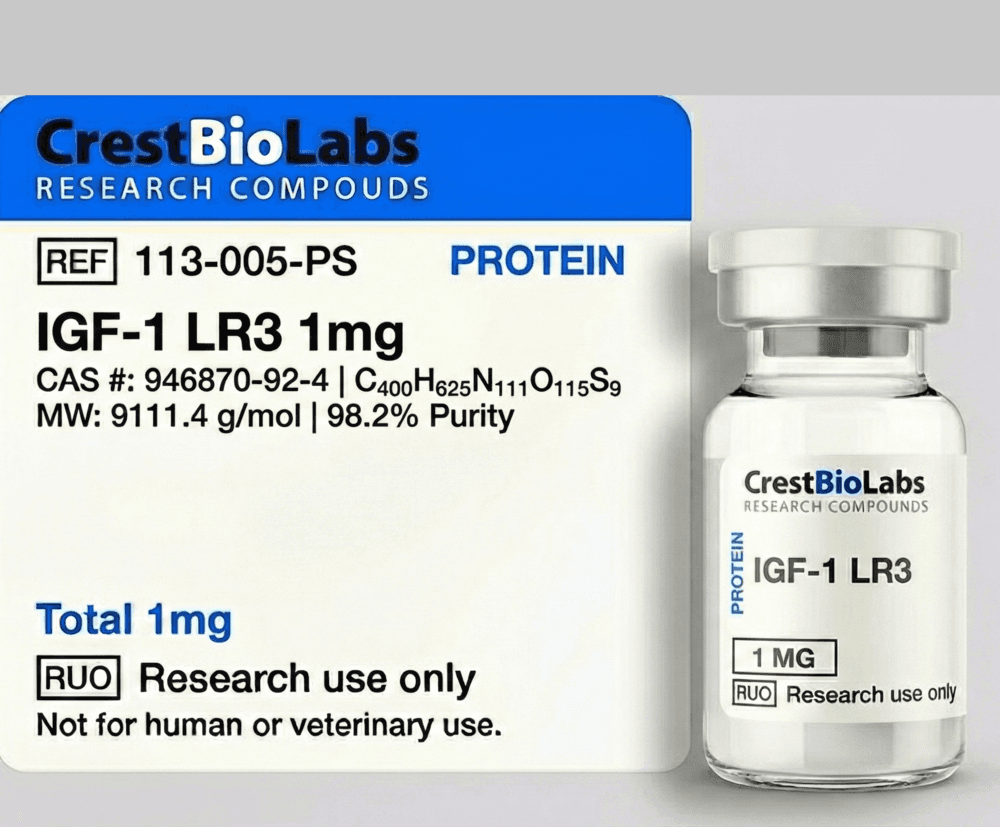
IGF-1 LR3 (Long R3 Insulin-like Growth Factor-1) is an engineered analog of human insulin-like growth factor-1 (IGF-1) that incorporates two modifications to the native 70-amino acid IGF-1 sequence: an N-terminal extension of 13 amino acids and a substitution of arginine for glutamic acid at position 3 of the native sequence (position 16 of the extended sequence). These modifications were specifically designed to reduce IGF-1 LR3's affinity for IGF-binding proteins (IGFBPs), the family of six high-affinity carrier proteins that normally sequester and regulate the bioavailability of circulating IGF-1.
The development of IGF-1 LR3 arose from decades of research into the somatotropic axis and the role of IGF-1 as the primary mediator of growth hormone's effects on cell proliferation, differentiation, and survival. IGF-1 was first characterized in the 1970s as "somatomedin C," a factor that mediated the growth-promoting effects of growth hormone. The subsequent discovery that IGF-1 bioavailability is tightly regulated by IGFBPs, particularly IGFBP-3, led to interest in creating IGF-1 analogs that could evade this regulatory system for research purposes.
The rationale for the Glu3→Arg substitution is based on structural studies showing that glutamic acid at position 3 of native IGF-1 forms critical electrostatic interactions with IGFBPs. Replacing this negatively charged residue with a positively charged arginine disrupts these interactions, reducing IGFBP affinity by approximately 100-fold while maintaining full activity at the IGF-1 receptor (IGF-1R). The 13-amino acid N-terminal extension provides additional steric interference with IGFBP binding without affecting receptor interactions.
In the research literature, IGF-1 LR3 has become the standard tool for investigating IGF-1 receptor signaling in experimental systems where IGFBP interference would confound results. Its reduced IGFBP binding means that the effective free concentration of IGF-1 LR3 in cell culture media is significantly higher than that of native IGF-1, where a large fraction would be sequestered by IGFBPs present in serum or secreted by cells.
IGF-1 LR3 has been employed in a wide range of in-vitro research applications, including studies of cell proliferation, differentiation, metabolism, and survival signaling. The compound activates the IGF-1R with comparable potency to native IGF-1, triggering the same downstream signaling cascades (IRS/PI3K/Akt and RAS/MAPK pathways) while providing more predictable and reproducible IGF-1R stimulation in the presence of IGFBPs.
The compound has been particularly valuable in cell culture research, where it is commonly used as a serum supplement or growth factor additive. Its enhanced bioavailability relative to native IGF-1 in IGFBP-containing media makes it a preferred research tool for applications requiring sustained IGF-1R activation. IGF-1 LR3 is widely used in myoblast, hepatocyte, and epithelial cell culture systems, among others.
As a recombinant protein with 83 amino acids and a molecular weight of approximately 9.1 kDa, IGF-1 LR3 is substantially larger than most peptides in the research catalog and requires protein-appropriate handling and storage protocols. Its three disulfide bonds (a characteristic shared with native IGF-1) are essential for maintaining the correct three-dimensional fold and biological activity.
Chemical Classification
IGF-1 LR3 is classified as a recombinant protein analog of human insulin-like growth factor-1. It belongs to the insulin superfamily of peptide hormones, which also includes insulin, IGF-2, and relaxin. As an engineered analog, it is further classified as a modified growth factor with altered binding protein interactions.
Chemically, IGF-1 LR3 is an 83-amino acid single-chain polypeptide with a molecular weight of approximately 9111.4 Da. It contains three intramolecular disulfide bonds that are essential for its tertiary structure and biological activity. The protein is produced by recombinant DNA technology, typically in E. coli expression systems, and requires proper refolding and disulfide bond formation during manufacturing to achieve the biologically active conformation.
Within the classification of growth factors, IGF-1 LR3 belongs to the type 1 IGF receptor agonists. Its classification as a "long" analog refers to the 13-amino acid N-terminal extension, while "R3" denotes the arginine substitution at position 3 of the native IGF-1 sequence.
Structural Information
IGF-1 LR3 is an 83-amino acid single-chain polypeptide with a molecular weight of 9111.4 Da, making it the largest compound in this research catalog. The protein consists of the 13-amino acid N-terminal extension peptide fused to a modified human IGF-1 sequence in which Glu3 has been replaced by Arg.
The three-dimensional structure of IGF-1 LR3 is based on the native IGF-1 fold, which belongs to the insulin structural superfamily. The core IGF-1 structure consists of three alpha-helices (B-helix, approximately residues 23-39; C-region, approximately residues 42-49; A-helix, approximately residues 54-70 in the LR3 numbering) connected by loops and stabilized by three disulfide bonds.
The three disulfide bonds connect Cys18-Cys61, Cys47-Cys52, and Cys6-Cys48 (LR3 numbering). These cystine bridges are absolutely essential for maintaining the protein's tertiary fold and receptor-binding competence. Disruption of any disulfide bond results in loss of the native three-dimensional structure and abolition of IGF-1R binding activity.
The 13-amino acid N-terminal extension (Met-Phe-Pro-Ala-Met-Pro-Leu-Ser-Ser-Leu-Phe-Val-Asn) is largely unstructured and extends away from the core IGF-1 domain. Its primary function is to provide steric bulk that interferes with IGFBP binding surfaces. The extension does not contact the IGF-1 receptor and thus does not affect receptor activation.
The Arg3 substitution (position 16 in the 83-amino acid LR3 sequence) introduces a positive charge at a position that normally bears a negative charge (Glu). This charge reversal disrupts the electrostatic complementarity between IGF-1 and the IGFBP binding surface, which relies on the native Glu3 for key salt bridge interactions. The IGF-1R binding surface is located on the opposite face of the molecule and is unaffected by this substitution.
The receptor-binding surface of IGF-1 LR3 involves residues from both the B-helix and A-helix domains, which together form a hydrophobic face that interacts with the L1 and CR domains of the IGF-1R extracellular region.
Mechanism of Action
IGF-1 LR3 exerts its biological effects through activation of the type 1 IGF receptor (IGF-1R), a receptor tyrosine kinase (RTK) that is structurally and functionally related to the insulin receptor. The mechanism of IGF-1R activation by IGF-1 LR3 is identical to that of native IGF-1, as the receptor-binding surface is preserved in the analog.
IGF-1R is a heterotetrameric receptor consisting of two extracellular alpha subunits and two transmembrane beta subunits linked by disulfide bonds. Binding of IGF-1 LR3 to the alpha subunits induces a conformational change that activates the intrinsic tyrosine kinase activity of the beta subunit intracellular domains. The activated kinase autophosphorylates specific tyrosine residues on the beta subunit, creating docking sites for downstream signaling adaptor proteins.
The two major signaling cascades downstream of IGF-1R are the IRS/PI3K/Akt pathway and the RAS/MAPK (ERK1/2) pathway. In the PI3K/Akt arm, insulin receptor substrate (IRS) proteins are recruited to the phosphorylated IGF-1R and become tyrosine phosphorylated, creating binding sites for the p85 regulatory subunit of PI3K. Activated PI3K generates PIP3, which recruits Akt to the membrane for activation by PDK1 and mTORC2. Activated Akt phosphorylates numerous downstream targets involved in protein synthesis (mTOR/S6K/4E-BP1), glucose metabolism (GSK3β), cell survival (BAD, FoxO transcription factors), and cell cycle progression.
In the MAPK arm, the adaptor proteins Shc and Grb2 recruit the guanine nucleotide exchange factor SOS to the activated receptor complex, promoting GTP loading of Ras. Activated Ras initiates the Raf-MEK-ERK1/2 kinase cascade, leading to phosphorylation of transcription factors (Elk-1, c-Fos, c-Jun) and regulation of gene expression programs involved in cell proliferation and differentiation.
The key mechanistic distinction of IGF-1 LR3 compared to native IGF-1 lies in its interactions with IGF-binding proteins. In physiological conditions, approximately 99% of circulating IGF-1 is bound to IGFBPs, primarily IGFBP-3 in a ternary complex with the acid-labile subunit (ALS). This sequestration limits the free IGF-1 available for receptor activation. IGF-1 LR3's reduced IGFBP affinity means that a much larger fraction remains in the free, receptor-accessible form, resulting in enhanced IGF-1R activation per unit of total ligand concentration in experimental systems.
Stability and Storage
IGF-1 LR3 requires more stringent storage conditions than smaller peptides due to its protein nature and dependence on correct three-dimensional folding. The three disulfide bonds that maintain its structure are susceptible to reduction and reshuffling under non-optimal conditions.
Lyophilized IGF-1 LR3 should be stored at -20°C to -80°C, desiccated, and protected from light. Under these conditions, the protein maintains its structure and activity for extended periods. Storage at -80°C is preferred for very long-term preservation.
Reconstituted IGF-1 LR3 solutions are significantly less stable than the lyophilized form. The protein should be reconstituted in an acidic buffer (10 mM HCl or 100 mM acetic acid) to minimize aggregation during the initial dissolution step, then diluted into the final experimental buffer. Reconstituted solutions should be stored at 4°C for short-term use (up to 3-5 days) or aliquoted and frozen at -20°C or below.
The primary degradation pathways for IGF-1 LR3 in solution include disulfide bond reshuffling (leading to misfolded, inactive species), methionine oxidation (particularly Met1 and Met59 in the LR3 numbering), deamidation of asparagine and glutamine residues, and aggregation. Aggregation is a particular concern for IGF-1 LR3 at elevated concentrations and temperatures, and is promoted by freeze-thaw cycling, mechanical agitation, and exposure to hydrophobic surfaces.
The inclusion of carrier protein (0.1% bovine serum albumin) in dilute IGF-1 LR3 solutions can reduce surface adsorption losses and minimize aggregation. However, BSA may interfere with certain analytical methods and should be omitted when protein quantification of IGF-1 LR3 is required. Single-use aliquots are strongly recommended to avoid repeated freeze-thaw cycles.
For comprehensive storage protocols, see our Peptide Stability & Storage Guide.
Laboratory Handling
IGF-1 LR3 is supplied as a white to off-white lyophilized powder. Reconstitution protocol: add 10 mM HCl or 100 mM acetic acid to achieve an initial stock concentration of 0.5-1 mg/mL. Allow the protein to dissolve completely (this may require 5-10 minutes). Then dilute into the experimental buffer system as needed.
Working concentrations for cell culture applications typically range from 10-100 ng/mL (approximately 1-10 nM). The protein is commonly used as a growth factor supplement in serum-free or reduced-serum media formulations.
Due to the protein's susceptibility to surface adsorption, low-binding polypropylene tubes should be used for all storage and dilution steps. Carrier protein (0.1% BSA) should be included in dilute working solutions when compatible with the experimental design. All handling should be performed under aseptic conditions using sterile, filtered reagents and a biosafety cabinet.
For detailed reconstitution procedures, consult our Laboratory Handling Protocols.
Safety Considerations
Standard laboratory PPE (nitrile gloves, safety glasses, laboratory coat) should be worn when handling IGF-1 LR3. The recombinant protein should be handled under aseptic conditions. As a biologically active growth factor, it should be treated with appropriate precautions. Follow institutional biosafety guidelines for handling recombinant proteins. The compound is intended exclusively for in-vitro research and laboratory use.
Published Research & Literature
The following peer-reviewed publications represent key research on IGF-1 LR3 (Long R3 Insulin-like Growth Factor-1). All citations reference studies available through major scientific databases.
Long [Arg3] insulin-like growth factor I: an analog of IGF-I which is highly potent for stimulation of cell proliferation and glucose uptake
Francis GL, Ross M, Ballard FJ, et al.
Journal of Molecular Endocrinology (1992) · DOI: 10.1677/jme.0.0080213
Insulin-like growth factor binding proteins: biological actions
Firth SM, Baxter RC.
Endocrine Reviews (2002) · DOI: 10.1210/er.2001-0033
The IGF-I receptor in cell growth, transformation and apoptosis
Baserga R, Peruzzi F, Reiss K.
Biochimica et Biophysica Acta (2003) · DOI: 10.1016/j.bbcan.2003.06.001
Structural basis for receptor binding and activation of insulin-like growth factor-1
Xu Y, Kong GK, Menting JG, et al.
Nature Communications (2018) · DOI: 10.1038/s41467-018-03254-0
Potentiation of the activity of insulin-like growth factor I (IGF-I) by an analogue of IGF-I, Long R3 IGF-I, in L6 myoblasts
Ballard FJ, Francis GL, Ross M, et al.
Journal of Endocrinology (1993) · DOI: 10.1677/joe.0.1330R1
IGF-binding protein interactions with IGFs: characterisation by ligand blotting and receptor binding assay
Clemmons DR.
Growth Regulation (1992) · DOI: 10.1007/BF00058724
Related Research Resources
Research Use Only: All information on this page is provided for educational and research reference purposes.IGF-1 LR3 (Long R3 Insulin-like Growth Factor-1) is sold strictly for in-vitro laboratory and research use only. It is not intended for human or animal consumption. Not a drug, dietary supplement, or food additive. Not evaluated by the FDA.