
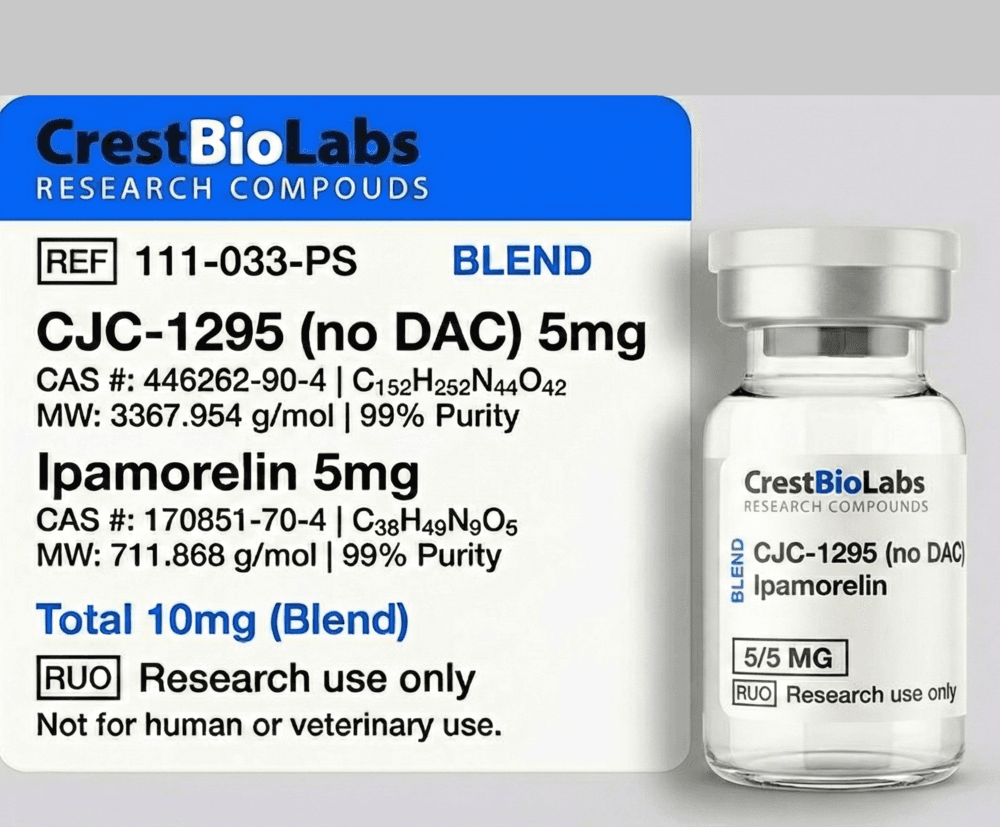
CJC-1295 / Ipamorelin Blend
A research blend combining CJC-1295 (No DAC) and Ipamorelin for synergistic studies on growth hormone secretion pathways.
Quick Reference
This product is temporarily unavailable. Join our notification list to be the first to know when it's back in stock.
About CJC-1295 / Ipamorelin Blend
This blend combines two well-studied growth hormone secretagogues: CJC-1295 without DAC (Mod GRF 1-29) and Ipamorelin. Research indicates that these two peptides may work synergistically through complementary mechanisms of action. CJC-1295 acts as a GHRH analog while Ipamorelin is a selective ghrelin receptor agonist.
Mechanism of Action
Dual-pathway GH release: CJC-1295 activates pituitary GHRH receptors while Ipamorelin activates GHS-R1a receptors, producing synergistic amplification of pulsatile growth hormone secretion with minimal cortisol or prolactin elevation.
Research Applications
Synergistic effects of GHRH and GHRP on GH release in humans
Journal of Clinical Endocrinology & Metabolism (2004)
Ipamorelin, the first selective growth hormone secretagogue
European Journal of Endocrinology (1998)
Prolonged stimulation of growth hormone (GH) and insulin-lik...
Journal of Clinical Endocrinology & Metabolism (2006)
Product Quick Facts
HPLC Verified
98.5%+ purity confirmed
COA Available
Full chromatograms & MS data
Same-Day Shipping
Orders before 2 PM EST
Cold Chain
Temperature-controlled packaging
Handling Protocol
- •Store at -20°C, desiccated
- •Reconstitute with bacteriostatic water
- •Avoid repeated freeze-thaw cycles
- •Handle under sterile conditions
Related Research
What Are Peptides?
Introduction to peptide structure, classification, and research significance.
Solid-Phase Peptide Synthesis (SPPS)
How SPPS works, Fmoc vs Boc chemistry, and modern synthesis advances.
Metabolic Research Compounds Hub
Research compounds investigated in preclinical models of metabolic function.
Lyophilization & Freeze-Drying
How lyophilization preserves peptide stability and shelf life.
Frequently Asked Questions About CJC-1295 / Ipamorelin Blend
CJC-1295 and Ipamorelin activate two entirely distinct receptor pathways — GHRH-R and GHS-R1a, respectively — meaning their GH-releasing effects are mechanistically non-redundant. Published in vitro and animal data demonstrate that simultaneous activation of both pathways produces a supra-additive (synergistic) GH pulse amplitude that exceeds the arithmetic sum of either peptide alone. This blend format ensures equimolar co-delivery at a fixed 1:1 mass ratio, eliminating the timing variability introduced when reconstituting and administering two separate vials in sequence.
CJC-1295 binds the GHRH receptor and activates the cAMP/PKA intracellular cascade, which primes somatotroph cells for secretion by increasing intracellular cyclic AMP. Ipamorelin independently binds GHS-R1a and triggers the IP3/calcium signaling pathway, causing direct calcium influx into the same somatotroph population. Because these two second-messenger systems converge on GH vesicle exocytosis through parallel but distinct intracellular routes, co-activation produces a multiplicative effect on GH granule release rather than a merely additive one. Importantly, Ipamorelin's high GHS-R1a selectivity means it does not appreciably raise cortisol or prolactin, preserving a clean hormonal signal that simplifies downstream data interpretation.
In pharmacology, synergy (or supra-additivity) means the combined effect of two agents exceeds the sum of their individual effects when tested at the same concentrations. For this blend, if CJC-1295 alone produces a GH pulse of magnitude X and Ipamorelin alone produces Y, synergistic output is significantly greater than X + Y, typically assessed via isobolographic analysis or Bliss independence modeling. This phenomenon arises because CJC-1295's cAMP-mediated priming of somatotrophs increases the pool of release-ready GH vesicles that Ipamorelin's calcium-dependent mechanism then triggers simultaneously.
Reconstitute the lyophilized blend by slowly injecting bacteriostatic water or sterile water down the inner wall of the vial — never directly onto the peptide cake — and allow it to dissolve by gentle swirling without vortexing or shaking, which can cause aggregation. A typical reconstitution volume of 2 mL yields a combined concentration of 1 mg/mL CJC-1295 plus 1 mg/mL Ipamorelin, and researchers should calculate individual peptide concentrations based on the known 2 mg + 2 mg fill. Because both peptides are stable in aqueous solution at neutral pH and share compatible solubility profiles, no special co-reconstitution buffer is needed. Once reconstituted, store at 2-8°C and use within 3-4 weeks; repeated freeze-thaw cycles accelerate degradation of both components.
The pre-blended format eliminates compounding error introduced during manual co-reconstitution, where pipetting inaccuracies across two separate vials can skew the intended 1:1 mass ratio and introduce inconsistent molar ratios between experiments. Co-lyophilization also means both peptides undergo identical storage and handling conditions, reducing the risk that one peptide degrades faster than the other due to separate storage histories. The blend undergoes a single purity and identity verification at manufacture, providing a unified certificate of analysis that covers both components and their ratio in the same matrix.
A rigorous study design requires at minimum four arms: vehicle-only control, CJC-1295 alone at the blend-equivalent concentration, Ipamorelin alone at the blend-equivalent concentration, and the CJC-1295/Ipamorelin combination. This factorial design is essential to distinguish additive from synergistic effects and to attribute specific biomarker changes to the correct peptide or their interaction. Researchers should match the total injection volume and vehicle composition across all arms to eliminate formulation artifacts. Time-resolved serial blood sampling at 5-15 minute intervals post-administration is recommended to capture the full GH pulsatile profile, as single time-point measurements will miss the peak amplitude differences that define the synergistic response.
At a 1:1 mass ratio the molar ratio is approximately 1:4.7 (CJC-1295 MW 3367.97 vs. Ipamorelin MW 711.85), meaning there are roughly 4.7 Ipamorelin molecules for every CJC-1295 molecule. This molar excess of Ipamorelin reflects the pharmacological reality that GHS-R1a requires higher molar occupancy to generate a robust calcium-driven secretory signal, while the GHRH-R pathway achieves near-maximal cAMP activation at comparatively lower CJC-1295 molar concentrations. Published dose-finding studies in animal models have shown that GH pulse amplitude plateaus at lower GHRH-analogue concentrations relative to ghrelin-mimetics, supporting this asymmetric molar design.
Animal studies using GHRH analogues combined with ghrelin-mimetics have reported peak GH concentrations 2-3-fold higher than the best-responding single agent and AUC increases of 5-10-fold over vehicle controls, though exact magnitudes vary by species, strain, and assay sensitivity. The onset of detectable GH elevation typically occurs within 5-10 minutes of administration for the blend, similar to Ipamorelin alone, but the peak is both higher and sustained longer due to the cAMP-primed vesicle pool created by CJC-1295. Pulse duration may extend to 60-90 minutes versus 30-45 minutes for Ipamorelin as a single agent. Researchers should use ultrasensitive GH ELISAs with dynamic ranges capable of capturing these elevated peaks to avoid signal saturation.
You May Also Need
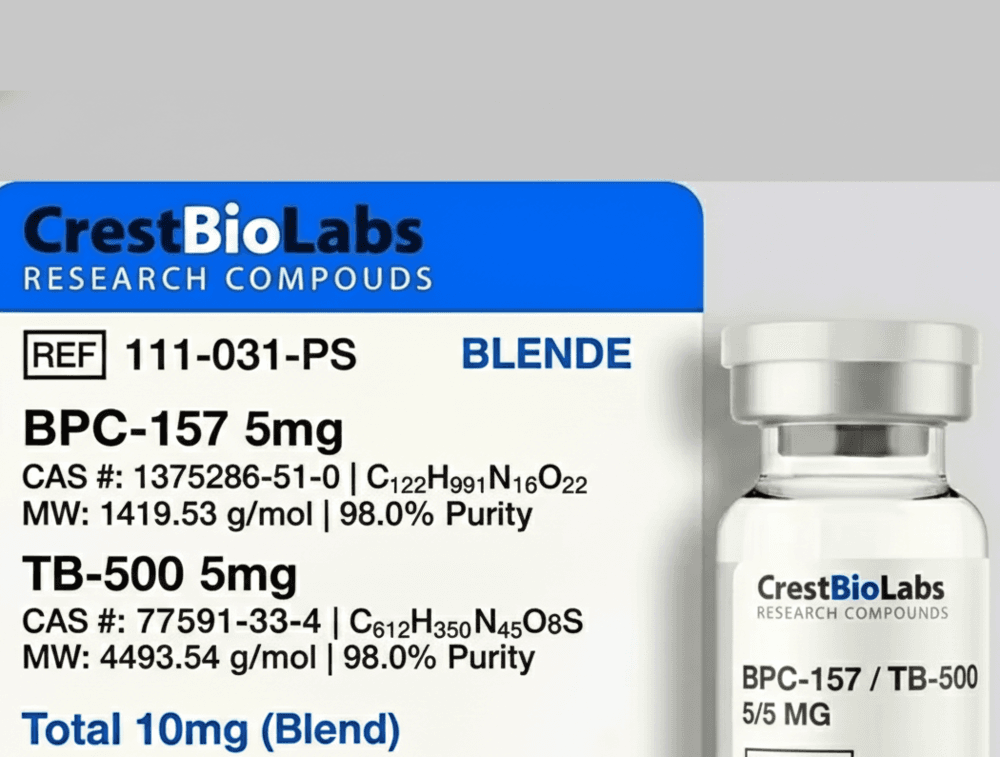
BPC-157 / TB-500 Blend
A combination of BPC-157 and TB-500 for research into tissue repair and regeneration pathways.