Introduction to Lyophilization in Peptide Science
Lyophilization — commonly referred to as freeze-drying — is the gold-standard preservation technique employed throughout the peptide research industry. The process converts an aqueous peptide solution into a dry, stable solid by removing water through sublimation under reduced pressure, thereby avoiding the liquid phase entirely. This is critical because peptides in aqueous solution are inherently susceptible to a range of degradation pathways including hydrolysis of amide bonds, deamidation of asparagine and glutamine residues, oxidation of methionine and cysteine side chains, and aggregation driven by intermolecular interactions.
The fundamental advantage of lyophilization over conventional evaporative drying or spray-drying is that it operates at temperatures well below the denaturation threshold of most peptides and proteins. Because the water transitions directly from ice to vapor without passing through the liquid state, thermal stress, surface tension effects, and concentration-dependent aggregation are minimized. The resulting dry powder — referred to as the lyophilized cake — retains the peptide in an amorphous or partially crystalline solid matrix that dramatically slows chemical degradation kinetics.
For research-grade peptides, lyophilization serves multiple purposes: it enables ambient-temperature shipping, simplifies long-term archival storage, permits gravimetric quantification of peptide mass at the point of use, and provides a standardized starting format for reconstitution into virtually any solvent system required by a given experimental protocol. Understanding the lyophilization process, the properties of the resulting cake, and the correct reconstitution and post-reconstitution handling procedures is therefore essential knowledge for any laboratory working with synthetic peptides.
The Three Stages of the Lyophilization Process
Lyophilization proceeds through three distinct thermodynamic stages, each of which must be carefully controlled to yield a stable, high-quality product. The process parameters — shelf temperature, chamber pressure, and cycle duration — are optimized for each specific peptide formulation based on its eutectic point, glass transition temperature, and collapse temperature.
Stage 1: Freezing
The peptide solution is loaded into glass vials and placed on temperature-controlled shelves within the lyophilizer chamber. The shelf temperature is ramped down at a controlled rate — typically 0.5 to 2.0 degrees Celsius per minute — to a final temperature of -40 to -80 degrees Celsius, which must be well below the eutectic temperature of the formulation. During freezing, water crystallizes into ice, concentrating the peptide and any excipients (such as mannitol, trehalose, or sucrose) into an interstitial amorphous or crystalline matrix between ice crystals.
The freezing rate profoundly influences the final cake structure. Slow freezing produces large ice crystals with wide pores in the dried cake, facilitating faster sublimation during primary drying and producing a more porous, easily reconstitutable product. Rapid freezing generates smaller ice crystals with finer pore structure, which may slow sublimation but can be advantageous for preserving the spatial distribution of peptide molecules and minimizing concentration-gradient-induced aggregation. An annealing step — briefly warming the frozen product before initiating vacuum — is sometimes employed to promote Ostwald ripening and homogenize ice crystal size.
Stage 2: Primary Drying (Sublimation)
Once the product is fully frozen, the chamber is evacuated to a pressure of approximately 50 to 200 milliTorr (6.7 to 26.7 Pa). At this reduced pressure, the ice sublimes directly into water vapor, which is captured on the condenser coils maintained at -50 to -70 degrees Celsius. Gentle shelf heating is applied to provide the energy of sublimation (approximately 2840 J/g of ice) without raising the product temperature above its critical collapse temperature.
Primary drying is the longest phase of the lyophilization cycle, often requiring 12 to 48 hours depending on fill volume, vial geometry, and formulation. The sublimation front progresses from the top surface of the frozen plug downward, leaving behind the dried porous cake above and frozen material below. Product temperature is monitored via thermocouples or Pirani gauges; a rise in product temperature toward the shelf temperature, combined with a drop in chamber pressure, indicates the endpoint of primary drying. Approximately 90 to 95 percent of the total water content is removed during this stage.
Stage 3: Secondary Drying (Desorption)
After ice sublimation is complete, a significant fraction of water remains bound to the peptide and excipient matrix through hydrogen bonds and adsorption. Secondary drying removes this residual moisture by gradually increasing the shelf temperature — typically to 20 to 40 degrees Celsius — while maintaining vacuum. The elevated temperature increases the kinetic energy of bound water molecules, facilitating their desorption from the solid matrix and their subsequent removal from the chamber.
Secondary drying typically requires 6 to 12 hours and reduces the residual moisture content of the product to 1 to 3 percent by weight, as measured by Karl Fischer titration or thermogravimetric analysis. The target moisture level is a balance: too much residual water accelerates chemical degradation, while excessively aggressive drying can strip structurally important water molecules and destabilize the peptide. For most research peptides, a final moisture content of 1 to 2 percent provides optimal long-term stability.
Why Research Peptides Are Supplied in Lyophilized Form
The chemical instability of peptides in aqueous solution is the primary driver behind universal adoption of lyophilization in the research peptide industry. In solution, peptides are continuously exposed to water-mediated degradation reactions. Hydrolysis of peptide bonds — particularly at Asp-Pro and Asp-Gly junctions — proceeds at measurable rates even at neutral pH and refrigerated temperatures. Deamidation of asparagine residues, which converts Asn to a mixture of aspartate and isoaspartate via a cyclic succinimide intermediate, has half-times as short as 1 to 30 days in aqueous solution depending on the flanking sequence context.
Oxidation represents another critical degradation pathway for peptides containing methionine, cysteine, tryptophan, or histidine residues. Dissolved oxygen, trace metal ions, and reactive oxygen species in aqueous media can oxidize methionine to methionine sulfoxide, convert cysteine thiols to disulfides or sulfinic/sulfonic acids, and modify tryptophan indole rings. These modifications alter the charge state, hydrophobicity, and biological activity of the peptide.
In the lyophilized state, the virtual absence of mobile water reduces the rates of all these reactions by orders of magnitude. Hydrolysis cannot proceed without water as a reactant. Deamidation rates drop dramatically because the succinimide intermediate formation requires conformational flexibility that is restricted in the solid state. Oxidation is slowed both by reduced molecular mobility and by the absence of dissolved oxygen. Additionally, the lyophilized form eliminates the risk of microbial contamination that exists in aqueous peptide solutions, even those containing bacteriostatic agents.
Lyophilized Cake Structure, Morphology, and Quality Assessment
The physical appearance of the lyophilized cake provides important qualitative information about the success of the freeze-drying process. An ideal cake presents as a uniform, white to off-white, porous plug that faithfully retains the volume and shape of the original frozen solution. The pore structure — which mirrors the ice crystal morphology from the freezing step — should be open and interconnected, allowing rapid penetration of reconstitution solvent.
Cake collapse is the most common defect observed in peptide lyophilization. Collapse occurs when the product temperature exceeds the glass transition temperature of the maximally freeze-concentrated solute during primary drying. The amorphous matrix loses its rigidity, and the porous structure caves in under its own weight, producing a dense, glassy residue with reduced surface area. Collapsed cakes are not necessarily degraded, but they dissolve more slowly, may contain higher residual moisture (due to reduced drying efficiency), and may exhibit altered long-term stability.
Other visual indicators to assess upon receipt of lyophilized research peptides include shrinkage (the cake pulling away from the vial walls, which is generally cosmetic and does not indicate degradation), meltback (a thin liquid or glassy layer at the bottom of the vial suggesting incomplete freezing), and discoloration (which may indicate chemical modification such as Maillard reactions in the presence of reducing sugars or oxidative degradation). Researchers should document the appearance of each vial upon receipt as part of standard incoming material inspection protocols.
Excipients and Formulation Considerations
Most lyophilized peptide formulations include one or more excipients to improve cake structure, protect the peptide during the freezing and drying stresses, and enhance reconstitution behavior. Bulking agents such as mannitol provide mechanical structure to the cake and prevent blowout (eruption of the cake during aggressive sublimation). Lyoprotectants — most commonly the disaccharides trehalose and sucrose — replace the hydrogen bonds normally provided by water, stabilizing the peptide in the dried state through the vitrification hypothesis.
Buffer salts (phosphate, acetate, or citrate systems) maintain pH during the freezing step, although researchers should be aware that certain buffers exhibit pH shifts upon freezing. Sodium phosphate dibasic, for example, can crystallize selectively during freezing, causing a dramatic pH drop in the residual solution that may damage acid-labile peptides. Potassium phosphate and histidine buffers are generally more stable during freezing. The choice of buffer system, peptide concentration, and lyoprotectant ratio are all formulation variables that influence the quality and stability of the final lyophilized product.
For simple research-grade peptides supplied without complex excipient systems, the peptide itself may serve as the primary solute with only a volatile buffer (such as ammonium bicarbonate or dilute acetic acid) present at the time of lyophilization. These minimalist formulations produce clean cakes with low ionic content, which is advantageous for downstream applications such as mass spectrometry or cell-based assays where salt interference is undesirable.
Reconstitution Protocols for Lyophilized Peptides
Proper reconstitution is essential to recover the peptide in its fully active, monomeric form. Before opening the vial, allow the lyophilized product to equilibrate to ambient temperature (approximately 20 to 25 degrees Celsius) for 15 to 30 minutes to prevent moisture condensation on the cold cake, which could locally dissolve and denature the peptide before uniform reconstitution can occur.
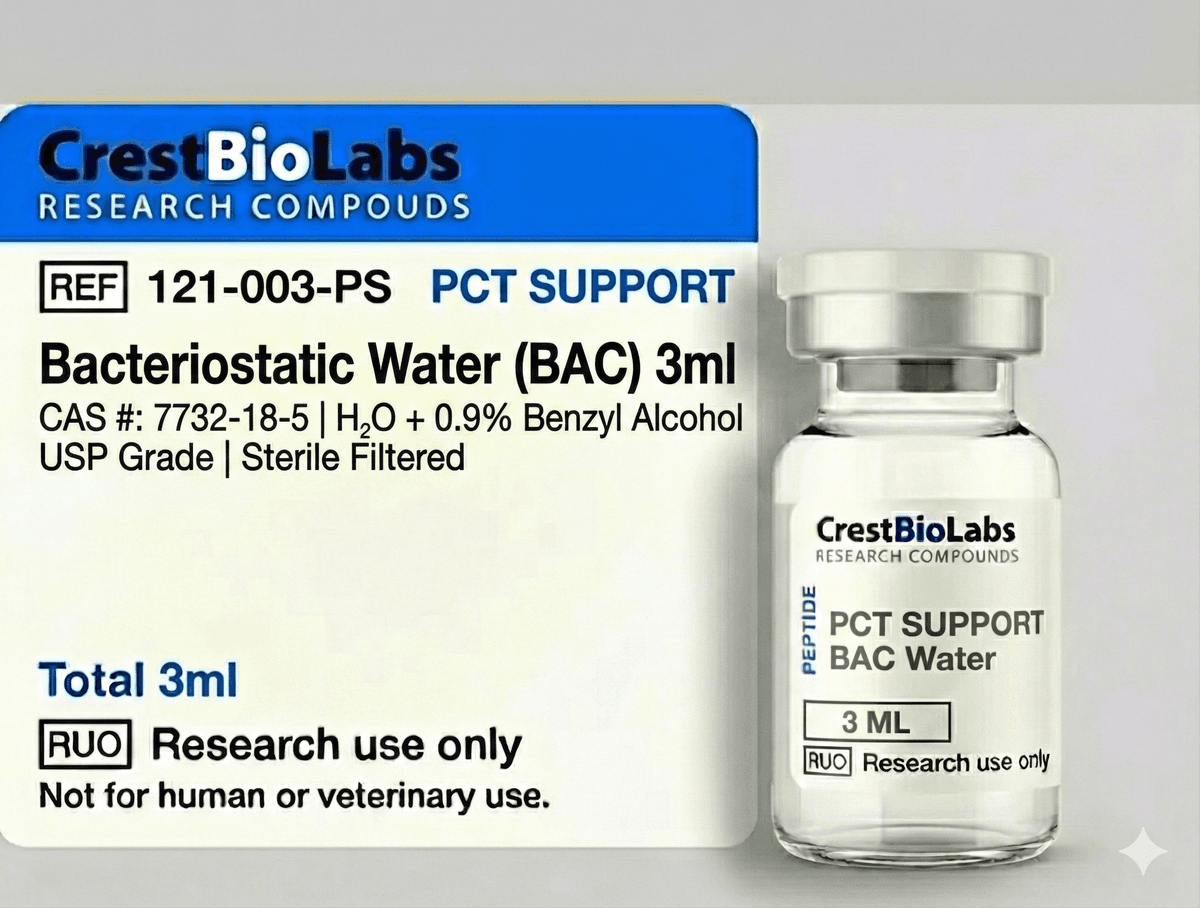
For most hydrophilic peptides, bacteriostatic water (containing 0.9% benzyl alcohol) or sterile water for injection are appropriate reconstitution solvents. Add the solvent slowly along the inner wall of the vial — not directly onto the cake — to prevent foaming and ensure gradual wetting of the porous structure. A typical reconstitution volume of 1 to 2 mL per milligram of peptide is common, though the optimal concentration depends on the experimental requirements and the solubility characteristics of the specific sequence.
After adding solvent, allow the vial to sit undisturbed for 2 to 5 minutes, then gently swirl or roll — never vortex aggressively, as the mechanical shear and air-liquid interfacial stress can cause peptide aggregation and loss of activity. For hydrophobic or amphipathic peptides that resist dissolution in aqueous media, an initial wetting step with a small volume of DMSO, dilute acetic acid (0.1%), or 10% acetonitrile may be necessary, followed by dilution with the primary aqueous solvent.
After reconstitution, visually inspect the solution for clarity. A hazy or turbid solution may indicate incomplete dissolution, aggregation, or the presence of insoluble excipient material. If the solution is not clear, brief gentle sonication in a water bath (not a probe sonicator) at room temperature for 30 to 60 seconds may help. Persistent turbidity after reconstitution should be documented and may warrant investigation into the peptide integrity or the suitability of the solvent system.
Shelf Life and Post-Lyophilization Storage Conditions
The shelf life of a lyophilized peptide is governed by the intrinsic chemical stability of its sequence, the residual moisture content, the storage temperature, and the integrity of the container closure system. Under optimal conditions — sealed under vacuum or inert gas (nitrogen or argon) in a crimped glass vial, stored at -20 degrees Celsius with desiccant — most lyophilized research peptides maintain greater than 95 percent purity for 24 to 36 months. Certain robust sequences (such as short, hydrophilic peptides lacking oxidation-sensitive residues) may remain stable for 5 years or longer under these conditions.
Temperature is the single most important storage variable. Arrhenius kinetics predict that each 10-degree Celsius reduction in storage temperature roughly halves the rate of most chemical degradation reactions. Storage at -80 degrees Celsius is recommended for particularly labile sequences or for long-term archival beyond 3 years. Storage at 4 degrees Celsius (standard refrigerator temperature) is acceptable for short-term holding of robust peptides but is not recommended for long-term archival due to the higher rates of deamidation and oxidation at this temperature.
Moisture control is equally critical. Even sealed vials can experience slow moisture ingress through imperfect crimps or stopper permeability over extended storage periods. Secondary desiccant packaging (the vial enclosed in a sealed foil pouch with silica gel or molecular sieve desiccant) provides an additional moisture barrier that is particularly valuable for long-term storage. Repeated opening and resealing of vials without desiccant protection exposes the lyophilized cake to ambient humidity, which can incrementally increase moisture content and accelerate degradation.
Once reconstituted, peptide solutions are significantly less stable than the lyophilized form. Aliquoting the reconstituted solution into single-use volumes and freezing them at -20 degrees Celsius or below is strongly recommended. Each aliquot should be thawed only once immediately before use, as repeated freeze-thaw cycles introduce mechanical stress, ice crystal damage, and transient concentration effects at the ice-liquid interface that promote aggregation and chemical modification. Documentation of storage conditions, reconstitution dates, and freeze-thaw history is an essential component of laboratory record-keeping for peptide research.