
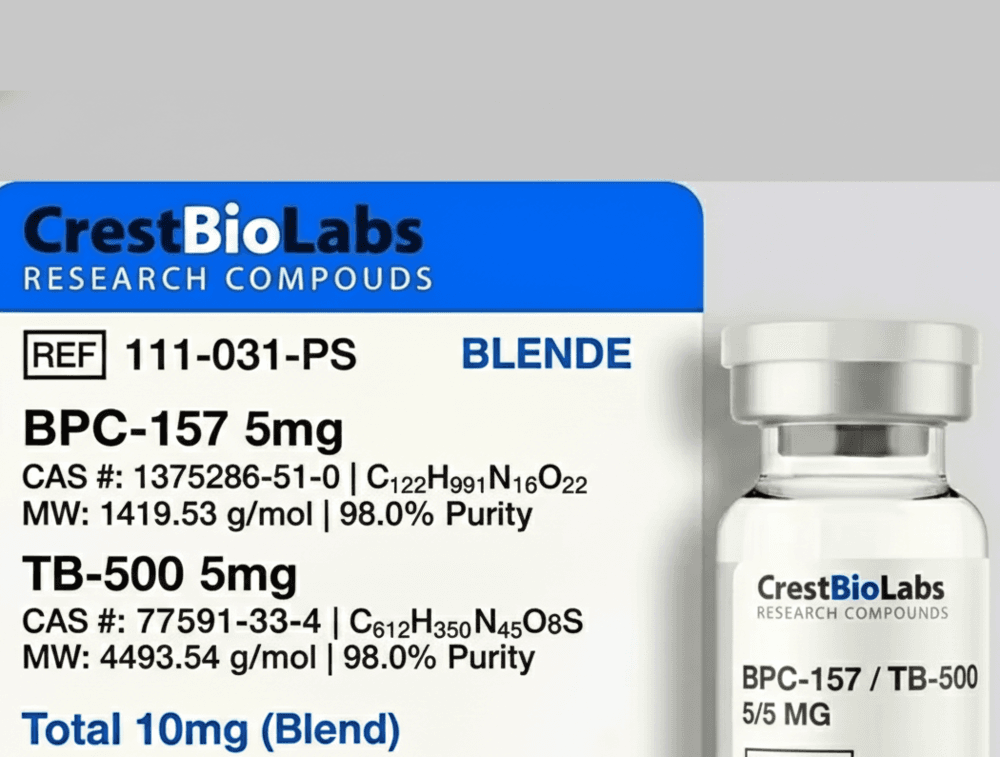
BPC-157 / TB-500 Blend
A combination of BPC-157 and TB-500 for research into tissue repair and regeneration pathways.
Quick Reference
This product is temporarily unavailable. Join our notification list to be the first to know when it's back in stock.
About BPC-157 / TB-500 Blend
This research blend combines two peptides that have been individually studied for their regenerative properties. BPC-157 (Body Protection Compound) and TB-500 (Thymosin Beta-4) have been the subject of numerous studies examining tissue repair mechanisms. This blend allows researchers to study their combined effects.
Mechanism of Action
Complementary regenerative pathways: BPC-157 modulates the NO system and upregulates growth factors (VEGF, EGF) while TB-500 promotes actin polymerization and cell migration, together accelerating angiogenesis, fibroblast recruitment, and tissue remodeling.
Research Applications
Stable gastric pentadecapeptide BPC 157: novel therapy in ga...
Current Pharmaceutical Design (2011)
Thymosin beta4 activates integrin-linked kinase and promotes...
Nature (2004)
Product Quick Facts
HPLC Verified
98.0%+ purity confirmed
COA Available
Full chromatograms & MS data
Same-Day Shipping
Orders before 2 PM EST
Cold Chain
Temperature-controlled packaging
Handling Protocol
- •Store at -20°C, desiccated
- •Reconstitute with bacteriostatic water
- •Avoid repeated freeze-thaw cycles
- •Handle under sterile conditions
Frequently Asked Questions About BPC-157 / TB-500 Blend
BPC-157 and TB-500 operate through non-overlapping regenerative mechanisms — BPC-157 primarily modulates the nitric oxide system and upregulates VEGF and EGF to drive angiogenesis and cytoprotection, while TB-500 promotes actin polymerization, cell migration, and anti-apoptotic signaling through the Akt pathway. Because these pathways converge on tissue remodeling at different stages (vascular supply vs. cellular recruitment and structural repair), co-administration in animal studies has shown accelerated outcomes versus either peptide alone. The pre-blended format guarantees that both peptides are present in every aliquot at the intended 1:1 mass ratio, eliminating the variability of sequential or manual mixing in multi-peptide research protocols.
BPC-157 initiates early-phase repair by stimulating nitric oxide synthase activity, which improves local blood flow, and by upregulating VEGF to promote new capillary formation at the injury site — establishing the vascular infrastructure that regenerating tissue requires. TB-500, through its active domain thymosin beta-4, sequesters G-actin monomers and promotes their controlled polymerization into F-actin filaments, which is the cytoskeletal driver of fibroblast and keratinocyte migration into the wound bed. TB-500 simultaneously activates Akt signaling to suppress apoptosis in migrating cells, improving their survival in the hypoxic wound environment. The net effect is that BPC-157 builds the blood supply while TB-500 populates the repaired vasculature with the structural and matrix-producing cells needed for functional tissue restoration.
Add bacteriostatic water or sterile water slowly along the vial wall — a common reconstitution volume of 2 mL yields 2.5 mg/mL of each peptide — and allow the lyophilized cake to dissolve by gentle swirling over 1-2 minutes without shaking or vortexing. Both BPC-157 and TB-500 are freely soluble in aqueous solution at neutral pH, so no co-solvent or pH adjustment is needed for the blend. The key difference from mixing two separately reconstituted vials is that the blend avoids the additional dilution step and pipetting error inherent in combining two liquid stocks, which is particularly important given the large molecular weight difference between BPC-157 (1419.53) and TB-500 (4963.44) that makes equal-mass and equal-molar calculations non-trivial.
Co-lyophilized peptides can theoretically interact through hydrogen bonding or electrostatic interactions during the freeze-drying process, but BPC-157 and TB-500 have been shown to maintain independent structural integrity when co-formulated, as confirmed by dual-peptide HPLC purity analysis on the certificate of analysis. The significant molecular weight difference (1419.53 vs. 4963.44) actually aids quality control because the two species are easily resolved on reverse-phase HPLC, allowing independent purity verification for each component. Researchers should watch for signs of degradation specific to each peptide: BPC-157 degradation may manifest as loss of the characteristic HPLC peak, while TB-500 aggregation appears as visible particulates or turbidity in solution.
At the 5 mg + 5 mg mass ratio in this blend, the molar ratio is approximately 3.5:1 (BPC-157:TB-500) because BPC-157's molecular weight is roughly one-third that of TB-500. Researchers conducting dose-response studies must convert mass concentrations to molar concentrations to make pharmacologically meaningful comparisons, since receptor binding affinity and enzyme kinetics are governed by molarity, not mass. This means that at equal mass, BPC-157 contributes 3.5-fold more molecules than TB-500, which should be accounted for when interpreting relative potency contributions in combination studies. When reporting results, publications should specify both mass and molar concentrations for reproducibility.
The most commonly published models include rodent Achilles tendon transection, gastric ulcer induction via cysteamine or ethanol, skin incision wound healing, and ligament transection models, with outcome measures including tensile strength recovery, histological collagen organization scores, and time-to-closure metrics. Ischemia-reperfusion injury models in gut and muscle tissue have also been used to evaluate the combined angiogenic and anti-apoptotic properties relevant to this blend's dual mechanism. More recent studies have employed diabetic wound healing models (streptozotocin-induced), which are particularly relevant because impaired angiogenesis and delayed cell migration are concurrent deficits that map directly to BPC-157 and TB-500's respective pathways.
A minimum of four experimental arms is required: vehicle control, BPC-157 alone at 5 mg-equivalent concentration, TB-500 alone at 5 mg-equivalent concentration, and the BPC-157/TB-500 combination at the blend ratio. This design enables distinction between additive effects (sum of individual responses) and true synergy (combination response exceeding the sum), typically assessed via two-way ANOVA with interaction terms or formal synergy models such as the Chou-Talalay combination index. Time-course sampling is critical because the two peptides likely peak at different phases of the repair cascade — BPC-157's angiogenic effects manifest early (days 1-3 in rodent models) while TB-500's structural remodeling effects become measurable later (days 5-10) — and single-endpoint studies may miss phase-specific contributions.
Visible turbidity, particulate formation, or a color change from clear/colorless to yellow or brown in the reconstituted solution are immediate indicators that one or both peptides have undergone oxidation or aggregation. BPC-157 is susceptible to methionine oxidation, which can be detected as a secondary peak on analytical HPLC absent from the original certificate of analysis. TB-500 is more prone to aggregation due to its larger size and hydrophobic domains, manifesting as loss of the monomer peak on size-exclusion chromatography. Researchers should prepare single-use aliquots immediately after reconstitution and freeze at -20°C to minimize repeated freeze-thaw exposure, which accelerates both oxidation and aggregation pathways simultaneously.
You May Also Need
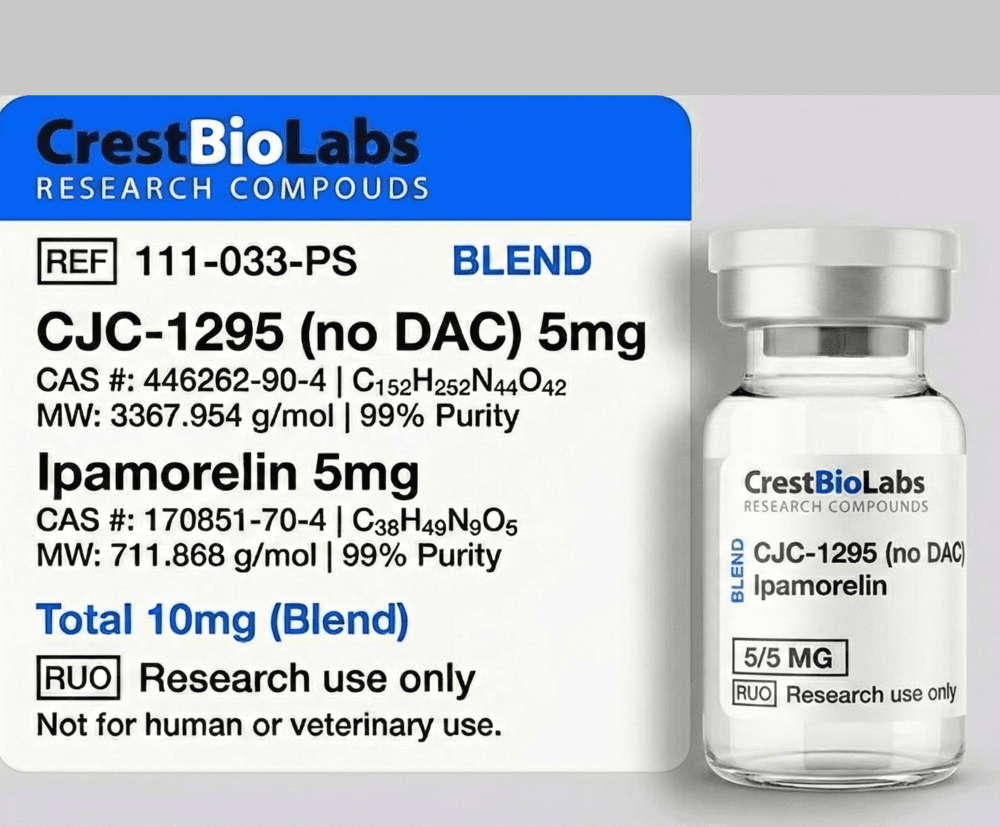
CJC-1295 / Ipamorelin Blend
A research blend combining CJC-1295 (No DAC) and Ipamorelin for synergistic studies on growth hormone secretion pathways.