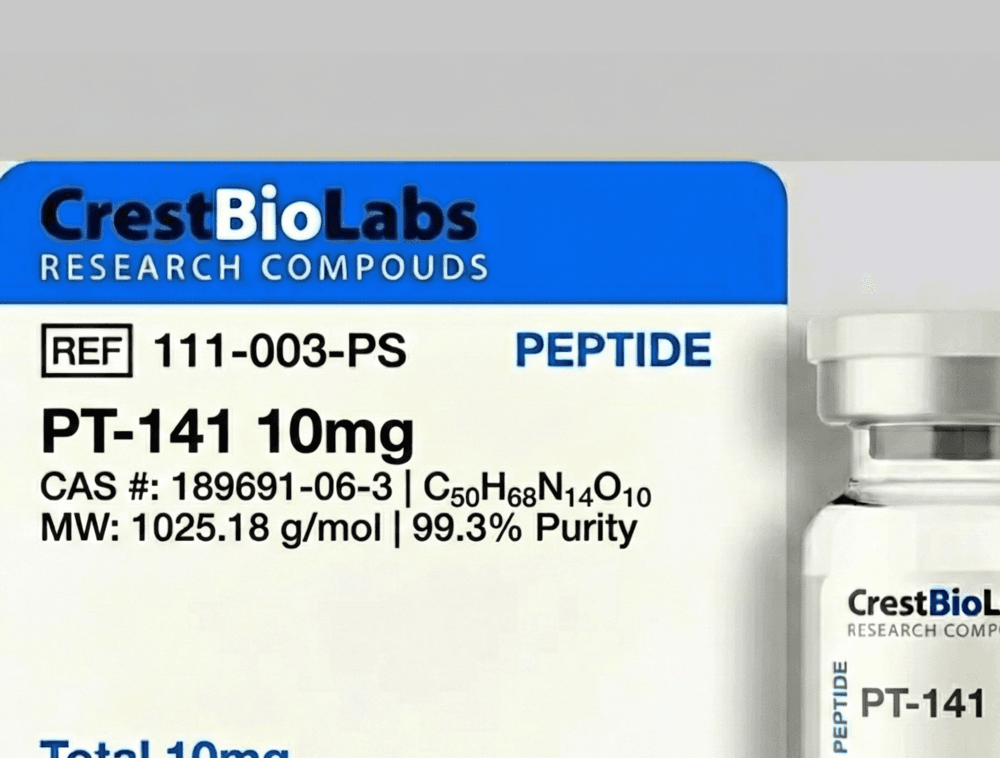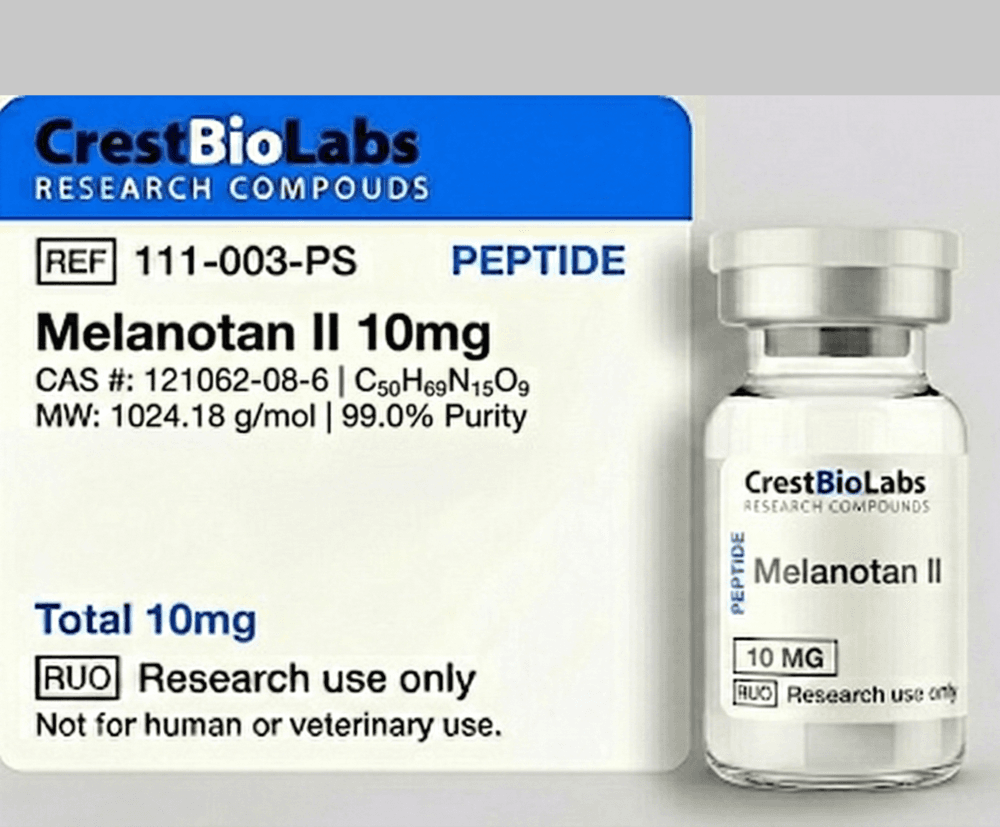
Scientific Overview
PT-141 (bremelanotide) and Melanotan II are two closely related cyclic melanocortin peptide analogs that share an identical core structure but differ in their terminal chemical modifications. Both compounds contain the cyclic lactam heptapeptide framework with the melanocortin pharmacophore His-D-Phe-Arg-Trp and the non-natural residue substitutions norleucine (Nle) and D-phenylalanine (D-Phe). The sole structural difference is that Melanotan II carries an N-terminal acetyl group and a C-terminal amide (NH2), while PT-141 retains the N-terminal acetyl but has a free C-terminal carboxyl group (OH).
Despite this seemingly minor structural difference, published research has demonstrated that PT-141 and Melanotan II exhibit distinct pharmacological profiles. The C-terminal modification alters the charge distribution and hydrogen bonding capacity of the peptide, which influences receptor binding kinetics, subtype selectivity ratios, and pharmacokinetic behavior. The comparative study of these two compounds represents one of the clearest illustrations in peptide pharmacology of how terminal group modifications can functionally diversify closely related analogs.
For research purposes only. Not for human or veterinary use. All data presented in this comparison are sourced from peer-reviewed preclinical research and are intended exclusively to support scientific understanding of these melanocortin research compounds.
For research purposes only. Not for human or veterinary use. The compounds discussed in this comparison are intended exclusively for in-vitro and preclinical research applications.
Head-to-Head Comparison
| Property | PT-141 (Bremelanotide) | Melanotan II |
|---|---|---|
| Peptide Class | Cyclic Melanocortin Heptapeptide (C-terminal free acid) | Cyclic Melanocortin Heptapeptide (C-terminal amide) |
| Receptor Targets | MC1R, MC3R, MC4R, MC5R (non-selective, MC4R-preferring) | MC1R, MC3R, MC4R, MC5R (non-selective) |
| Molecular Weight | ~1,025.18 Da | ~1,024.18 Da |
| CAS Number | 189691-06-3 | 121062-08-6 |
| Mechanism (Research) | PT-141 activates melanocortin receptors through the Gs-adenylyl cyclase-cAMP-PKA signaling cascade. Its free C-terminal carboxyl group alters the electrostatic profile compared to Melanotan II, influencing receptor binding kinetics and potentially shifting relative potency ratios across MCR subtypes. In preclinical models, PT-141 has been studied for its activation of central melanocortin pathways, particularly those involving MC4R in hypothalamic and limbic structures. | Melanotan II activates melanocortin receptors through the same Gs-cAMP-PKA signaling cascade as PT-141. Its C-terminal amide group eliminates the negative charge present in PT-141, optimizing electrostatic complementarity with certain MCR binding pocket residues. In melanocyte models, MC1R activation drives melanogenesis through the cAMP-CREB-MITF signaling axis, while MC4R activation in the CNS engages hypothalamic melanocortin circuits. |
| Stability | PT-141 shares the cyclic lactam structure and D-Phe substitution that confer metabolic stability to the Melanotan II class. The free C-terminal carboxyl group introduces a negative charge at physiological pH that is absent in Melanotan II's amidated terminus. The tryptophan residue is photosensitive. Lyophilized preparations maintain stability at -20 degrees C under desiccation. | Melanotan II demonstrates the enhanced metabolic stability characteristic of cyclic lactam melanocortin analogs. The C-terminal amide protects against carboxypeptidase degradation, potentially conferring marginally greater exopeptidase resistance than PT-141's free carboxyl terminus. Light protection is required due to tryptophan photosensitivity. Lyophilized preparations are stable at -20 degrees C under desiccation. |
| Research Applications | PT-141 is studied as a melanocortin receptor agonist for investigating MC4R-dependent central nervous system signaling, melanocortin pharmacophore modifications, and the effects of terminal group changes on peptide receptor pharmacology. It also serves as a key compound in structure-activity relationship studies within the melanocortin analog series. | Melanotan II is the foundational cyclic melanocortin analog used for studying the melanocortin pharmacophore concept, MCR subtype signaling, melanogenesis mechanisms, and structure-activity relationships. It serves as the parent compound from which PT-141 was derived and remains one of the most widely cited melanocortin research tools. |
| Analytical Methods | Reversed-phase HPLC, ESI-MS for molecular weight confirmation (1,025.18 Da), MCR subtype binding assays, cAMP accumulation measurements, and beta-arrestin recruitment assays for biased agonism profiling. | Reversed-phase HPLC, LC-MS/MS for sequence confirmation and molecular weight verification (1,024.18 Da), competitive binding assays across MCR subtypes, cAMP functional assays, and melanin content quantification in melanocyte preparations. |
Peptide Class
Cyclic Melanocortin Heptapeptide (C-terminal free acid)
Cyclic Melanocortin Heptapeptide (C-terminal amide)
Receptor Targets
MC1R, MC3R, MC4R, MC5R (non-selective, MC4R-preferring)
MC1R, MC3R, MC4R, MC5R (non-selective)
Molecular Weight
~1,025.18 Da
~1,024.18 Da
CAS Number
189691-06-3
121062-08-6
Mechanism (Research)
PT-141 activates melanocortin receptors through the Gs-adenylyl cyclase-cAMP-PKA signaling cascade. Its free C-terminal carboxyl group alters the electrostatic profile compared to Melanotan II, influencing receptor binding kinetics and potentially shifting relative potency ratios across MCR subtypes. In preclinical models, PT-141 has been studied for its activation of central melanocortin pathways, particularly those involving MC4R in hypothalamic and limbic structures.
Melanotan II activates melanocortin receptors through the same Gs-cAMP-PKA signaling cascade as PT-141. Its C-terminal amide group eliminates the negative charge present in PT-141, optimizing electrostatic complementarity with certain MCR binding pocket residues. In melanocyte models, MC1R activation drives melanogenesis through the cAMP-CREB-MITF signaling axis, while MC4R activation in the CNS engages hypothalamic melanocortin circuits.
Stability
PT-141 shares the cyclic lactam structure and D-Phe substitution that confer metabolic stability to the Melanotan II class. The free C-terminal carboxyl group introduces a negative charge at physiological pH that is absent in Melanotan II's amidated terminus. The tryptophan residue is photosensitive. Lyophilized preparations maintain stability at -20 degrees C under desiccation.
Melanotan II demonstrates the enhanced metabolic stability characteristic of cyclic lactam melanocortin analogs. The C-terminal amide protects against carboxypeptidase degradation, potentially conferring marginally greater exopeptidase resistance than PT-141's free carboxyl terminus. Light protection is required due to tryptophan photosensitivity. Lyophilized preparations are stable at -20 degrees C under desiccation.
Research Applications
PT-141 is studied as a melanocortin receptor agonist for investigating MC4R-dependent central nervous system signaling, melanocortin pharmacophore modifications, and the effects of terminal group changes on peptide receptor pharmacology. It also serves as a key compound in structure-activity relationship studies within the melanocortin analog series.
Melanotan II is the foundational cyclic melanocortin analog used for studying the melanocortin pharmacophore concept, MCR subtype signaling, melanogenesis mechanisms, and structure-activity relationships. It serves as the parent compound from which PT-141 was derived and remains one of the most widely cited melanocortin research tools.
Analytical Methods
Reversed-phase HPLC, ESI-MS for molecular weight confirmation (1,025.18 Da), MCR subtype binding assays, cAMP accumulation measurements, and beta-arrestin recruitment assays for biased agonism profiling.
Reversed-phase HPLC, LC-MS/MS for sequence confirmation and molecular weight verification (1,024.18 Da), competitive binding assays across MCR subtypes, cAMP functional assays, and melanin content quantification in melanocyte preparations.
Effects of C-Terminal Modification on Pharmacology
The pharmacological comparison of PT-141 and Melanotan II centers on a single structural variable: the C-terminal functional group. Melanotan II carries a C-terminal amide (-CONH2), which eliminates the negative charge that would be present with a free carboxyl group at physiological pH. PT-141 has a free C-terminal carboxyl group (-COOH), which is deprotonated at physiological pH to yield a negatively charged carboxylate (-COO-). This charge difference, while seemingly minor, has measurable consequences for receptor binding.
The melanocortin receptor binding pocket contains both acidic and basic residues that participate in electrostatic interactions with bound ligands. The C-terminal amide of Melanotan II is electrically neutral and serves as a hydrogen bond donor, forming specific contacts with receptor residues that complement this functionality. The C-terminal carboxylate of PT-141 introduces a negative charge at this position, which may create electrostatic repulsion with nearby acidic receptor residues or form alternative salt bridge interactions with basic residues.
Comparative binding studies have demonstrated that these terminal modifications produce measurable differences in binding affinity ratios across MCR subtypes. While both compounds retain nanomolar-range affinities at MC1R, MC3R, MC4R, and MC5R, the relative potency rankings across subtypes can shift depending on the specific electrostatic environment of each receptor's binding pocket. These subtle selectivity shifts have been characterized through systematic receptor pharmacology studies.
From a medicinal chemistry perspective, the PT-141/Melanotan II comparison is a textbook example of how terminal group modifications can tune the pharmacological profile of a peptide without altering its core pharmacophore. This principle has broad applicability in peptide design, and the melanocortin system has served as one of the most thoroughly characterized model systems for studying these structure-activity relationships.
Molecular Weight and Charge State Analysis
The molecular weights of PT-141 (1,025.18 Da) and Melanotan II (1,024.18 Da) differ by approximately 1 Da, reflecting the replacement of a C-terminal amide nitrogen-hydrogen bond with a carboxyl oxygen-hydrogen bond. This 1 Da difference, while analytically resolvable by high-resolution mass spectrometry, requires careful analytical methodology to discriminate reliably between the two compounds in quality control settings.
The molecular formulas further clarify the distinction: Melanotan II is C50H69N15O9 while PT-141 is C50H68N14O10. The swap of one nitrogen for one oxygen and the net loss of one hydrogen atom correspond precisely to the amide-to-carboxyl conversion at the C-terminus. High-resolution mass spectrometry using instruments capable of resolving these formula differences (such as Orbitrap or FTICR platforms) can definitively distinguish the two compounds based on exact mass.
At physiological pH, the charge state difference between the two compounds is more significant than the molecular weight difference. Melanotan II carries a net charge determined by its arginine (positive), histidine (partially positive at pH 7.4), lysine (ring-constrained, less accessible), and the absence of free carboxyl groups (N-terminal acetylated, C-terminal amidated). PT-141, with its free C-terminal carboxylate, carries an additional negative charge that alters the overall electrostatic profile and isoelectric point.
This charge difference has practical implications for chromatographic separation and analytical characterization. In reversed-phase HPLC, the two compounds can be resolved under optimized gradient conditions, with the more charged PT-141 typically eluting slightly earlier than Melanotan II. In ion-exchange chromatography, the additional negative charge of PT-141 provides a clear basis for separation. Capillary electrophoresis, which separates compounds based on charge-to-size ratio, also readily distinguishes these two analogs.
For researchers working with both compounds, the availability of multiple orthogonal analytical methods for distinguishing PT-141 from Melanotan II is essential for confirming compound identity and ensuring that experimental results are attributed to the correct analog.
Pharmacokinetic and Behavioral Differences in Preclinical Models
The C-terminal modification that distinguishes PT-141 from Melanotan II has been shown to influence pharmacokinetic behavior in preclinical models. The free carboxylate of PT-141 alters the peptide's lipophilicity relative to Melanotan II's amidated terminus, which can affect absorption, distribution, and clearance characteristics. In preclinical pharmacokinetic studies, these differences have been reflected in distinct plasma concentration-time profiles.
The charge state difference between the two compounds may also influence their ability to cross biological barriers, including the blood-brain barrier (BBB). Melanocortin peptides access central nervous system targets through mechanisms that may include receptor-mediated transcytosis and passive permeation of circumventricular organs. The additional negative charge on PT-141 could theoretically affect its BBB penetration characteristics compared to the neutral-terminus Melanotan II, though both compounds have demonstrated central melanocortin pathway activation in preclinical models.
In preclinical behavioral studies, PT-141 and Melanotan II have been used as tool compounds for investigating melanocortin circuit function in animal models. While both compounds activate central MCRs, their relative potencies and duration of action in behavioral paradigms have been reported to differ, consistent with their distinct pharmacokinetic profiles and potentially different receptor engagement kinetics. These behavioral differences have been documented using standardized preclinical assessment protocols.
The metabolic fate of the two compounds also diverges at the C-terminus. Melanotan II's C-terminal amide is resistant to carboxypeptidase cleavage, while PT-141's free carboxyl terminus is theoretically accessible to carboxypeptidases, although the cyclic ring structure limits the practical impact of C-terminal degradation on overall peptide integrity. The primary degradation pathways for both compounds involve tryptophan oxidation, aspartimide formation, and histidine oxidation, which are shared degradation mechanisms independent of the C-terminal modification.
Structure-Activity Relationship Insights
The PT-141/Melanotan II pair represents one of the most precisely controlled structure-activity relationship (SAR) comparisons available in melanocortin pharmacology. Because the two compounds differ at only a single chemical position — the C-terminal functional group — any pharmacological differences between them can be attributed directly to this modification rather than to confounding structural variables. This level of structural precision in SAR analysis is rare in peptide pharmacology and makes these compounds particularly valuable research tools.
The derivation of PT-141 from Melanotan II has historical significance in the melanocortin field. PT-141 was initially identified as a metabolic product of Melanotan II in which the C-terminal amide had been converted to a free acid. When this metabolite was found to retain melanocortin receptor activity with a potentially differentiated pharmacological profile, it was synthesized independently and characterized as a distinct research compound. This discovery illustrated the principle that metabolites of bioactive peptides can themselves possess distinct and useful pharmacological properties.
The broader SAR implications of the PT-141/Melanotan II comparison extend to the general understanding of how C-terminal modifications influence peptide-receptor interactions. Across multiple peptide-receptor systems, C-terminal amidation has been shown to enhance receptor affinity relative to free acid forms, a trend attributed to the removal of a negative charge that can create electrostatic repulsion with acidic receptor residues. However, the melanocortin system demonstrates that this general rule has exceptions, as PT-141 retains high-affinity binding at MCRs despite carrying the free acid terminus.
The development of PT-141 from Melanotan II also illustrates the concept of pharmacological diversification through minimal structural modification. Rather than designing entirely new peptide scaffolds, the melanocortin field has generated pharmacologically distinct compounds through strategic single-site modifications of existing analogs. This approach has proven productive not only in the Melanotan II to PT-141 conversion but also in the broader melanocortin analog series, where systematic single-residue substitutions have produced subtype-selective agonists and antagonists for specific MCR subtypes.
Scientific References
[1] Al-Obeidi F, Castrucci AM, Hadley ME, Hruby VJ.. “Potent and prolonged acting cyclic lactam analogues of alpha-melanotropin: design based on molecular dynamics.” Journal of Medicinal Chemistry (1989). doi:10.1021/jm00124a032
[2] Molinoff PB, Shadiack AM, Earle D, et al.. “PT-141: a melanocortin agonist for the treatment of sexual dysfunction.” Annals of the New York Academy of Sciences (2003). doi:10.1196/annals.1297.024
[3] Hadley ME, Dorr RT.. “Melanocortin peptide therapeutics: historical milestones, clinical studies and commercialization.” Peptides (2006). doi:10.1016/j.peptides.2005.01.029
[4] Hruby VJ, Lu D, Sharma SD, et al.. “Cyclic lactam alpha-melanotropin analogues of Ac-Nle4-cyclo[Asp5, D-Phe7, Lys10] alpha-melanocyte-stimulating hormone-(4-10)-NH2.” Journal of Medicinal Chemistry (1995). doi:10.1021/jm00009a007
[5] Cone RD.. “Studies on the physiological functions of the melanocortin system.” Endocrine Reviews (2006). doi:10.1210/er.2005-0034
[6] Dorr RT, Lines R, Levine N, et al.. “Evaluation of melanotan-II, a superpotent cyclic melanotropic peptide in a pilot phase-I clinical study.” Life Sciences (1996). doi:10.1016/0024-3205(96)00191-8
[7] Tao YX.. “The melanocortin-4 receptor: physiology, pharmacology, and pathophysiology.” Endocrine Reviews (2010). doi:10.1210/er.2009-0037