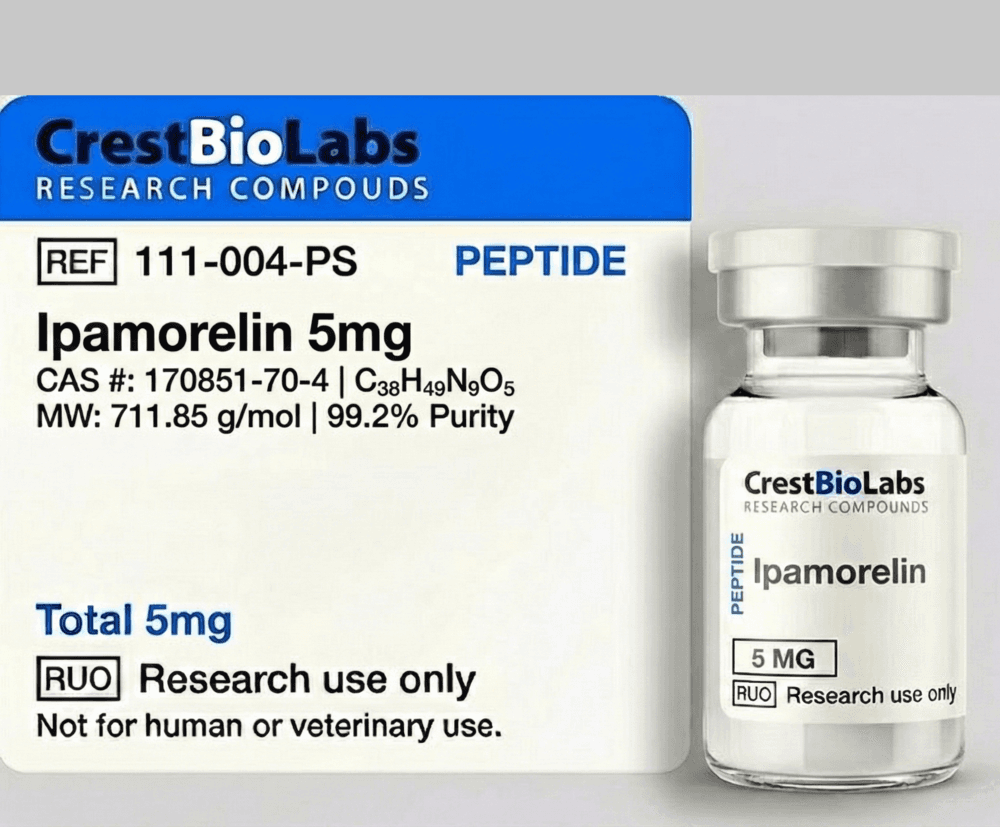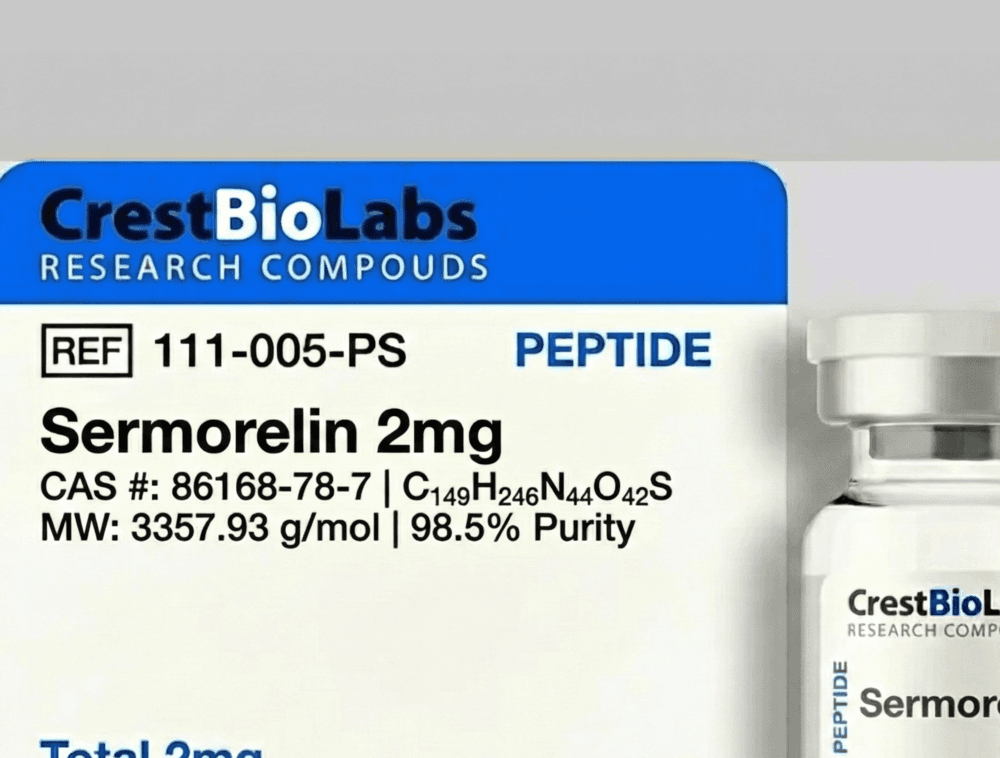
Scientific Overview
Ipamorelin and sermorelin are two structurally and mechanistically distinct peptides that both influence the somatotropic axis through different receptor targets. Ipamorelin is a synthetic pentapeptide growth hormone secretagogue that selectively activates the growth hormone secretagogue receptor (GHS-R1a, also known as the ghrelin receptor), while sermorelin is a 29-amino acid peptide corresponding to the native sequence of the biologically active fragment of growth hormone-releasing hormone (GHRH). Their distinct receptor targets — GHS-R1a for ipamorelin and GHRHR for sermorelin — represent two parallel and complementary pathways converging on pituitary somatotroph cells.
The comparison of these two compounds is particularly informative for researchers studying the somatotropic axis because it allows the dissection of GHRH-dependent versus GHS-dependent signaling contributions. Sermorelin activates the Gs-cAMP-PKA cascade through the GHRH receptor, while ipamorelin signals through the Gq/11-PLC-IP3-calcium pathway via GHS-R1a. Published preclinical studies have demonstrated that these two pathways converge at the level of intracellular calcium in somatotroph cells, providing a mechanistic basis for the synergistic amplification of secretory responses observed when both pathways are engaged simultaneously.
For research purposes only. Not for human or veterinary use. The data and analysis presented in this comparison are derived from peer-reviewed preclinical research and are intended solely to support scientific understanding of these research compounds.
For research purposes only. Not for human or veterinary use. The compounds discussed in this comparison are intended exclusively for in-vitro and preclinical research applications.
Head-to-Head Comparison
| Property | Ipamorelin | Sermorelin |
|---|---|---|
| Peptide Class | Growth Hormone Secretagogue (GHS) Pentapeptide | GHRH Receptor Agonist (Native Sequence GRF 1-29) |
| Receptor Targets | GHS-R1a (Ghrelin Receptor) | GHRHR (GHRH Receptor) |
| Molecular Weight | ~711.85 Da | ~3,357.93 Da |
| CAS Number | 170851-70-4 | 86168-78-7 |
| Mechanism (Research) | Ipamorelin selectively activates GHS-R1a, coupling to Gq/11 to stimulate phospholipase C (PLC), generating IP3 and DAG. IP3 releases calcium from intracellular stores while PKC-mediated inhibition of Kir channels causes membrane depolarization and voltage-gated calcium influx. This dual calcium mobilization triggers exocytosis of secretory granules from somatotroph cells with high selectivity for the somatotropic axis. | Sermorelin activates the GHRH receptor (GHRHR), a class B GPCR that couples to Gs. Upon binding, the receptor stimulates adenylyl cyclase, elevating intracellular cAMP. PKA activated by cAMP phosphorylates L-type calcium channels (promoting calcium influx), CREB (promoting GH gene transcription), and components of the exocytic secretory machinery, producing a coordinated somatotroph response. |
| Stability | Ipamorelin contains two non-natural amino acid residues (Aib and D-2-Nal) that confer resistance to enzymatic degradation. The lyophilized peptide demonstrates good stability at -20 degrees C under desiccated conditions. Its compact pentapeptide structure and non-natural residues provide superior metabolic stability compared to many peptides of similar size. | Sermorelin retains the native GRF(1-29) sequence, making it susceptible to rapid DPP-IV cleavage at the Ala2-Asp3 bond. Additional vulnerabilities include Met27 oxidation and Asn8 deamidation. Lyophilized preparations stored at -20 degrees C under desiccation demonstrate acceptable long-term stability. Reconstituted solutions require short-term use or frozen aliquot storage. |
| Research Applications | Ipamorelin is studied as a selective GHS-R1a agonist for investigating ghrelin receptor signaling, somatotroph biology, and the interactions between GHS and GHRH pathways. Its selectivity for the somatotropic axis without significant effects on cortisol, prolactin, or ACTH makes it a preferred pharmacological tool for isolating GHS receptor-mediated responses. | Sermorelin is used as the reference native-sequence GHRH agonist for studying GHRH receptor pharmacology, pituitary somatotroph function, and GH pulsatility. Its unmodified sequence makes it valuable for research requiring native receptor-ligand interactions without confounding effects of amino acid substitutions. |
| Analytical Methods | Reversed-phase HPLC for purity assessment, ESI-MS for molecular weight confirmation (711.85 Da), GHS-R1a binding assays, calcium mobilization assays, and cAMP measurements in somatotroph preparations. | Reversed-phase HPLC, LC-MS/MS for sequence confirmation and molecular weight verification, GHRHR binding assays, cAMP accumulation assays, and GH secretion measurements in pituitary cell preparations. |
Peptide Class
Growth Hormone Secretagogue (GHS) Pentapeptide
GHRH Receptor Agonist (Native Sequence GRF 1-29)
Receptor Targets
GHS-R1a (Ghrelin Receptor)
GHRHR (GHRH Receptor)
Molecular Weight
~711.85 Da
~3,357.93 Da
CAS Number
170851-70-4
86168-78-7
Mechanism (Research)
Ipamorelin selectively activates GHS-R1a, coupling to Gq/11 to stimulate phospholipase C (PLC), generating IP3 and DAG. IP3 releases calcium from intracellular stores while PKC-mediated inhibition of Kir channels causes membrane depolarization and voltage-gated calcium influx. This dual calcium mobilization triggers exocytosis of secretory granules from somatotroph cells with high selectivity for the somatotropic axis.
Sermorelin activates the GHRH receptor (GHRHR), a class B GPCR that couples to Gs. Upon binding, the receptor stimulates adenylyl cyclase, elevating intracellular cAMP. PKA activated by cAMP phosphorylates L-type calcium channels (promoting calcium influx), CREB (promoting GH gene transcription), and components of the exocytic secretory machinery, producing a coordinated somatotroph response.
Stability
Ipamorelin contains two non-natural amino acid residues (Aib and D-2-Nal) that confer resistance to enzymatic degradation. The lyophilized peptide demonstrates good stability at -20 degrees C under desiccated conditions. Its compact pentapeptide structure and non-natural residues provide superior metabolic stability compared to many peptides of similar size.
Sermorelin retains the native GRF(1-29) sequence, making it susceptible to rapid DPP-IV cleavage at the Ala2-Asp3 bond. Additional vulnerabilities include Met27 oxidation and Asn8 deamidation. Lyophilized preparations stored at -20 degrees C under desiccation demonstrate acceptable long-term stability. Reconstituted solutions require short-term use or frozen aliquot storage.
Research Applications
Ipamorelin is studied as a selective GHS-R1a agonist for investigating ghrelin receptor signaling, somatotroph biology, and the interactions between GHS and GHRH pathways. Its selectivity for the somatotropic axis without significant effects on cortisol, prolactin, or ACTH makes it a preferred pharmacological tool for isolating GHS receptor-mediated responses.
Sermorelin is used as the reference native-sequence GHRH agonist for studying GHRH receptor pharmacology, pituitary somatotroph function, and GH pulsatility. Its unmodified sequence makes it valuable for research requiring native receptor-ligand interactions without confounding effects of amino acid substitutions.
Analytical Methods
Reversed-phase HPLC for purity assessment, ESI-MS for molecular weight confirmation (711.85 Da), GHS-R1a binding assays, calcium mobilization assays, and cAMP measurements in somatotroph preparations.
Reversed-phase HPLC, LC-MS/MS for sequence confirmation and molecular weight verification, GHRHR binding assays, cAMP accumulation assays, and GH secretion measurements in pituitary cell preparations.
Distinct Receptor Pathways: GHS-R1a vs GHRHR
The most fundamental distinction between ipamorelin and sermorelin lies in their receptor targets and the intracellular signaling cascades they activate. Ipamorelin binds to the growth hormone secretagogue receptor type 1a (GHS-R1a), a seven-transmembrane GPCR that couples primarily to Gq/11. Activation of Gq/11 by ipamorelin stimulates phospholipase C (PLC), which hydrolyzes phosphatidylinositol 4,5-bisphosphate (PIP2) into inositol 1,4,5-trisphosphate (IP3) and diacylglycerol (DAG). IP3 triggers calcium release from endoplasmic reticulum stores, while DAG activates protein kinase C (PKC).
Sermorelin, by contrast, activates the GHRH receptor (GHRHR), a class B GPCR that couples to Gs. Gs-mediated activation of adenylyl cyclase elevates intracellular cAMP, which in turn activates protein kinase A (PKA). PKA phosphorylates multiple downstream targets in somatotrophs, including L-type calcium channels to promote calcium influx, CREB transcription factor to drive GH gene expression, and vesicle trafficking proteins to facilitate GH granule exocytosis.
These two signaling cascades converge at the level of intracellular calcium in pituitary somatotroph cells. Ipamorelin elevates calcium through IP3-mediated release from intracellular stores and through PKC-mediated depolarization that opens voltage-gated calcium channels. Sermorelin elevates calcium primarily through PKA-mediated phosphorylation of L-type calcium channels. The convergence of these two calcium-mobilizing mechanisms provides the molecular basis for the synergistic interaction between GHS and GHRH pathways that has been documented in preclinical research.
From a research methodology perspective, the mechanistic independence of these two pathways makes ipamorelin and sermorelin complementary pharmacological tools. Researchers can use selective receptor antagonists or pathway inhibitors alongside these compounds to deconvolve the individual contributions of GHS-R1a and GHRHR signaling to specific somatotroph responses.
Structural and Molecular Differences
Ipamorelin and sermorelin differ dramatically in their structural properties, reflecting their distinct evolutionary origins and pharmacological design strategies. Ipamorelin is a compact pentapeptide with a molecular weight of 711.85 Da and the sequence Aib-His-D-2-Nal-D-Phe-Lys-NH2. It contains two non-natural amino acids — alpha-aminoisobutyric acid (Aib) at position 1 and D-2-naphthylalanine (D-2-Nal) at position 3 — along with a D-phenylalanine at position 4. These non-natural residues are central to ipamorelin's receptor selectivity and metabolic stability.
Sermorelin is a substantially larger 29-amino acid linear peptide with a molecular weight of 3,357.93 Da and the sequence Tyr-Ala-Asp-Ala-Ile-Phe-Thr-Asn-Ser-Tyr-Arg-Lys-Val-Leu-Gly-Gln-Leu-Ser-Ala-Arg-Lys-Leu-Leu-Gln-Asp-Ile-Met-Ser-Arg-NH2. It contains exclusively natural L-amino acids in the native GHRH(1-29) sequence, making it the minimal biologically active fragment of endogenous GHRH.
The structural contrast between these compounds has significant implications for their pharmacological profiles. Ipamorelin's compact size and non-natural residues give it favorable metabolic stability and resistance to enzymatic degradation. The Aib residue constrains backbone conformation and blocks aminopeptidase access, while the D-configuration of positions 3 and 4 provides resistance to endopeptidases. Sermorelin's native sequence, while providing unmodified receptor-ligand interactions, renders it highly susceptible to DPP-IV cleavage at the Ala2-Asp3 bond, resulting in rapid inactivation in biological systems.
Circular dichroism and NMR studies have revealed distinct secondary structures for these compounds. Sermorelin adopts an amphipathic alpha-helical conformation in membrane-mimetic environments, consistent with its membership in the glucagon superfamily of peptides. Ipamorelin, with its two D-amino acids, adopts a type II' beta-turn conformation that is optimal for GHS-R1a binding pocket engagement. These fundamentally different three-dimensional structures reflect the distinct binding site architectures of their respective receptor targets.
Selectivity Profiles and Off-Target Activity
A defining characteristic of ipamorelin that distinguishes it from both earlier GHS peptides and from sermorelin is its high selectivity for the somatotropic axis. Published comparative studies have demonstrated that ipamorelin stimulates growth hormone release with minimal effects on cortisol, prolactin, and ACTH levels in preclinical models. This selectivity is thought to arise from its specific binding pose within GHS-R1a that preferentially activates Gq/11-PLC signaling over alternative pathways that might engage corticotroph or lactotroph stimulation.
Earlier GHS peptides such as GHRP-6 and GHRP-2, while activating the same GHS-R1a receptor, produce broader neuroendocrine effects including stimulation of ACTH, cortisol, and prolactin release. Research suggests that these non-selective GHS peptides may engage additional receptor contacts or activate biased signaling pathways through GHS-R1a that differ from ipamorelin's more focused mode of receptor engagement. The concept of biased agonism — where different ligands at the same receptor preferentially activate distinct downstream cascades — may explain these selectivity differences.
Sermorelin's selectivity profile is defined by its receptor specificity rather than biased agonism. The GHRH receptor is primarily expressed on pituitary somatotrophs, which naturally constrains the cellular targets of sermorelin-mediated signaling. However, GHRHR expression has been detected in other tissues including the hypothalamus, immune cells, and peripheral organs in preclinical studies, suggesting that sermorelin may engage non-somatotroph targets in some research contexts.
For researchers designing experiments involving the somatotropic axis, the selectivity profiles of ipamorelin and sermorelin have practical implications. Ipamorelin's clean selectivity for the GH axis makes it valuable for studies where confounding neuroendocrine effects must be minimized. Sermorelin's receptor-level specificity for GHRHR makes it the standard reference compound for native GHRH pathway studies. The combination of both compounds allows researchers to simultaneously engage both upstream regulatory pathways while maintaining interpretable selectivity profiles.
Synergistic Interaction and Combined Research Protocols
The mechanistic complementarity of ipamorelin (GHS-R1a pathway) and sermorelin (GHRHR pathway) has made their combined study a significant area of somatotropic axis research. Published preclinical studies have demonstrated that co-stimulation of GHS-R1a and GHRHR produces supra-additive amplification of growth hormone secretory responses from somatotroph cells, a phenomenon termed GHS-GHRH synergy.
The molecular basis for this synergy lies in the convergence of two distinct calcium-mobilizing mechanisms at the somatotroph level. Sermorelin-activated PKA phosphorylation of L-type calcium channels provides sustained calcium influx, while ipamorelin-activated IP3-mediated calcium release from intracellular stores provides a rapid calcium transient. Additionally, ipamorelin-driven PKC activation enhances L-type calcium channel sensitivity through a mechanism that is additive with PKA-mediated phosphorylation. The resulting intracellular calcium profile exceeds what either pathway can achieve alone.
Beyond the acute secretory response, the two pathways may also synergize at the transcriptional level. Sermorelin-activated CREB phosphorylation drives GH gene transcription, while GHS-R1a signaling through the MAPK pathway can modulate additional transcription factors, including Pit-1, that regulate somatotroph differentiation and GH gene expression. Research in primary pituitary cultures has demonstrated that combined GHS and GHRH stimulation can produce enhanced GH mRNA levels compared to either stimulus alone.
The practical design of combined ipamorelin-sermorelin research protocols requires consideration of their different pharmacokinetic properties. Ipamorelin's compact structure and non-natural residues confer relatively longer metabolic stability compared to sermorelin's rapid DPP-IV-mediated degradation. In time-course experiments using biological preparations, this stability differential must be accounted for through appropriate experimental design, including staggered additions, protease inhibitor inclusion, or the use of cell-free receptor binding systems where enzymatic degradation is not a confounding variable.
Scientific References
[1] Raun K, Hansen BS, Johansen NL, et al.. “Ipamorelin, the first selective growth hormone secretagogue.” European Journal of Endocrinology (1998). doi:10.1530/eje.0.1390552
[2] Guillemin R, Brazeau P, Bohlen P, et al.. “Growth hormone-releasing factor from a human pancreatic tumor that caused acromegaly.” Science (1982). doi:10.1126/science.6812220
[3] Bowers CY.. “Growth hormone-releasing peptide (GHRP).” Cellular and Molecular Life Sciences (1998). doi:10.1007/s000180050156
[4] Muller EE, Locatelli V, Cocchi D.. “Neuroendocrine control of growth hormone secretion.” Physiological Reviews (1999). doi:10.1152/physrev.1999.79.2.511
[5] Howard AD, Feighner SD, Cully DF, et al.. “A receptor in pituitary and hypothalamus that functions in growth hormone release.” Science (1996). doi:10.1126/science.273.5277.974
[6] Prakash A, Goa KL.. “Sermorelin: a review of its use in the diagnosis and treatment of children with idiopathic growth hormone deficiency.” BioDrugs (1999). doi:10.2165/00063030-199912020-00006
[7] Hansen BS, Raun K, Nielsen KK, et al.. “Pharmacological characterisation of a new oral GH secretagogue, NN703.” Journal of Endocrinology (1999). doi:10.1677/joe.0.1590107