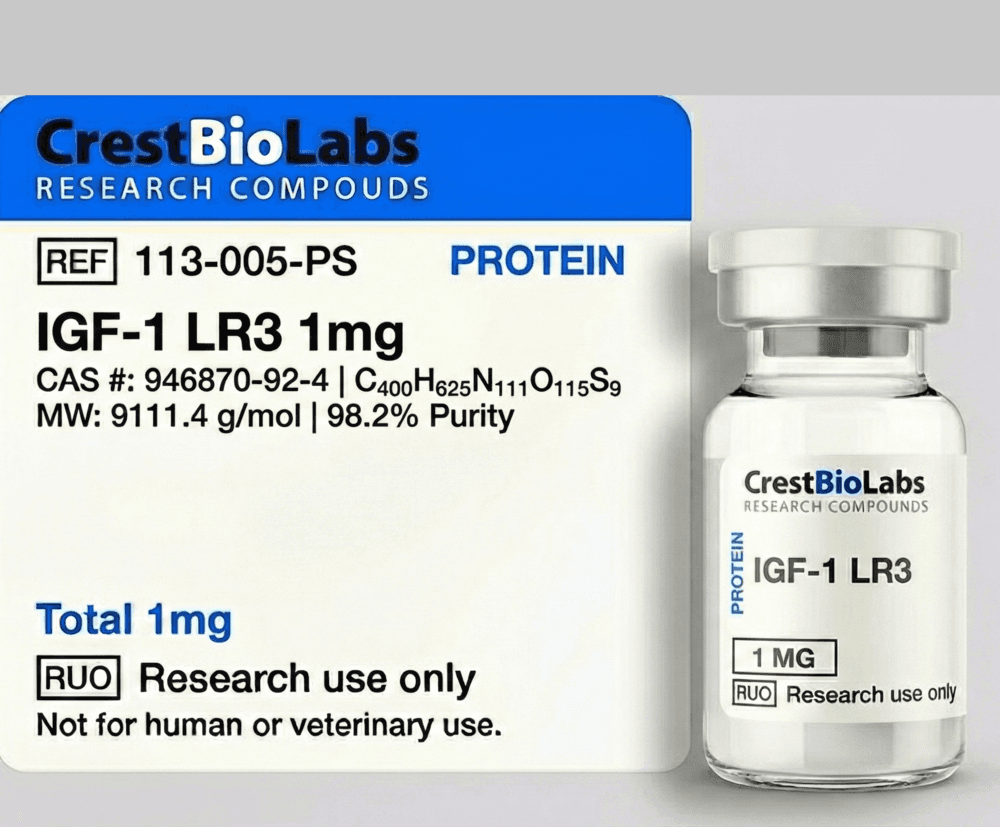
Scientific Overview
IGF-1 LR3 (Long R3 Insulin-like Growth Factor-1) and MGF (Mechano Growth Factor) are both derived from the insulin-like growth factor-1 gene, yet they represent fundamentally different products of that gene's biology. IGF-1 LR3 is an engineered 83-amino acid recombinant protein analog of the mature IGF-1 peptide, modified to reduce binding to IGF binding proteins (IGFBPs) while preserving full IGF-1 receptor activation. MGF, by contrast, is a 24-amino acid synthetic peptide corresponding to the unique C-terminal E domain of the IGF-1Ec splice variant in humans, a naturally occurring isoform whose expression has been observed to increase in mechanically stimulated tissues in preclinical models.
The comparative study of these two compounds is instructive because they illuminate distinct facets of the IGF-1 signaling axis. IGF-1 LR3 engages the canonical IGF-1R tyrosine kinase receptor and activates well-characterized downstream cascades including PI3K/Akt and MAPK/ERK. MGF, as the E-domain peptide of a splice variant, has been investigated for potential signaling activities that may be independent of or complementary to classical IGF-1R activation, though its precise receptor pharmacology remains an area of active investigation in the research literature.
For research purposes only. Not for human or veterinary use. All data and analysis presented in this comparison are derived from peer-reviewed preclinical research and are intended exclusively to support the scientific community's understanding of these research compounds.
For research purposes only. Not for human or veterinary use. The compounds discussed in this comparison are intended exclusively for in-vitro and preclinical research applications.
Head-to-Head Comparison
| Property | IGF-1 LR3 | MGF (Mechano Growth Factor) |
|---|---|---|
| Peptide Class | Recombinant IGF-1 Analog (Modified Growth Factor) | IGF-1 Splice Variant E-Domain Peptide |
| Receptor Targets | IGF-1R (type 1 IGF receptor) | Under investigation; potential IGF-1R-independent pathways |
| Molecular Weight | ~9,111.4 Da | ~2,867.2 Da |
| CAS Number | 946870-92-4 | 96827-07-5 |
| Mechanism (Research) | IGF-1 LR3 activates the IGF-1 receptor (IGF-1R), a receptor tyrosine kinase, triggering autophosphorylation and recruitment of IRS adapter proteins. Downstream signaling proceeds through two principal cascades: PI3K/Akt (regulating protein synthesis via mTOR, glucose uptake, and cell survival) and RAS/MAPK/ERK1/2 (regulating gene expression and cell proliferation). Its reduced IGFBP binding, approximately 100-fold lower affinity than native IGF-1, results in enhanced bioavailability in research systems. | MGF corresponds to the 24-amino acid C-terminal E domain unique to the IGF-1Ec splice variant. In preclinical models, the MGF peptide has been investigated for signaling activities that may operate independently of the canonical IGF-1R. Research suggests potential involvement of the MAPK/ERK pathway and interactions with extracellular matrix components, though the precise primary receptor or binding partner for the isolated E-domain peptide remains an active area of investigation. |
| Stability | IGF-1 LR3 requires stringent storage as a recombinant protein with three essential disulfide bonds. Lyophilized preparations should be stored at -20 to -80 degrees C, desiccated and protected from light. Reconstitution in acidic buffer (10 mM HCl or 100 mM acetic acid) is recommended, with reconstituted solutions aliquoted and frozen to avoid repeated freeze-thaw cycles. Primary degradation pathways include disulfide reshuffling, methionine oxidation, and aggregation. | As a 24-amino acid linear peptide, MGF is susceptible to proteolytic degradation in biological fluids. Lyophilized MGF should be stored at -20 degrees C under desiccated conditions. Reconstituted solutions demonstrate limited stability and should be used promptly or aliquoted and frozen. PEGylated analogs of MGF have been developed in research settings to extend its stability profile. |
| Research Applications | IGF-1 LR3 is employed as a research tool for investigating IGF-1R signaling in cell culture systems where IGFBP interference would confound results. It is used in studies of cell proliferation, differentiation, metabolism, and survival signaling across myoblast, hepatocyte, and epithelial cell culture models. Its enhanced bioavailability relative to native IGF-1 makes it a preferred reagent for sustained IGF-1R activation experiments. | MGF is studied in the context of IGF-1 splice variant biology, mechanotransduction signaling, and the comparative roles of IGF-1 isoform-specific E domains. It serves as a research tool for investigating whether the E domain of IGF-1Ec possesses independent biological activities beyond those attributable to the mature IGF-1 peptide released after proteolytic processing. |
| Analytical Methods | Reversed-phase HPLC for purity assessment, LC-MS/MS for molecular weight confirmation and sequence verification, SDS-PAGE under reducing and non-reducing conditions to verify disulfide bond integrity, IGF-1R phosphorylation assays for functional activity, and cell proliferation assays using IGF-1R-expressing cell lines. | Reversed-phase HPLC for purity determination, ESI-MS for molecular weight confirmation, MALDI-TOF for intact mass analysis, and cell-based proliferation or migration assays to assess biological activity in preclinical research models. |
Peptide Class
Recombinant IGF-1 Analog (Modified Growth Factor)
IGF-1 Splice Variant E-Domain Peptide
Receptor Targets
IGF-1R (type 1 IGF receptor)
Under investigation; potential IGF-1R-independent pathways
Molecular Weight
~9,111.4 Da
~2,867.2 Da
CAS Number
946870-92-4
96827-07-5
Mechanism (Research)
IGF-1 LR3 activates the IGF-1 receptor (IGF-1R), a receptor tyrosine kinase, triggering autophosphorylation and recruitment of IRS adapter proteins. Downstream signaling proceeds through two principal cascades: PI3K/Akt (regulating protein synthesis via mTOR, glucose uptake, and cell survival) and RAS/MAPK/ERK1/2 (regulating gene expression and cell proliferation). Its reduced IGFBP binding, approximately 100-fold lower affinity than native IGF-1, results in enhanced bioavailability in research systems.
MGF corresponds to the 24-amino acid C-terminal E domain unique to the IGF-1Ec splice variant. In preclinical models, the MGF peptide has been investigated for signaling activities that may operate independently of the canonical IGF-1R. Research suggests potential involvement of the MAPK/ERK pathway and interactions with extracellular matrix components, though the precise primary receptor or binding partner for the isolated E-domain peptide remains an active area of investigation.
Stability
IGF-1 LR3 requires stringent storage as a recombinant protein with three essential disulfide bonds. Lyophilized preparations should be stored at -20 to -80 degrees C, desiccated and protected from light. Reconstitution in acidic buffer (10 mM HCl or 100 mM acetic acid) is recommended, with reconstituted solutions aliquoted and frozen to avoid repeated freeze-thaw cycles. Primary degradation pathways include disulfide reshuffling, methionine oxidation, and aggregation.
As a 24-amino acid linear peptide, MGF is susceptible to proteolytic degradation in biological fluids. Lyophilized MGF should be stored at -20 degrees C under desiccated conditions. Reconstituted solutions demonstrate limited stability and should be used promptly or aliquoted and frozen. PEGylated analogs of MGF have been developed in research settings to extend its stability profile.
Research Applications
IGF-1 LR3 is employed as a research tool for investigating IGF-1R signaling in cell culture systems where IGFBP interference would confound results. It is used in studies of cell proliferation, differentiation, metabolism, and survival signaling across myoblast, hepatocyte, and epithelial cell culture models. Its enhanced bioavailability relative to native IGF-1 makes it a preferred reagent for sustained IGF-1R activation experiments.
MGF is studied in the context of IGF-1 splice variant biology, mechanotransduction signaling, and the comparative roles of IGF-1 isoform-specific E domains. It serves as a research tool for investigating whether the E domain of IGF-1Ec possesses independent biological activities beyond those attributable to the mature IGF-1 peptide released after proteolytic processing.
Analytical Methods
Reversed-phase HPLC for purity assessment, LC-MS/MS for molecular weight confirmation and sequence verification, SDS-PAGE under reducing and non-reducing conditions to verify disulfide bond integrity, IGF-1R phosphorylation assays for functional activity, and cell proliferation assays using IGF-1R-expressing cell lines.
Reversed-phase HPLC for purity determination, ESI-MS for molecular weight confirmation, MALDI-TOF for intact mass analysis, and cell-based proliferation or migration assays to assess biological activity in preclinical research models.
Receptor Signaling and Pathway Engagement
The most significant mechanistic distinction between IGF-1 LR3 and MGF lies in their relationship to the IGF-1 receptor. IGF-1 LR3 is a well-characterized IGF-1R agonist whose signaling mechanism has been extensively documented. Upon binding to the extracellular alpha subunits of the IGF-1R heterotetrameric receptor, IGF-1 LR3 induces a conformational change that activates the intrinsic tyrosine kinase activity of the beta subunit intracellular domains. The activated kinase autophosphorylates specific tyrosine residues, creating docking sites for insulin receptor substrate (IRS) proteins that recruit PI3K and other downstream effectors.
The PI3K/Akt axis activated by IGF-1 LR3 has been extensively characterized in preclinical cell culture models. Akt phosphorylation leads to activation of mTORC1, which in turn phosphorylates p70S6K and 4E-BP1 to promote cap-dependent translation initiation and ribosomal biogenesis. This signaling cascade has been demonstrated in numerous in-vitro studies using IGF-1 LR3 as the stimulating ligand, particularly in myoblast and epithelial cell systems where protein synthesis regulation is a primary research endpoint.
MGF presents a more complex and less fully resolved signaling picture. As the isolated E-domain peptide of the IGF-1Ec splice variant, MGF does not contain the mature IGF-1 receptor-binding domain and therefore would not be expected to activate IGF-1R through the same mechanism as IGF-1 LR3. Published research has suggested that the MGF peptide may engage alternative signaling mechanisms. Yang and Goldspink (2002) reported that MGF activated the MAPK/ERK pathway in C2C12 myoblast models, and subsequent research has explored whether this activation occurs through a receptor distinct from IGF-1R.
The question of whether MGF possesses a dedicated receptor remains unresolved in the literature. Some research groups have proposed that MGF may interact with extracellular matrix components or membrane-associated proteins distinct from IGF-1R, while others have suggested that observed effects could be mediated through low-affinity interactions with IGF-1R or related receptors in the insulin receptor family. This mechanistic ambiguity makes MGF an active subject of receptor pharmacology research and contrasts sharply with the well-defined IGF-1R-mediated signaling of IGF-1 LR3.
Structural and Molecular Architecture
IGF-1 LR3 and MGF differ dramatically in their structural characteristics, reflecting their distinct origins within the IGF-1 gene product. IGF-1 LR3 is an 83-amino acid single-chain polypeptide with a molecular weight of approximately 9,111.4 Da, making it one of the largest compounds in the research peptide catalog. Its structure is based on the native IGF-1 fold belonging to the insulin structural superfamily, featuring three alpha-helices stabilized by three intramolecular disulfide bonds (Cys18-Cys61, Cys47-Cys52, and Cys6-Cys48 in LR3 numbering). These cystine bridges are absolutely essential for maintaining the tertiary fold and receptor-binding competence.
The two key engineering modifications in IGF-1 LR3, the 13-amino acid N-terminal extension and the Glu3-to-Arg substitution, are strategically positioned to disrupt IGFBP binding without affecting the IGF-1R interaction surface. The N-terminal extension (Met-Phe-Pro-Ala-Met-Pro-Leu-Ser-Ser-Leu-Phe-Val-Asn) is largely unstructured and provides steric hindrance at the IGFBP binding interface. The Arg3 charge reversal disrupts electrostatic complementarity with IGFBPs, as the native Glu3 participates in critical salt bridge interactions with IGFBPs. The IGF-1R binding surface, located on the opposite face of the molecule involving residues from both the B-helix and A-helix domains, is unaffected by either modification.
MGF, by contrast, is a 24-amino acid linear peptide corresponding to the unique C-terminal portion of the E domain of the IGF-1Ec splice variant. With a molecular weight of approximately 2,867.2 Da, it is roughly one-third the size of IGF-1 LR3. The MGF peptide does not share sequence homology with the mature IGF-1 coding region and does not contain any of the structural elements (alpha-helices, disulfide bonds) that characterize the IGF-1 receptor-binding domain. Solution-state structural studies suggest that MGF adopts a largely extended or disordered conformation, lacking the stable tertiary fold of IGF-1 LR3.
This structural divergence has important practical implications for research. IGF-1 LR3 requires protein-appropriate handling protocols to preserve its disulfide-dependent tertiary structure, including careful reconstitution in acidic buffers and avoidance of reducing agents. MGF, as a linear peptide without disulfide constraints, is more tolerant of handling conditions but correspondingly more susceptible to proteolytic degradation in biological systems.
IGF-1 Splice Variant Biology and E-Domain Function
Understanding the relationship between IGF-1 LR3 and MGF requires context from IGF-1 gene biology. The human IGF-1 gene produces multiple mRNA splice variants through alternative splicing of exons 4, 5, and 6. All splice variants encode the same mature IGF-1 peptide (70 amino acids) but differ in their E-domain extensions. The IGF-1Ea variant contains an E domain encoded by exon 6, while the IGF-1Ec variant (from which MGF is derived) contains a unique E domain arising from inclusion of a portion of exon 5 followed by a reading frame shift in exon 6. In rodent models, the corresponding variant is designated IGF-1Eb.
In preclinical models, the IGF-1Ec/MGF splice variant has been observed to be upregulated in response to mechanical loading. Research by Goldspink and colleagues demonstrated increased IGF-1Ec mRNA expression in skeletal muscle tissue subjected to mechanical stretch in rodent models, leading to the designation "Mechano Growth Factor." This mechanosensitive expression pattern distinguishes IGF-1Ec from the constitutively expressed IGF-1Ea isoform and has generated significant research interest in the role of alternative splicing in mechanotransduction signaling.
A central question in IGF-1 splice variant research is whether the E domain peptides released during post-translational processing of IGF-1 pro-peptides possess independent biological activities. The mature IGF-1 peptide is released from all pro-IGF-1 isoforms by proteolytic cleavage of the E domain, and IGF-1 LR3 was specifically designed to study the mature IGF-1 signaling axis in isolation. The MGF peptide, representing just the unique E domain, allows researchers to investigate potential E-domain-specific activities separately from mature IGF-1R signaling.
Published preclinical research has provided evidence that the MGF E-domain peptide may influence cell proliferation and migration through mechanisms that do not require IGF-1R activation. Studies in satellite cell and myoblast models have reported that synthetic MGF peptide can stimulate proliferation even in the presence of IGF-1R blocking antibodies, suggesting a receptor-independent or alternative-receptor-dependent mechanism. However, these findings remain areas of active investigation, and the molecular identity of the putative MGF receptor has not been definitively established.
Research Applications and Experimental Considerations
IGF-1 LR3 and MGF serve complementary but distinct roles in IGF-1 biology research programs. IGF-1 LR3 is the standard research tool for investigating canonical IGF-1R signaling in experimental systems where IGFBP interference would confound results. Its approximately 100-fold reduction in IGFBP binding affinity means that the effective free concentration of IGF-1 LR3 in cell culture media containing serum or IGFBP-secreting cells is substantially higher than that of native IGF-1. Working concentrations of 10-100 ng/mL (approximately 1-10 nM) are typically employed in cell culture, achieving sustained IGF-1R activation that is more reproducible than equivalent concentrations of native IGF-1.
MGF research focuses on different biological questions, primarily centered on whether the IGF-1Ec E domain possesses independent signaling capacity and what role this splice-variant-specific peptide plays in mechanotransduction biology. MGF is used in research protocols designed to separate E-domain-mediated effects from those attributable to the mature IGF-1 peptide. This experimental approach typically involves comparing cellular responses to MGF alone, IGF-1 LR3 alone, and combinations, sometimes in the presence of IGF-1R antagonists or in IGF-1R-knockout cell lines to isolate potential receptor-independent activities.
From a practical laboratory perspective, the two compounds present different handling requirements. IGF-1 LR3, as a 9.1 kDa recombinant protein with essential disulfide bonds, requires protein-grade handling protocols including reconstitution in acidic buffers, inclusion of carrier protein (0.1% BSA) in dilute solutions to prevent surface adsorption, and single-use aliquoting to avoid freeze-thaw-induced aggregation. Standard protein quantification methods (BCA assay, UV absorbance at 280 nm) are applicable. MGF, as a smaller linear peptide, is amenable to standard peptide handling protocols but requires attention to its susceptibility to proteolytic degradation when used in serum-containing systems.
Researchers investigating the broader IGF-1 signaling axis may employ both compounds within the same research program to dissect the contributions of canonical IGF-1R signaling (using IGF-1 LR3) from potential E-domain-mediated activities (using MGF). Such comparative studies require careful experimental design to account for the differing stability profiles, effective concentration ranges, and signaling kinetics of these structurally distinct compounds.
Scientific References
[1] Francis GL, Ross M, Ballard FJ, et al.. “Novel recombinant fusion protein analogues of insulin-like growth factor (IGF)-I indicate the relative importance of IGF-binding protein and receptor binding for enhanced biological potency.” Journal of Molecular Endocrinology (1992). doi:10.1677/jme.0.0090213
[2] Yang SY, Goldspink G.. “Different roles of the IGF-I Ec peptide (MGF) and mature IGF-I in myoblast proliferation and differentiation.” FEBS Letters (2002). doi:10.1016/S0014-5793(02)03918-0
[3] Goldspink G.. “Mechanical signals, IGF-I gene splicing, and muscle adaptation.” Physiology (2005). doi:10.1152/physiol.00004.2005
[4] Philippou A, Maridaki M, Halapas A, Koutsilieris M.. “The role of the insulin-like growth factor 1 (IGF-1) in skeletal muscle physiology.” In Vivo (2007). doi:10.1007/s11626-007-9033-z
[5] Dluzniewska J, Sarnowska A, Beresewicz M, et al.. “A strong neuroprotective effect of the autonomous C-terminal peptide of IGF-1 Ec (MGF) in brain ischemia.” FASEB Journal (2005). doi:10.1096/fj.05-3786fje
[6] Tian XC, Chen MJ, Bhatt RS, et al.. “Long [Arg3] insulin-like growth factor I is an analog of IGF-I which is highly potent for stimulation of cell proliferation and glucose uptake.” Biochemical and Biophysical Research Communications (1999). doi:10.1006/bbrc.1999.0746
[7] Mills P, Dominique JC, Lafreniere JF, et al.. “A synthetic mechano growth factor E peptide enhances myogenic precursor cell transplantation success.” American Journal of Transplantation (2007). doi:10.1111/j.1600-6143.2007.01923.x
[8] Hede MS, Salimova E, Engstrom A, et al.. “E-peptides control bioavailability of IGF-1.” PLoS ONE (2012). doi:10.1371/journal.pone.0051152