Scientific Overview
CJC-1295 with DAC and CJC-1295 without DAC (Mod GRF 1-29) share the same stabilized GHRH analog peptide backbone — a modified GRF(1-29) sequence with four amino acid substitutions for enhanced metabolic stability — but differ in a critical structural feature: the presence or absence of a Drug Affinity Complex (DAC). The DAC is a maleimidopropionic acid derivative conjugated to the peptide that is designed to form a covalent bond with the cysteine-34 residue of serum albumin in biological systems, dramatically altering the compound's pharmacokinetic behavior.
This comparison is instructive for researchers studying the impact of albumin conjugation strategies on peptide pharmacology. Both compounds activate the GHRH receptor through the same signaling cascade, but the DAC-mediated albumin binding fundamentally changes the duration and pattern of receptor engagement. CJC-1295 No DAC functions as a free peptide with improved (but still limited) metabolic stability, while CJC-1295 with DAC behaves as a peptide-albumin conjugate with substantially extended pharmacokinetic properties. Understanding these differences is essential for selecting the appropriate research tool for specific experimental applications.
For research purposes only. Not for human or veterinary use. All data presented in this comparison are derived from published peer-reviewed preclinical and analytical studies and are intended solely to support scientific understanding of these research compounds.
For research purposes only. Not for human or veterinary use. The compounds discussed in this comparison are intended exclusively for in-vitro and preclinical research applications.
Head-to-Head Comparison
| Property | CJC-1295 with DAC | CJC-1295 No DAC |
|---|---|---|
| Peptide Class | Albumin-Conjugating GHRH Analog | Stabilized GHRH Analog (Modified GRF 1-29) |
| Receptor Targets | GHRHR (Growth Hormone-Releasing Hormone Receptor) | GHRHR (Growth Hormone-Releasing Hormone Receptor) |
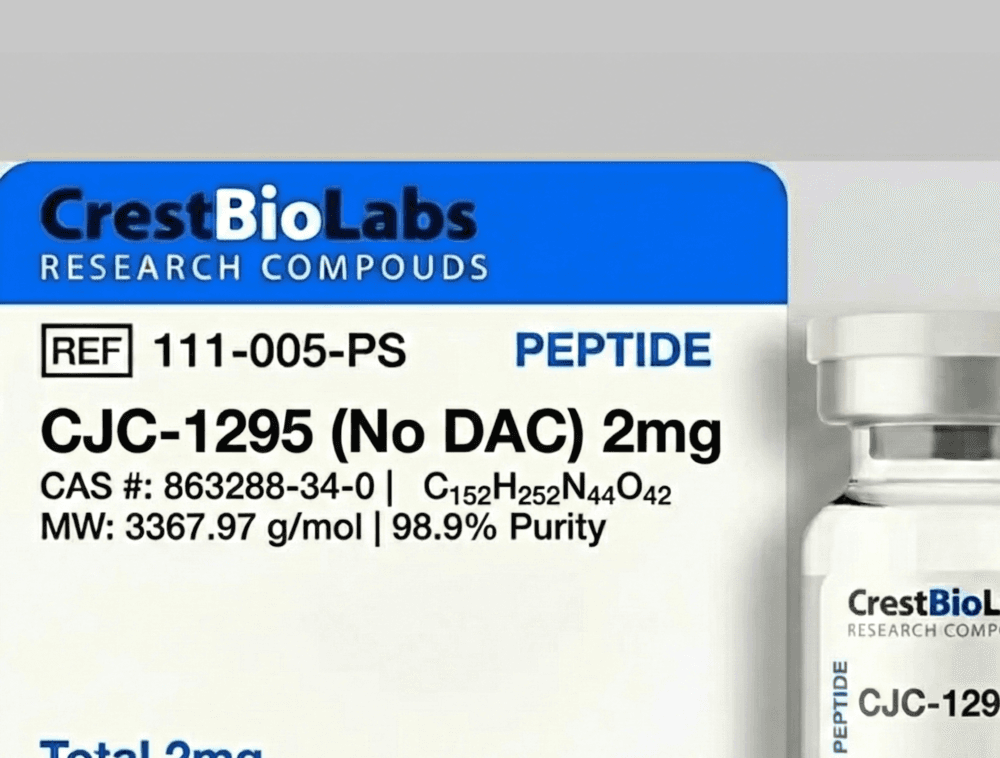
| Molecular Weight | ~3,647.3 Da | ~3,367.97 Da |
| CAS Number | 863288-34-0 | 863288-34-0 |
| Mechanism (Research) | CJC-1295 with DAC activates the GHRHR through the same Gs-cAMP-PKA cascade as the No DAC variant. The maleimido-derived DAC linker forms a covalent thioether bond with albumin Cys-34 in biological systems, creating a peptide-albumin conjugate that reduces renal clearance and dramatically extends the pharmacokinetic profile. In preclinical studies, this conjugation produces sustained GHRHR stimulation over extended timeframes. | CJC-1295 No DAC activates the GHRHR through the canonical Gs-cAMP-PKA signaling cascade. Its four amino acid substitutions (D-Ala2, Gln8, Ala15, Leu27) enhance metabolic stability compared to native GRF(1-29) by blocking DPP-IV cleavage, deamidation, oxidation, and backbone flexibility. It circulates as a free peptide without covalent albumin binding. |
| Stability | CJC-1295 with DAC retains the four stabilizing amino acid substitutions (D-Ala2, Gln8, Ala15, Leu27) of the No DAC variant. The maleimide group is reactive and must be protected from premature hydrolysis or reaction with thiol-containing compounds during storage. Lyophilized preparations require storage at -20 degrees C under desiccation with protection from moisture. | CJC-1295 No DAC demonstrates significantly improved stability compared to native sermorelin through its four targeted amino acid substitutions. The elimination of the Met27 oxidation site and the Asn8 deamidation site are particularly impactful. Lyophilized preparations are stable at -20 degrees C under desiccation for extended periods. |
| Research Applications | CJC-1295 with DAC is studied as a model compound for albumin-conjugation pharmacokinetic strategies, extended-duration GHRHR stimulation, and comparative studies of sustained versus pulsatile somatotropic axis activation. It serves as a reference for evaluating Drug Affinity Complex technology in peptide research. | CJC-1295 No DAC is used as a stabilized GHRH agonist for pituitary cell culture studies, GHRHR signaling pathway characterization, and combination studies with growth hormone secretagogues. It is the preferred GHRH analog when sustained but not ultra-long receptor activation is required. |
| Analytical Methods | Reversed-phase HPLC, LC-MS for molecular weight confirmation (free and albumin-conjugated forms), maleimide reactivity assays, albumin binding kinetics studies (surface plasmon resonance), and GHRHR functional assays. | Reversed-phase HPLC, LC-MS for molecular weight and substitution confirmation, GHRHR binding assays, cAMP accumulation assays, DPP-IV resistance assays, and circular dichroism for secondary structure analysis. |
Peptide Class
Albumin-Conjugating GHRH Analog
Stabilized GHRH Analog (Modified GRF 1-29)
Receptor Targets
GHRHR (Growth Hormone-Releasing Hormone Receptor)
GHRHR (Growth Hormone-Releasing Hormone Receptor)
Molecular Weight
~3,647.3 Da
~3,367.97 Da
CAS Number
863288-34-0
863288-34-0
Mechanism (Research)
CJC-1295 with DAC activates the GHRHR through the same Gs-cAMP-PKA cascade as the No DAC variant. The maleimido-derived DAC linker forms a covalent thioether bond with albumin Cys-34 in biological systems, creating a peptide-albumin conjugate that reduces renal clearance and dramatically extends the pharmacokinetic profile. In preclinical studies, this conjugation produces sustained GHRHR stimulation over extended timeframes.
CJC-1295 No DAC activates the GHRHR through the canonical Gs-cAMP-PKA signaling cascade. Its four amino acid substitutions (D-Ala2, Gln8, Ala15, Leu27) enhance metabolic stability compared to native GRF(1-29) by blocking DPP-IV cleavage, deamidation, oxidation, and backbone flexibility. It circulates as a free peptide without covalent albumin binding.
Stability
CJC-1295 with DAC retains the four stabilizing amino acid substitutions (D-Ala2, Gln8, Ala15, Leu27) of the No DAC variant. The maleimide group is reactive and must be protected from premature hydrolysis or reaction with thiol-containing compounds during storage. Lyophilized preparations require storage at -20 degrees C under desiccation with protection from moisture.
CJC-1295 No DAC demonstrates significantly improved stability compared to native sermorelin through its four targeted amino acid substitutions. The elimination of the Met27 oxidation site and the Asn8 deamidation site are particularly impactful. Lyophilized preparations are stable at -20 degrees C under desiccation for extended periods.
Research Applications
CJC-1295 with DAC is studied as a model compound for albumin-conjugation pharmacokinetic strategies, extended-duration GHRHR stimulation, and comparative studies of sustained versus pulsatile somatotropic axis activation. It serves as a reference for evaluating Drug Affinity Complex technology in peptide research.
CJC-1295 No DAC is used as a stabilized GHRH agonist for pituitary cell culture studies, GHRHR signaling pathway characterization, and combination studies with growth hormone secretagogues. It is the preferred GHRH analog when sustained but not ultra-long receptor activation is required.
Analytical Methods
Reversed-phase HPLC, LC-MS for molecular weight confirmation (free and albumin-conjugated forms), maleimide reactivity assays, albumin binding kinetics studies (surface plasmon resonance), and GHRHR functional assays.
Reversed-phase HPLC, LC-MS for molecular weight and substitution confirmation, GHRHR binding assays, cAMP accumulation assays, DPP-IV resistance assays, and circular dichroism for secondary structure analysis.
Drug Affinity Complex (DAC) Technology
The Drug Affinity Complex (DAC) technology represents a bioconjugation strategy designed to extend the pharmacokinetic half-life of peptides by exploiting the long circulating half-life of serum albumin. Albumin, the most abundant plasma protein with a half-life of approximately 19 days in humans, has been used as a pharmacokinetic carrier for various drug molecules. The DAC approach employs a reactive maleimide group that forms a stable thioether bond with the free thiol of albumin's Cys-34 residue.
In the case of CJC-1295 with DAC, a maleimidopropionic acid (MPA) derivative is conjugated to a lysine residue on the modified GRF(1-29) backbone. The maleimide group undergoes a Michael addition reaction with the thiol group of albumin Cys-34, forming a covalent carbon-sulfur bond. This reaction is relatively specific because Cys-34 is the only free (non-disulfide-bonded) cysteine residue in human serum albumin, and under physiological conditions it exists predominantly in the reduced form available for conjugation.
The covalent nature of the DAC-albumin bond distinguishes this approach from the non-covalent albumin binding strategies employed by fatty acid-acylated peptides such as semaglutide and tirzepatide. Non-covalent albumin binding is reversible and characterized by equilibrium kinetics, with the peptide continuously dissociating from and re-associating with albumin. The DAC covalent bond, in contrast, produces a permanent peptide-albumin conjugate that is only separated by proteolytic degradation of the albumin carrier or the linker itself.
From a research chemistry perspective, the maleimide group in CJC-1295 with DAC is reactive and requires careful handling. In the absence of a thiol reaction partner, the maleimide can undergo hydrolysis (ring opening) in aqueous solution, which inactivates its conjugation capability. This hydrolysis is pH- and temperature-dependent, occurring more rapidly at alkaline pH and elevated temperatures. Researchers working with the pre-conjugated (free maleimide) form must minimize aqueous exposure time and maintain acidic to neutral pH conditions to preserve reactivity.
Comparative Pharmacokinetic Profiles
The pharmacokinetic profiles of CJC-1295 with DAC and without DAC differ dramatically as a direct consequence of the albumin conjugation strategy. CJC-1295 No DAC, while substantially more stable than native sermorelin due to its four amino acid substitutions, still circulates as a free peptide subject to renal filtration and residual proteolytic degradation. Its pharmacokinetic profile in preclinical models shows improved but still limited duration of action compared to DAC-conjugated forms.
CJC-1295 with DAC, once conjugated to albumin, benefits from the carrier protein's large molecular size (~66.5 kDa), which effectively prevents glomerular filtration. The conjugate's pharmacokinetic half-life is governed by the turnover rate of the albumin carrier rather than the peptide's intrinsic metabolic stability. Published pharmacokinetic studies in healthy subjects have reported that CJC-1295 with DAC achieved sustained elevation of growth hormone and IGF-1 levels for extended periods following single administrations, reflecting the prolonged receptor stimulation enabled by albumin conjugation.
The practical implication for researchers is that CJC-1295 No DAC produces a temporal activation profile that is intermediate between native sermorelin (rapid degradation, transient activation) and CJC-1295 with DAC (albumin-conjugated, sustained activation). This three-compound spectrum — sermorelin, CJC-1295 No DAC, CJC-1295 with DAC — provides researchers with a graded series of GHRHR stimulation durations for investigating how the temporal pattern of receptor activation influences downstream biological responses.
In preclinical pharmacokinetic studies, the different clearance mechanisms of the two CJC-1295 variants also affect their tissue distribution profiles. Free peptides like CJC-1295 No DAC can access tissues more readily through capillary fenestrations and passive diffusion, while the albumin-conjugated DAC variant is largely confined to the vascular and interstitial compartments accessible to albumin. This distributional difference may influence the tissue-level receptor engagement patterns of each variant, though this remains an area requiring further preclinical investigation.
Structural and Chemical Differences
The structural distinction between CJC-1295 with DAC and without DAC centers on the maleimidopropionic acid (MPA) moiety that constitutes the Drug Affinity Complex. Both compounds share the identical 29-amino acid modified GRF backbone with the same four stabilizing substitutions (D-Ala2, Gln8, Ala15, Leu27). The DAC variant adds the MPA linker conjugated to a lysine side chain amine group on the peptide, increasing the molecular weight from approximately 3,367.97 Da (No DAC) to approximately 3,647.3 Da (with DAC).
The maleimide functional group is a five-membered unsaturated imide ring that provides the reactive electrophilic center for conjugation with thiol nucleophiles. The maleimide undergoes a rapid and selective Michael-type addition with the sulfhydryl group of albumin Cys-34, forming a succinimide thioether linkage. This reaction is highly efficient under physiological conditions (pH 7.4, 37 degrees C), with second-order rate constants that favor near-complete conjugation within minutes of exposure to albumin.
The presence of the DAC moiety introduces analytical considerations distinct from those of the unmodified peptide. Mass spectrometric analysis of CJC-1295 with DAC reveals the additional mass corresponding to the MPA group, and fragmentation patterns can confirm the site of MPA attachment. In biological samples, the peptide may exist in three forms: free (unreacted maleimide), albumin-conjugated (post-thiol reaction), and hydrolyzed (ring-opened maleimide). Each form has distinct chromatographic and mass spectrometric signatures that must be distinguished during analytical characterization.
From a formulation perspective, the reactive maleimide group in CJC-1295 with DAC requires more stringent storage and handling conditions than the No DAC variant. The free maleimide must be protected from moisture, thiol-containing excipients, and elevated pH to prevent premature hydrolysis or non-specific conjugation. This additional reactivity is a deliberate design feature enabling in-situ albumin conjugation but represents a handling complexity absent from CJC-1295 No DAC.
Research Design Implications
The choice between CJC-1295 with DAC and without DAC in research protocols depends fundamentally on the experimental question being addressed and the desired temporal profile of GHRHR stimulation. CJC-1295 No DAC is appropriate for studies requiring stabilized but time-limited GHRHR activation, such as acute signaling pathway characterization, receptor binding kinetics, and short-duration cell culture experiments. Its free peptide format allows direct receptor engagement without the steric or pharmacokinetic complications introduced by albumin conjugation.
CJC-1295 with DAC is suited for research investigating sustained GHRHR stimulation, receptor desensitization and downregulation over extended timeframes, and the pharmacokinetic principles of albumin conjugation strategies. In preclinical animal models, the DAC variant has been used to study the effects of continuous versus pulsatile somatotropic axis stimulation on growth hormone secretion patterns, IGF-1 levels, and downstream tissue responses. The extended pharmacokinetic profile reduces the frequency of compound administration required in chronic studies.
An important consideration for in-vitro researchers is that CJC-1295 with DAC will conjugate to any free thiol groups present in the experimental system, including cysteine residues in media supplements (such as those in serum), reducing agents (DTT, beta-mercaptoethanol), and intracellular glutathione. This non-specific reactivity must be controlled through experimental design, either by pre-conjugating the peptide to purified albumin before adding it to cell culture systems or by using serum-free conditions where the peptide's albumin-binding capacity is not relevant.
The comparison of CJC-1295 with and without DAC also provides a model system for evaluating the broader concept of bioconjugation-based pharmacokinetic optimization. The DAC technology represents one of several approaches to extending peptide half-life, alongside non-covalent albumin binding (fatty acid acylation), PEGylation, and Fc fusion. By studying CJC-1295 variants that differ only in the presence or absence of the DAC moiety while sharing the same receptor pharmacology, researchers can isolate the pharmacokinetic contributions of albumin conjugation from the pharmacodynamic properties of the underlying peptide.
Scientific References
[1] Teichman SL, Neale A, Lawrence B, Gagnon C, Caber JP, Bhatt RS.. “Prolonged stimulation of growth hormone (GH) and insulin-like growth factor I secretion by CJC-1295, a long-acting analog of GH-releasing hormone, in healthy adults.” Journal of Clinical Endocrinology & Metabolism (2006). doi:10.1210/jc.2005-1528
[2] Ionescu M, Bhatt RS, Gagnon C, et al.. “Pharmacokinetics and pharmacodynamics of CJC-1295, a growth hormone releasing factor analog, after subcutaneous administration in healthy subjects.” Growth Hormone & IGF Research (2006). doi:10.1016/j.ghir.2006.05.001
[3] Kratz F.. “Albumin as a drug carrier: design of prodrugs, drug conjugates and nanoparticles.” Journal of Controlled Release (2008). doi:10.1016/j.jconrel.2008.05.010
[4] Sleep D, Cameron J, Evans LR.. “Albumin as a versatile platform for drug half-life extension.” Biochimica et Biophysica Acta (2013). doi:10.1016/j.bbagen.2013.04.023
[5] Frohman LA, Downs TR, Heimer EP, Felix AM.. “Dipeptidylpeptidase IV and trypsin-like enzymatic degradation of human growth hormone-releasing hormone in plasma.” Journal of Clinical Investigation (1989). doi:10.1172/JCI114121
[6] Mayo KE, Miller TL, DeAlmeida V, et al.. “Regulation of the pituitary somatotroph cell by GHRH and its receptor.” Recent Progress in Hormone Research (2000). doi:10.1210/rp.55.1.237
[7] Jimenez JC, Bhatt RS, Bhargava P, et al.. “CJC-1295, a long-acting GHRH analog: development and clinical applications.” Current Drug Discovery Technologies (2004). doi:10.2174/1570163043484789