Scientific Overview
Melanotan I and Melanotan II are two structurally distinct synthetic analogs of alpha-melanocyte stimulating hormone (alpha-MSH) that have been extensively studied in melanocortin receptor pharmacology research. Both compounds were developed at the University of Arizona through systematic structure-activity relationship studies aimed at creating potent, metabolically stable melanocortin receptor agonists. Despite sharing a common origin in alpha-MSH research, they represent fundamentally different peptide engineering strategies — linear extension versus cyclic constraint — and consequently exhibit distinct receptor selectivity profiles, pharmacokinetic behaviors, and research applications.
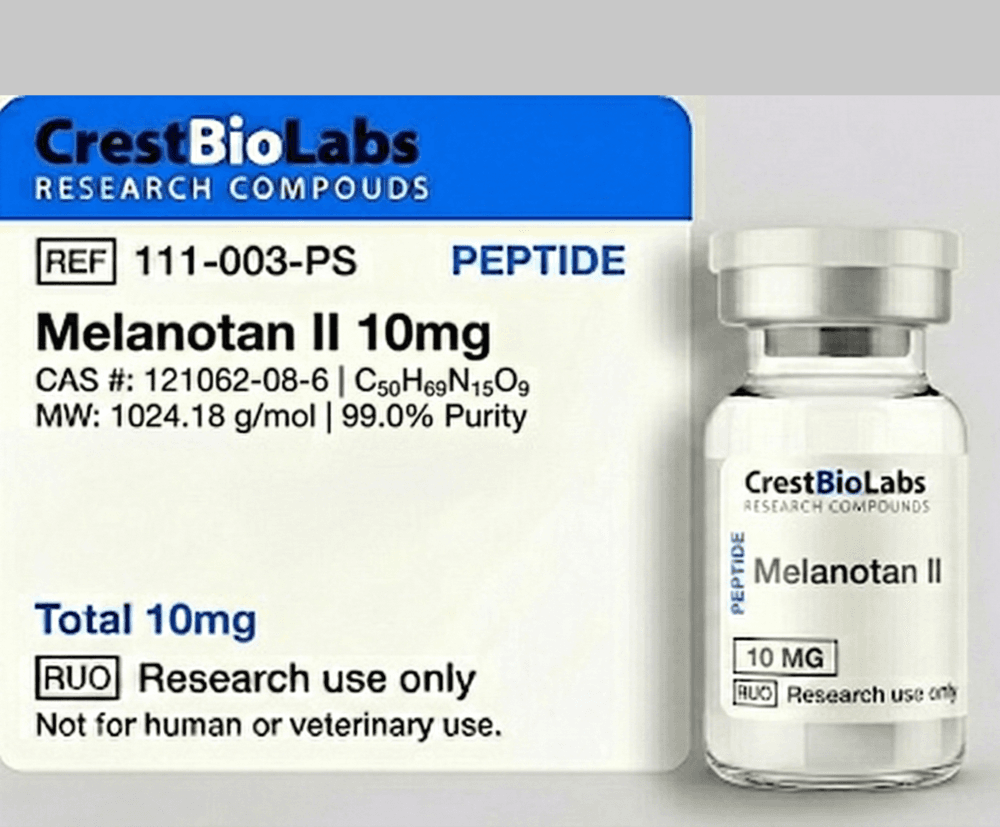
Melanotan I (afamelanotide, CAS 75921-69-6) is a linear tridecapeptide (13 amino acids) corresponding to a full-length alpha-MSH analog with a single amino acid substitution (Nle4 replacing Met4) to eliminate oxidation susceptibility. Melanotan II is a cyclic heptapeptide (7 amino acids) that retains only the core melanocortin pharmacophore within a conformationally constrained lactam ring. This structural divergence results in Melanotan I demonstrating greater selectivity for MC1R, while Melanotan II acts as a broader non-selective agonist across MC1R, MC3R, MC4R, and MC5R subtypes.
For research purposes only. Not for human or veterinary use. The information presented here draws on published preclinical and analytical research to support scientific understanding of these melanocortin research compounds.
For research purposes only. Not for human or veterinary use. The compounds discussed in this comparison are intended exclusively for in-vitro and preclinical research applications.
Head-to-Head Comparison
| Property | Melanotan I | Melanotan II |
|---|---|---|
| Peptide Class | Linear Alpha-MSH Analog (Tridecapeptide) | Cyclic Melanocortin Heptapeptide |
| Receptor Targets | MC1R (preferential), MC3R, MC4R, MC5R | MC1R, MC3R, MC4R, MC5R (non-selective) |
| Molecular Weight | ~1,646.9 Da | ~1,024.18 Da |
| CAS Number | 75921-69-6 | 121062-08-6 |
| Mechanism (Research) | Melanotan I activates melanocortin receptors through the Gs-adenylyl cyclase-cAMP-PKA signaling cascade, with preferential affinity for MC1R. In melanocyte models, MC1R activation elevates cAMP, activating CREB and upregulating MITF transcription, which drives expression of melanogenic enzymes including tyrosinase, TRP-1, and DCT. Its linear full-length structure allows interaction with the full extracellular domain of MC1R. | Melanotan II activates multiple melanocortin receptor subtypes through the Gs-cAMP-PKA pathway. Its cyclic lactam structure presents the melanocortin pharmacophore (His-D-Phe-Arg-Trp) in a constrained conformation that efficiently engages the binding pockets of MC1R, MC3R, MC4R, and MC5R. In preclinical models, MC4R activation by Melanotan II in the CNS engages hypothalamic melanocortin circuits, while MC1R activation drives melanocyte signaling. |
| Stability | Melanotan I incorporates a Nle4 substitution (norleucine replacing methionine at position 4) to eliminate the oxidation-susceptible sulfur-containing side chain. However, as a linear 13-amino acid peptide, it remains susceptible to exo- and endopeptidase degradation. Lyophilized preparations stored at -20 degrees C under desiccation maintain acceptable stability. | Melanotan II's cyclic lactam bridge and D-Phe substitution confer enhanced metabolic stability compared to linear melanocortin analogs. The constrained ring structure provides resistance to exopeptidases, while D-Phe resists endopeptidase cleavage. The tryptophan residue is photosensitive. Lyophilized preparations are stable at -20 degrees C; reconstituted solutions require light protection. |
| Research Applications | Melanotan I is studied as a reference MC1R-preferential agonist for investigating melanocortin receptor selectivity, melanogenesis signaling pathways, and the pharmacological differences between linear and cyclic melanocortin analogs. It serves as a key comparator for understanding how peptide cyclization affects receptor selectivity profiles. | Melanotan II is used as a non-selective melanocortin agonist tool compound for studying MC1R through MC5R signaling, melanocortin pharmacophore requirements, and structure-activity relationships in cyclic peptide design. It is also the parent compound from which PT-141 (bremelanotide) was derived. |
| Analytical Methods | Reversed-phase HPLC for purity, LC-MS for molecular weight confirmation (~1,646.9 Da), MC1R competitive binding assays, cAMP accumulation assays across MCR subtypes, and melanin content quantification in melanocyte models. | Reversed-phase HPLC, LC-MS/MS for molecular confirmation (1,024.18 Da), competitive binding assays across all five MCR subtypes, cAMP functional assays, and melanin synthesis quantification in melanocyte models. |
Peptide Class
Linear Alpha-MSH Analog (Tridecapeptide)
Cyclic Melanocortin Heptapeptide
Receptor Targets
MC1R (preferential), MC3R, MC4R, MC5R
MC1R, MC3R, MC4R, MC5R (non-selective)
Molecular Weight
~1,646.9 Da
~1,024.18 Da
CAS Number
75921-69-6
121062-08-6
Mechanism (Research)
Melanotan I activates melanocortin receptors through the Gs-adenylyl cyclase-cAMP-PKA signaling cascade, with preferential affinity for MC1R. In melanocyte models, MC1R activation elevates cAMP, activating CREB and upregulating MITF transcription, which drives expression of melanogenic enzymes including tyrosinase, TRP-1, and DCT. Its linear full-length structure allows interaction with the full extracellular domain of MC1R.
Melanotan II activates multiple melanocortin receptor subtypes through the Gs-cAMP-PKA pathway. Its cyclic lactam structure presents the melanocortin pharmacophore (His-D-Phe-Arg-Trp) in a constrained conformation that efficiently engages the binding pockets of MC1R, MC3R, MC4R, and MC5R. In preclinical models, MC4R activation by Melanotan II in the CNS engages hypothalamic melanocortin circuits, while MC1R activation drives melanocyte signaling.
Stability
Melanotan I incorporates a Nle4 substitution (norleucine replacing methionine at position 4) to eliminate the oxidation-susceptible sulfur-containing side chain. However, as a linear 13-amino acid peptide, it remains susceptible to exo- and endopeptidase degradation. Lyophilized preparations stored at -20 degrees C under desiccation maintain acceptable stability.
Melanotan II's cyclic lactam bridge and D-Phe substitution confer enhanced metabolic stability compared to linear melanocortin analogs. The constrained ring structure provides resistance to exopeptidases, while D-Phe resists endopeptidase cleavage. The tryptophan residue is photosensitive. Lyophilized preparations are stable at -20 degrees C; reconstituted solutions require light protection.
Research Applications
Melanotan I is studied as a reference MC1R-preferential agonist for investigating melanocortin receptor selectivity, melanogenesis signaling pathways, and the pharmacological differences between linear and cyclic melanocortin analogs. It serves as a key comparator for understanding how peptide cyclization affects receptor selectivity profiles.
Melanotan II is used as a non-selective melanocortin agonist tool compound for studying MC1R through MC5R signaling, melanocortin pharmacophore requirements, and structure-activity relationships in cyclic peptide design. It is also the parent compound from which PT-141 (bremelanotide) was derived.
Analytical Methods
Reversed-phase HPLC for purity, LC-MS for molecular weight confirmation (~1,646.9 Da), MC1R competitive binding assays, cAMP accumulation assays across MCR subtypes, and melanin content quantification in melanocyte models.
Reversed-phase HPLC, LC-MS/MS for molecular confirmation (1,024.18 Da), competitive binding assays across all five MCR subtypes, cAMP functional assays, and melanin synthesis quantification in melanocyte models.
Linear vs Cyclic Peptide Architecture
The structural relationship between Melanotan I and Melanotan II illustrates a fundamental principle of peptide medicinal chemistry: how the architectural framework of a peptide — linear versus cyclic — profoundly influences its receptor pharmacology. Melanotan I is a linear tridecapeptide with the sequence Ac-Ser-Tyr-Ser-Nle-Glu-His-D-Phe-Arg-Trp-Gly-Lys-Pro-Val-NH2, representing a full-length alpha-MSH analog with a single Nle4 substitution. Melanotan II is a cyclic heptapeptide with the sequence Ac-Nle-cyclo[Asp-His-D-Phe-Arg-Trp-Lys]-NH2, retaining only the core pharmacophore within a conformationally constrained macrocyclic ring.
The cyclization strategy employed in Melanotan II reduces the peptide from 13 to 7 amino acids while introducing a lactam bridge between the side chains of aspartic acid and lysine. This bridge creates a 23-membered macrocyclic ring that constrains the backbone conformational space by approximately 90% compared to the corresponding linear sequence. NMR studies have demonstrated that the cyclic ring adopts a type II' beta-turn centered on the D-Phe-Arg dipeptide, presenting the pharmacophoric residues (His, D-Phe, Arg, Trp) on a single face of the molecule in a defined spatial arrangement.
Melanotan I, as a linear peptide, retains greater conformational flexibility. While the alpha-MSH backbone adopts some degree of helical character in membrane-associated environments, it samples a broader ensemble of conformations in solution than Melanotan II. This flexibility means that Melanotan I can adapt its conformation to fit different receptor binding pockets, but the entropic cost of constraining its conformation upon binding may be higher than for the pre-organized cyclic structure of Melanotan II.
The practical consequence of these architectural differences is most apparent in comparative receptor binding studies. Melanotan II's pre-organized conformation produces very high binding affinity across multiple MCR subtypes because the pharmacophore is presented in a near-optimal geometry for receptor engagement regardless of the specific subtype. Melanotan I's linear framework, while still potent, allows the flanking residues outside the core pharmacophore to participate in subtype-selective interactions, particularly with the MC1R extracellular domain.
Melanocortin Receptor Selectivity Differences
The receptor selectivity profiles of Melanotan I and Melanotan II represent one of the most instructive examples in peptide pharmacology of how structural framework influences target selectivity. Both compounds contain the melanocortin pharmacophore (His-D-Phe-Arg-Trp) and both activate melanocortin receptors through the same Gs-cAMP signaling cascade. However, their selectivity profiles across the five MCR subtypes differ significantly.
Melanotan I demonstrates preferential affinity for MC1R, the melanocortin receptor subtype predominantly expressed in melanocytes. Published binding studies have shown that Melanotan I exhibits nanomolar affinity at MC1R with progressively lower affinities at MC3R, MC4R, and MC5R. This MC1R preference is attributed to the flanking residues in the linear tridecapeptide sequence that participate in selective interactions with the MC1R extracellular domain and transmembrane helices, contacts that are not available in the truncated cyclic structure of Melanotan II.
Melanotan II, by contrast, acts as a non-selective agonist with high-affinity binding at MC1R, MC3R, MC4R, and MC5R. Its cyclic constraint presents the pharmacophore in a geometry that efficiently engages the conserved binding pocket shared across MCR subtypes without the subtype-selective flanking interactions available to Melanotan I. In particular, Melanotan II's potent MC4R activity distinguishes it from Melanotan I, which shows relatively lower MC4R engagement.
This selectivity difference has direct implications for research applications. Researchers investigating MC1R-specific signaling pathways and melanogenesis may prefer Melanotan I as a more MC1R-directed tool compound. Studies focused on central melanocortin circuits involving MC4R, or studies requiring pan-MCR activation, benefit from Melanotan II's broader receptor engagement. Neither compound is MC2R active, consistent with the known requirement for ACTH-specific sequence elements at this receptor subtype.
The comparison of these two selectivity profiles has contributed fundamentally to the understanding of melanocortin receptor pharmacology. Structure-activity studies using Melanotan I, Melanotan II, and intermediary structural analogs have helped map the specific residue-receptor contacts that determine subtype selectivity across the MCR family.
Pharmacokinetic and Stability Comparison
The pharmacokinetic and stability properties of Melanotan I and Melanotan II differ substantially, reflecting the general principle that cyclic peptides tend to exhibit enhanced metabolic stability compared to their linear counterparts. In preclinical pharmacokinetic studies, Melanotan II has demonstrated longer circulating half-lives than Melanotan I in several experimental models, consistent with its resistance to exo- and endopeptidase-mediated degradation.
Melanotan I's linear structure leaves both termini accessible to exopeptidases, despite the presence of N-terminal acetylation and C-terminal amidation that provide partial protection. Internal peptide bonds in the linear sequence are also accessible to endopeptidases, creating multiple potential cleavage sites. The Nle4 substitution eliminates the oxidation vulnerability of the original Met4 residue, but the remaining natural L-amino acids provide standard peptidase substrates.
Melanotan II's cyclic lactam bridge protects the four pharmacophoric residues (His, D-Phe, Arg, Trp) within the ring from exopeptidase access. The D-phenylalanine at position 4 provides additional resistance to endopeptidases that require L-amino acid substrates. The net effect is a peptide that is substantially more resistant to enzymatic degradation than its linear counterpart, a property that has been confirmed through in-vitro plasma stability assays.
From a practical research perspective, the stability differences between these compounds affect experimental protocol design. Melanotan I's greater susceptibility to degradation requires more careful attention to protease inhibitor inclusion in biological preparations, shorter time-course designs, and more frequent compound replenishment in long-duration assays. Melanotan II's enhanced stability allows for simpler experimental designs and more confidence that the compound remains intact throughout the experimental window. Both compounds share susceptibility to tryptophan photooxidation, requiring light protection during handling and storage.
Research Applications and Scientific Legacy
Melanotan I and Melanotan II have each contributed uniquely to the understanding of melanocortin biology, and their distinct research applications reflect their complementary pharmacological profiles. Melanotan I has been primarily studied in the context of MC1R-mediated melanogenesis research. Its preferential MC1R selectivity has made it a valuable tool for investigating the molecular mechanisms of melanin synthesis, melanocyte biology, and the regulation of pigmentation at the cellular level.
In melanocyte culture systems, Melanotan I has been used to characterize the MC1R-cAMP-CREB-MITF signaling axis that drives tyrosinase expression and eumelanin production. Its relative MC1R selectivity allows researchers to study this pathway with less confounding activation of MC3R and MC4R, which are expressed in melanocyte cultures at lower but detectable levels. Research has demonstrated that Melanotan I robustly activates this melanogenic cascade in primary melanocyte preparations and melanoma cell lines.
Melanotan II's broader receptor profile has positioned it as the more versatile research tool for studying the melanocortin system as a whole. Its potent MC4R activity has made it particularly important for central nervous system melanocortin research, where MC4R-expressing neurons in the hypothalamus, amygdala, and brainstem mediate diverse physiological functions. Melanotan II has been instrumental in mapping melanocortin circuit anatomy and characterizing MC4R-dependent signaling cascades in neuronal preparations.
The derivative relationship between Melanotan II and PT-141 (bremelanotide) further extends Melanotan II's research impact. PT-141 was derived from Melanotan II by removing the N-terminal acetyl and C-terminal amide groups, demonstrating how minor terminal modifications can alter the pharmacological profile of a melanocortin peptide. This structure-activity relationship has informed the broader understanding of how terminal groups influence peptide-receptor interactions.
Together, the research histories of Melanotan I and Melanotan II have established foundational principles in melanocortin pharmacology, including the melanocortin pharmacophore concept, the effects of cyclization on receptor selectivity, and the roles of individual MCR subtypes in diverse physiological processes. These contributions make their comparative study essential background for any investigation of the melanocortin system.
Scientific References
[1] Hruby VJ, Lu D, Sharma SD, et al.. “Cyclic lactam alpha-melanotropin analogues of Ac-Nle4-cyclo[Asp5,D-Phe7,Lys10] alpha-melanocyte-stimulating hormone-(4-10)-NH2 with bulky aromatic amino acid at position 7.” Journal of Medicinal Chemistry (1995). doi:10.1021/jm00009a007
[2] Sawyer TK, Sanfilippo PJ, Hruby VJ, et al.. “4-Norleucine, 7-D-phenylalanine-alpha-melanocyte-stimulating hormone: a highly potent alpha-melanotropin with ultralong biological activity.” Proceedings of the National Academy of Sciences (1980). doi:10.1073/pnas.77.10.5754
[3] Al-Obeidi F, Hadley ME, Pettitt BM, Hruby VJ.. “Design of a new class of superpotent cyclic alpha-melanotropins based on quenched dynamic simulations.” Journal of the American Chemical Society (1989). doi:10.1021/ja00188a040
[4] Hadley ME, Hruby VJ, Jiang J, et al.. “Melanocortin receptors: identification and characterization by melanotropic peptide agonists and antagonists.” Pigment Cell Research (1996). doi:10.1111/j.1600-0749.1996.tb00116.x
[5] Cone RD.. “Studies on the physiological functions of the melanocortin system.” Endocrine Reviews (2006). doi:10.1210/er.2005-0034
[6] Catania A, Gatti S, Colombo G, Lipton JM.. “Targeting melanocortin receptors as a novel strategy to control inflammation.” Pharmacological Reviews (2004). doi:10.1124/pr.56.1.1
[7] Dorr RT, Lines R, Levine N, et al.. “Evaluation of melanotan-II, a superpotent cyclic melanotropic peptide in a pilot phase-I clinical study.” Life Sciences (1996). doi:10.1016/0024-3205(96)00191-8