Overview
GLP-3R (Reta), designated in the research literature as retatrutide (LY-3437943), is a synthetic tri-agonist peptide that simultaneously engages three metabolic hormone receptors: the glucagon-like peptide-1 receptor (GLP-1R), the glucose-dependent insulinotropic polypeptide receptor (GIPR), and the glucagon receptor (GCGR). This triple receptor engagement distinguishes it from dual-agonist compounds that target only two of these receptor pathways, representing a newer generation of multi-receptor agonist peptides in the metabolic research field.
The development of multi-receptor agonist peptides builds upon decades of research into the incretin system and its role in metabolic regulation. The incretin hormones GLP-1 and GIP, released from intestinal enteroendocrine cells in response to nutrient ingestion, potentiate glucose-dependent insulin secretion and modulate various aspects of metabolic function. The recognition that GLP-1 receptor agonists could produce significant effects in preclinical metabolic models led to the hypothesis that engaging additional receptor pathways might produce additive or synergistic metabolic effects.
The inclusion of glucagon receptor agonism in a tri-agonist peptide is based on research demonstrating that glucagon, traditionally viewed as a counter-regulatory hormone that opposes insulin action, also activates signaling pathways involved in energy expenditure, lipid oxidation, and hepatic metabolism. Preclinical studies have shown that balanced glucagon receptor activation, when combined with GLP-1R and GIPR agonism, can enhance the overall metabolic effect profile beyond what is achievable with dual-agonist approaches.
GLP-3R (Reta) incorporates structural features from the native sequences of GLP-1, GIP, and glucagon, optimized through medicinal chemistry to achieve balanced activity at all three receptors. The peptide includes a C20 fatty diacid acylation that extends its biological activity by promoting non-covalent binding to serum albumin, thereby reducing renal clearance and extending the duration of receptor engagement in experimental systems.
In the published research literature, tri-agonist peptides including retatrutide have been the subject of preclinical pharmacological characterization studies examining receptor binding kinetics, signaling pathway activation, and metabolic parameters in various model systems. The compound has been studied for its effects on glucose homeostasis, lipid metabolism, energy expenditure, and body composition in preclinical models.
The research significance of GLP-3R (Reta) lies in its role as a tool compound for investigating the hypothesis that multi-receptor metabolic agonism produces qualitatively different or quantitatively superior effects compared to single- or dual-receptor approaches. By studying the cellular and systemic responses to tri-receptor activation, researchers can dissect the individual and combined contributions of GLP-1R, GIPR, and GCGR signaling to metabolic regulation.
As one of the newest entries in the catalog of metabolic research peptides, GLP-3R (Reta) represents the current frontier of incretin-based research. Its complex pharmacology and multi-receptor mechanism provide a versatile tool for studies examining receptor cross-talk, pathway integration, and the systems-level effects of coordinated metabolic receptor activation.
Chemical Classification
GLP-3R (Reta) is classified as a synthetic acylated tri-agonist peptide belonging to the incretin and glucagon peptide family. It is a member of the emerging class of multi-receptor metabolic agonists, compounds designed to simultaneously activate multiple G protein-coupled receptors involved in energy homeostasis and glucose regulation.
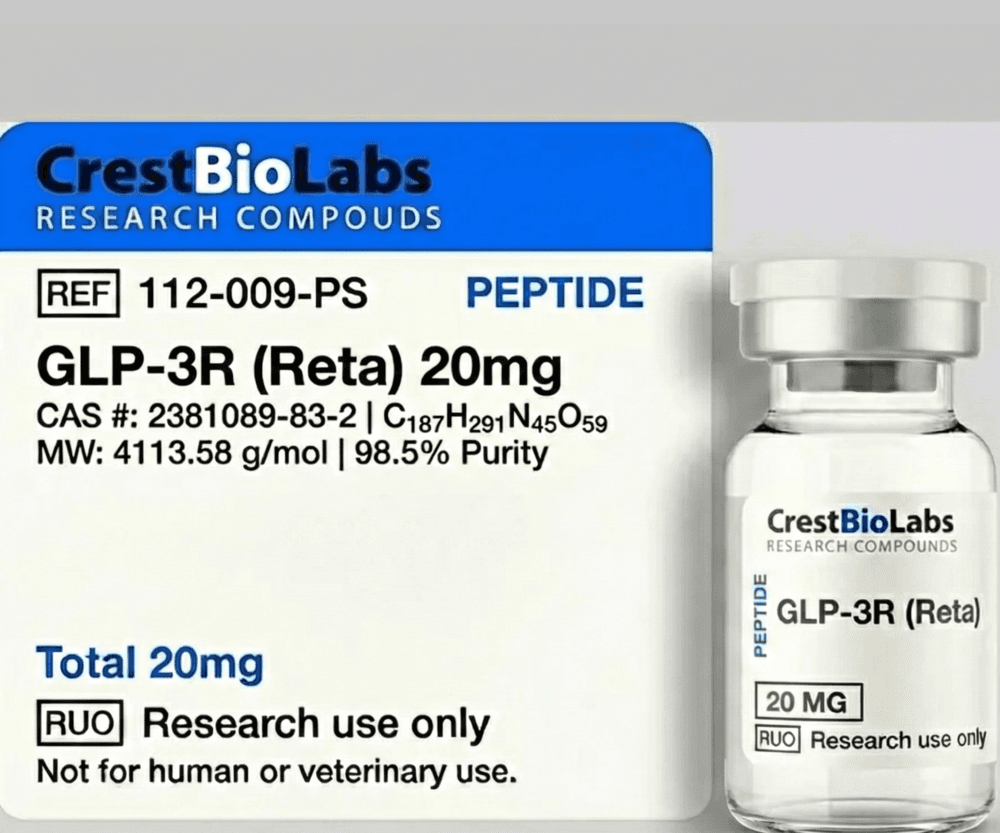
Chemically, GLP-3R (Reta) is a modified linear peptide with approximately 39 amino acids, a molecular weight of approximately 4113.58 Da, and a C20 fatty diacid modification attached via a linker to a specific lysine residue. The fatty acid acylation is a pharmacokinetic modification designed to promote albumin binding rather than to alter receptor pharmacology.
Within the classification of metabolic peptides, GLP-3R (Reta) is categorized as a triple incretin receptor agonist (TIRA), distinguishing it from single GLP-1R agonists, dual GLP-1R/GIPR agonists, and dual GLP-1R/GCGR agonists. It represents the most complex receptor engagement profile among currently available metabolic research peptides.
Structural Information
GLP-3R (Reta) is an acylated linear peptide of approximately 39 amino acid residues with a molecular weight of approximately 4113.58 Da. The peptide's structure integrates elements from three native hormone sequences: GLP-1, GIP, and glucagon, optimized through systematic amino acid substitutions to achieve balanced activity at all three target receptors.
The peptide backbone adopts an amphipathic alpha-helical conformation characteristic of the glucagon peptide superfamily. Members of this family (GLP-1, GIP, glucagon, secretin, VIP, and PACAP) share a common structural motif: an N-terminal receptor-activating domain (approximately residues 1-12) and a C-terminal alpha-helical domain (approximately residues 13-30+) that provides receptor affinity through hydrophobic interactions with the receptor extracellular domain.
The N-terminal region of GLP-3R (Reta) is particularly critical for receptor activation. Residues at positions 1-5 determine the selectivity and potency at each of the three target receptors. Strategic amino acid choices at these positions allow the single peptide to engage all three receptor binding pockets, which have overlapping but distinct structural requirements.
The C20 fatty diacid acylation (eicosanedioic acid derivative) is attached via a glutamic acid-based linker to a specific lysine side chain in the mid-chain region. This acylation does not directly participate in receptor binding but provides a hydrophobic anchor that binds non-covalently to fatty acid binding sites on serum albumin. The albumin association increases the hydrodynamic radius of the peptide-albumin complex, reducing glomerular filtration and extending the compound's residence time in experimental systems.
The peptide also incorporates alpha-aminoisobutyric acid (Aib) substitutions at key positions to enhance helical stability and resist DPP-IV degradation, following the same stabilization strategy used in CJC-1295 No DAC and other modified endocrine peptide analogs.
Mechanism of Action
GLP-3R (Reta) exerts its effects through simultaneous agonism of three class B G protein-coupled receptors: the GLP-1 receptor, the GIP receptor, and the glucagon receptor. Each receptor contributes distinct signaling outputs that converge to produce the compound's integrated metabolic effect profile.
GLP-1R activation by GLP-3R (Reta) triggers the Gs-adenylyl cyclase-cAMP-PKA signaling cascade in multiple target cell types. In pancreatic beta cells, this pathway potentiates glucose-dependent insulin secretion through PKA-mediated phosphorylation of SNAP-25, Epac2 (a cAMP-regulated guanine nucleotide exchange factor), and ATP-sensitive potassium channels. In central nervous system neurons expressing GLP-1R (particularly in the hypothalamus, brainstem nucleus tractus solitarius, and area postrema), cAMP elevation modulates neuronal firing patterns that influence appetite-related behaviors.
GIPR activation engages the same Gs-cAMP-PKA pathway in pancreatic beta cells, providing additive insulinotropic signaling. In adipocytes, GIPR activation modulates lipid metabolism through cAMP-dependent regulation of lipolysis and lipogenesis. The integration of GLP-1R and GIPR signaling in beta cells produces synergistic effects on insulin granule exocytosis, as both receptors converge on the cAMP pool but are subject to distinct desensitization kinetics.
GCGR activation in hepatocytes stimulates Gs-cAMP-PKA signaling that promotes glycogenolysis (through phosphorylase kinase activation of glycogen phosphorylase) and gluconeogenesis (through CREB-mediated transcription of PEPCK and G6Pase). In adipose tissue, glucagon receptor signaling activates cAMP-dependent lipolysis and may promote thermogenic gene expression. Importantly, the counter-regulatory hyperglycemic effect of isolated GCGR activation is attenuated by the concurrent GLP-1R and GIPR-mediated insulinotropic signaling, achieving a balanced metabolic outcome.
The tri-receptor mechanism produces signaling pathway interactions that go beyond simple additive effects. Cross-talk between the three receptor systems occurs at multiple levels: shared second messengers (cAMP pools), convergent transcription factor activation (CREB, FoxO), and integrated metabolic flux regulation (hepatic glucose output versus peripheral glucose disposal). These interactions form the mechanistic basis for the hypothesis that tri-agonism produces qualitatively different metabolic effects compared to mono- or dual-receptor agonism.
Stability and Storage
GLP-3R (Reta) requires careful storage due to its complex structure including the fatty acid acylation moiety and the need to maintain the peptide's alpha-helical conformation for receptor binding activity.
Lyophilized GLP-3R (Reta) should be stored at -20°C or below, desiccated, and protected from light. The fatty acid acylation is chemically stable under lyophilized conditions but may contribute to aggregation in reconstituted solutions at elevated concentrations due to hydrophobic interactions between acyl chains.
Reconstituted solutions should be prepared in mildly acidic buffers (pH 4-6) to minimize aggregation and deamidation. DMSO can be used as a co-solvent for initial dissolution if aqueous solubility is insufficient. Reconstituted solutions should be stored at 4°C for short-term use (up to 5 days) or frozen in aliquots at -20°C.
The primary degradation pathways include: Aib-adjacent peptide bond cleavage (slow), deamidation of Asn/Gln residues, methionine oxidation (if present in the sequence), fatty acid hydrolysis from the linker (very slow under standard conditions), and aggregation mediated by hydrophobic interactions. The Aib substitutions provide substantial resistance to DPP-IV degradation.
Single-use aliquots are strongly recommended. HPLC and mass spectrometry should be used for quality control assessment.
For comprehensive storage protocols, see our Peptide Stability & Storage Guide.
Laboratory Handling
GLP-3R (Reta) is supplied as a white to off-white lyophilized powder. Reconstitution requires careful attention due to the acylated peptide's amphiphilic character. Add sterile water or bacteriostatic water slowly along the vial wall. If dissolution is incomplete, a small amount of DMSO (up to 10% v/v) may be added as a co-solvent before dilution into the final aqueous medium.
Working concentrations for in-vitro receptor binding and functional assays are typically in the nanomolar range. Due to the peptide's albumin-binding properties, experiments conducted in serum-containing media will have a significant fraction of the peptide bound to albumin, which should be considered when interpreting concentration-response relationships.
All handling should be performed under aseptic conditions with standard equipment. Low-binding tubes are recommended due to the peptide's hydrophobic acyl moiety, which may promote surface adsorption.
For detailed reconstitution procedures, consult our Laboratory Handling Protocols.
Safety Considerations
Standard laboratory PPE (nitrile gloves, safety glasses, laboratory coat) should be worn when handling GLP-3R (Reta). Handle in a ventilated area. This is a pharmacologically active tri-receptor agonist; avoid skin and eye contact. The compound is intended exclusively for in-vitro research and laboratory investigation. Follow all institutional safety guidelines for handling bioactive peptides.
Published Research & Literature
The following peer-reviewed publications represent key research on GLP-3R (Reta). All citations reference studies available through major scientific databases.
Retatrutide, a GIP, GLP-1 and glucagon receptor agonist, for people with type 2 diabetes: a randomised, double-blind, placebo and active-comparator controlled, parallel-group, phase 2 trial
Rosenstock J, Frias J, Jastreboff AM, et al.
The Lancet (2023) · DOI: 10.1016/S0140-6736(23)01053-X
Triple-hormone-receptor agonist retatrutide for obesity — a phase 2 trial
Jastreboff AM, Kaplan LM, Frias JP, et al.
New England Journal of Medicine (2023) · DOI: 10.1056/NEJMoa2301972
GLP-1 receptor agonists: beyond the treatment of type 2 diabetes
Drucker DJ.
Nature Reviews Drug Discovery (2018) · DOI: 10.1038/nrd.2018.97
Unimolecular dual incretins maximize metabolic benefits in rodents, monkeys, and humans
Finan B, Ma T, Ottaway N, et al.
Science Translational Medicine (2013) · DOI: 10.1126/scitranslmed.3007218
A rationally designed monomeric peptide triagonist corrects obesity and diabetes in rodents
Finan B, Yang B, Ottaway N, et al.
Nature Medicine (2015) · DOI: 10.1038/nm.3761
The role of GIP in the regulation of GLP-1 satiety and nausea
Samms RJ, Coghlan MP, Sloop KW.
Diabetes (2020) · DOI: 10.2337/dbi20-0004
Related Research Resources
Research Use Only: All information on this page is provided for educational and research reference purposes.GLP-3R (Reta) is sold strictly for in-vitro laboratory and research use only. It is not intended for human or animal consumption. Not a drug, dietary supplement, or food additive. Not evaluated by the FDA.