Overview
Melanotan II (MT-II) is a synthetic cyclic lactam analog of alpha-melanocyte stimulating hormone (α-MSH), first developed in the early 1990s at the University of Arizona by Victor Hruby and colleagues. The peptide was designed through systematic structure-activity relationship studies aimed at creating potent, metabolically stable melanocortin receptor agonists. Melanotan II represents one of the earliest and most influential synthetic melanocortin analogs, and its development has been foundational to the understanding of melanocortin receptor pharmacology.
The design of Melanotan II incorporated several strategic structural modifications to the native α-MSH sequence. The 13-amino acid linear α-MSH was truncated to a core heptapeptide, cyclized via a lactam bridge, and modified with non-natural amino acids (norleucine and D-phenylalanine). These modifications collectively enhanced receptor binding affinity, improved metabolic stability, and conferred resistance to enzymatic degradation, producing a research tool with significantly improved pharmacological properties relative to the native hormone.
As a non-selective melanocortin receptor agonist, Melanotan II activates multiple MCR subtypes, including MC1R, MC3R, MC4R, and MC5R. This broad receptor activation profile has made it a versatile tool compound for investigating diverse aspects of melanocortin biology. MC1R activation in melanocytes drives melanogenesis (melanin synthesis), while MC3R and MC4R activation in the central nervous system influences energy homeostasis, neuroendocrine function, and other processes.
The research significance of Melanotan II extends well beyond its pharmacological activity. The synthetic strategies employed in its design, particularly the use of cyclic lactam constraints and D-amino acid substitutions, have become standard approaches in peptide medicinal chemistry. The compound has served as a template for the development of numerous subsequent melanocortin analogs, including PT-141 (bremelanotide), which was directly derived from Melanotan II through a terminal modification.
In the published literature, Melanotan II has been used as a research tool in hundreds of studies examining melanocortin receptor function, signal transduction, and structure-activity relationships. It has been instrumental in characterizing the roles of individual MCR subtypes in various physiological processes and has contributed to the development of subtype-selective melanocortin ligands.
From a chemical perspective, Melanotan II has been well characterized by multiple analytical techniques, including NMR spectroscopy, X-ray crystallography, circular dichroism, and molecular dynamics simulations. These structural studies have provided detailed insight into the three-dimensional conformation of the peptide and its mode of interaction with melanocortin receptors, contributing to structure-based design of next-generation melanocortin analogs.
The peptide's research legacy is further evidenced by its role in validating the melanocortin pharmacophore concept. Studies with Melanotan II and its derivatives established that the tetrapeptide sequence His-D-Phe-Arg-Trp constitutes the minimal structural element required for melanocortin receptor activation, a principle that has guided the design of all subsequent melanocortin analogs.
Chemical Classification
Melanotan II is classified as a synthetic cyclic melanocortin peptide agonist. It belongs to the family of α-MSH analogs, which are synthetic peptides designed to reproduce and enhance the receptor-binding and signaling activity of the endogenous melanocortin hormone alpha-melanocyte stimulating hormone.
Chemically, Melanotan II is a cyclic heptapeptide (seven amino acid residues) containing a lactam bridge formed between the side chains of aspartic acid and lysine. The peptide features an acetylated N-terminus and an amidated C-terminus, modifications that protect against exopeptidase degradation and alter the charge state of the peptide termini. The incorporation of norleucine (replacing Met) and D-phenylalanine (replacing L-Phe) represents non-natural amino acid substitutions that enhance stability and receptor selectivity.
Within the taxonomy of melanocortin ligands, Melanotan II is classified as a non-selective agonist, meaning it activates multiple melanocortin receptor subtypes without strong selectivity for any single subtype. Its pharmacological profile is closest to that of the endogenous pan-agonist α-MSH, though with enhanced potency and stability.
Structural Information
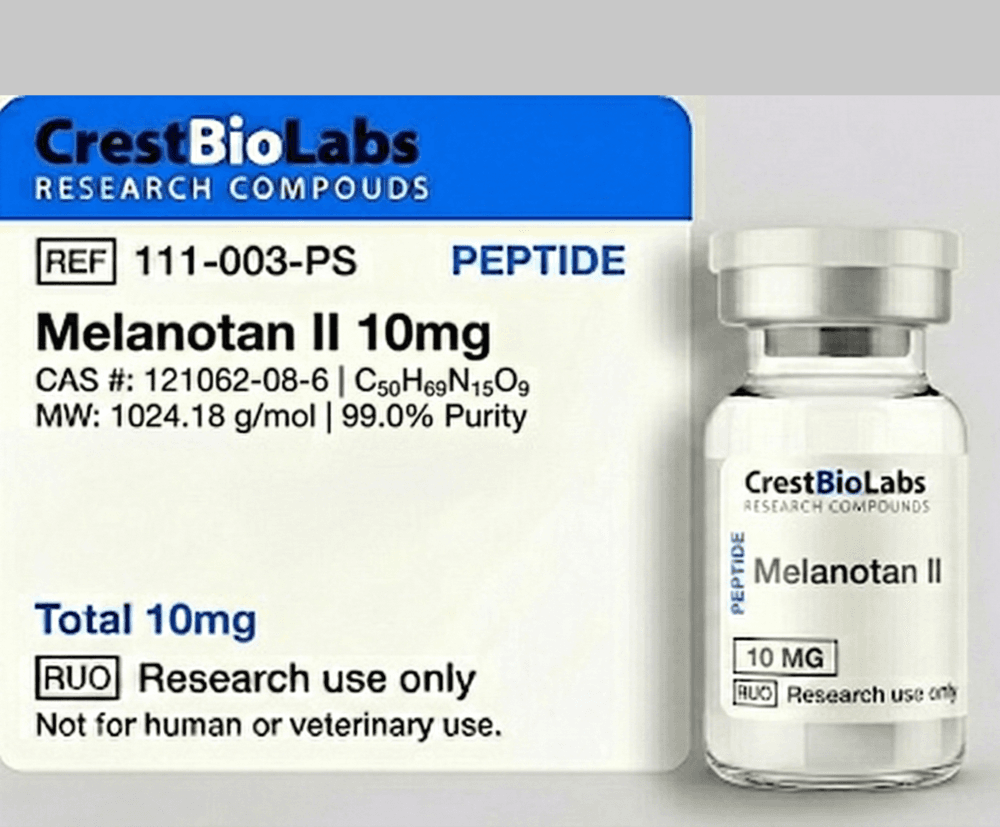
Melanotan II is a cyclic heptapeptide with a molecular weight of 1024.18 Da, closely related in structure to PT-141. The peptide sequence is Ac-Nle-Asp-His-D-Phe-Arg-Trp-Lys-NH2, with a lactam bridge connecting the Asp and Lys side chains. The N-terminal acetyl group and C-terminal amide distinguish Melanotan II from PT-141 (which has a free C-terminal carboxyl).
The cyclic core of Melanotan II forms a 23-membered ring encompassing residues 2 through 7 (Asp through Lys). NMR studies in aqueous and organic solvents have revealed that this macrocyclic ring adopts a relatively well-defined conformation featuring a type II' beta-turn centered on the D-Phe-Arg dipeptide segment. This beta-turn positions the pharmacophoric side chains (His, D-Phe, Arg, Trp) on the same face of the cyclic structure, creating a bioactive surface that complements the melanocortin receptor binding pocket.
The norleucine residue at position 1 extends from the ring as a linear, exocyclic element. Its four-carbon alkyl side chain provides hydrophobic character without the oxidation vulnerability of the methionine residue it replaces. The acetyl cap at the N-terminus eliminates the positive charge of the free amino group, reducing electrostatic repulsion with basic receptor residues and preventing aminopeptidase degradation.
The C-terminal amide group serves dual functions: it eliminates the negative charge of the free carboxyl group, optimizing electrostatic complementarity with the receptor, and it blocks carboxypeptidase access. The difference between the C-terminal amide of Melanotan II and the free carboxyl of PT-141 represents the primary structural distinction between these two closely related compounds.
Conformational studies using molecular dynamics simulations have shown that Melanotan II samples a restricted conformational ensemble in solution, with the cyclic constraint reducing the available backbone conformational space by approximately 90% compared to the corresponding linear peptide. This pre-organization of the bioactive conformation contributes to the high binding affinity of Melanotan II for melanocortin receptors.
Mechanism of Action
Melanotan II exerts its effects through agonism of melanocortin receptors, activating the same Gs-adenylyl cyclase-cAMP-PKA signaling cascade described for PT-141. The primary mechanistic distinction of Melanotan II lies in its activation profile across receptor subtypes and the resulting diversity of downstream signaling events.
MC1R activation by Melanotan II initiates the melanogenesis signaling cascade in melanocytes. The cAMP elevation triggered by MC1R stimulation activates PKA, which phosphorylates the cAMP response element-binding protein (CREB). Phosphorylated CREB translocates to the nucleus and binds to cAMP response elements (CREs) in the promoter of the MITF gene, upregulating its transcription. MITF subsequently activates the transcription of melanogenic enzymes, including tyrosinase, TRP-1, and DCT, which catalyze the multistep conversion of L-tyrosine to melanin pigments within melanosomes.
MC3R and MC4R activation by Melanotan II in the central nervous system engages hypothalamic circuits involved in energy balance regulation. MC4R-expressing neurons in the paraventricular nucleus (PVN) and other hypothalamic areas respond to melanocortin signaling by modulating the release of downstream neuropeptides and neurotransmitters. The melanocortin-4 receptor pathway is integrated with the leptin-melanocortin axis, which coordinates signals from peripheral energy stores with central appetite and energy expenditure regulation.
MC5R activation, while less extensively studied than MC1R and MC4R activation, has been linked to exocrine gland function in preclinical models. Studies in MC5R-deficient mice have revealed roles for this receptor subtype in sebaceous gland secretion and other exocrine processes.
The signal transduction initiated by Melanotan II extends beyond the canonical Gs-cAMP pathway. Studies have demonstrated that melanocortin receptor activation can also engage Gq-phospholipase C signaling, leading to inositol trisphosphate (IP3) production and intracellular calcium mobilization. Additionally, melanocortin receptors can recruit β-arrestins, which serve as scaffold proteins for alternative signaling cascades, including ERK1/2 MAP kinase activation. The relative engagement of these parallel signaling pathways varies by cell type and receptor expression level, contributing to the tissue-specific effects observed with Melanotan II.
The accessory proteins MRAP (melanocortin receptor accessory protein) and MRAP2 have been identified as modulators of melanocortin receptor signaling. These single-transmembrane proteins interact with MCRs and can alter their trafficking, ligand sensitivity, and signaling output. The influence of MRAPs on Melanotan II responses represents an area of ongoing research.
Stability and Storage
Lyophilized Melanotan II is stable under standard cold storage conditions. The cyclic lactam structure provides inherent resistance to exopeptidase degradation, while the D-Phe substitution confers resistance to endopeptidases. However, several residues remain susceptible to chemical degradation pathways.
Storage of the lyophilized peptide at -20°C in a sealed, desiccated container protected from light is recommended for long-term preservation. Short-term storage at 2-8°C is acceptable for periods of weeks. The tryptophan residue is photosensitive and susceptible to oxidation, making light protection particularly important for Melanotan II.
Reconstituted solutions should be stored at 4°C for short-term use (up to 7-10 days) or aliquoted and frozen at -20°C. Light-protective storage conditions (amber vials or foil-wrapped containers) are recommended to minimize tryptophan photooxidation. The arginine residue may undergo deimination (conversion to citrulline) under prolonged storage at elevated temperatures, though this is a relatively slow process under standard storage conditions.
The primary degradation pathways in solution include tryptophan oxidation, aspartimide formation at the Asp residue, deamidation of the C-terminal amide, and histidine oxidation. These processes are accelerated by elevated temperature, exposure to light, and non-optimal pH. Solution pH of 4-6 generally provides the best overall stability profile.
Analytical monitoring of stored Melanotan II using reversed-phase HPLC can detect degradation products as additional peaks or shifts in retention time. Mass spectrometric confirmation of the molecular ion at the expected mass provides definitive verification of molecular integrity.
For comprehensive storage protocols, see our Peptide Stability & Storage Guide.
Laboratory Handling
Melanotan II is supplied as a white to off-white lyophilized powder. Reconstitution is performed by adding sterile water or bacteriostatic water to the vial with gentle swirling to achieve dissolution. The solution should be clear and colorless upon complete dissolution.
Working concentrations for melanocortin receptor binding assays and cell-based functional studies are typically in the nanomolar range. Stock solutions at 1-10 mM are commonly prepared and diluted as needed. Melanotan II is soluble in water and may also be dissolved in dilute acetic acid or DMSO for specific applications.
All handling should be performed under aseptic conditions using a laminar flow hood or biosafety cabinet. Due to the photosensitivity of the tryptophan residue, exposure to direct light, especially UV radiation, should be minimized during preparation and use. Amber or opaque containers are recommended for both stock and working solutions. Calibrated micropipettes and sterile filtered tips should be used for all transfers.
For detailed reconstitution procedures, consult our Laboratory Handling Protocols.
Safety Considerations
Standard laboratory PPE, including nitrile gloves, safety glasses, and a laboratory coat, should be worn at all times when handling Melanotan II. The peptide should be handled in a well-ventilated area, and inhalation of the lyophilized powder should be avoided.
Melanotan II is a pharmacologically active melanocortin receptor agonist. Skin and eye contact should be avoided, and contaminated areas should be washed thoroughly with water. The compound is intended exclusively for in-vitro research and laboratory investigation. All institutional safety protocols and chemical hygiene plan guidelines should be followed.
Published Research & Literature
The following peer-reviewed publications represent key research on Melanotan II. All citations reference studies available through major scientific databases.
Design of potent cyclic alpha-melanotropin analogues
Al-Obeidi F, Hadley ME, Pettitt BM, Hruby VJ.
Journal of the American Chemical Society (1989) · DOI: 10.1021/ja00188a040
The melanocortin receptors: agonists, antagonists, and the hormonal control of pigmentation
Hadley ME, Hruby VJ, Jiang J, et al.
Pigment Cell Research (1996) · DOI: 10.1111/j.1600-0749.1996.tb00116.x
Melanocortin receptors, melanotropic peptides, and penile erection
Hadley ME, Dorr RT.
Annual Review of Sex Research (2006) · DOI: 10.1080/10532528.2006.10559838
Structure-activity studies of melanocortin analogues incorporating amino acid residue substitution
Hruby VJ, Lu D, Sharma SD, et al.
Journal of Medicinal Chemistry (1995) · DOI: 10.1021/jm00009a007
Cyclic lactam alpha-melanotropin analogues of Ac-Nle4-cyclo[Asp5,D-Phe7,Lys10] alpha-melanocyte-stimulating hormone-(4-10)-NH2 with bulky aromatic amino acid substitutions
Cai M, Mayorov AV, Ying J, et al.
Journal of Peptide Research (2005) · DOI: 10.1111/j.1399-3011.2005.00254.x
The melanocortin system
Cone RD.
Annals of the New York Academy of Sciences (2003) · DOI: 10.1196/annals.1297.002
Related Research Resources
Research Use Only: All information on this page is provided for educational and research reference purposes.Melanotan II is sold strictly for in-vitro laboratory and research use only. It is not intended for human or animal consumption. Not a drug, dietary supplement, or food additive. Not evaluated by the FDA.