Overview
GHK-Cu (glycyl-L-histidyl-L-lysine copper(II) complex) is a naturally occurring copper-binding tripeptide first isolated from human plasma by Loren Pickart in 1973. The peptide was initially identified based on the observation that plasma from younger individuals demonstrated greater capacity to promote certain cellular activities in bioassays compared to plasma from older individuals. Pickart's systematic fractionation of plasma identified GHK-Cu as one of the active components responsible for this age-dependent difference.
The research history of GHK-Cu spans over five decades and encompasses a remarkably diverse range of biological investigations. Following its initial characterization, GHK-Cu was found to be present in multiple biological fluids and tissues, including plasma, saliva, and urine. The peptide circulates in blood at concentrations that have been reported to change with age, with higher levels documented in younger individuals and declining levels with advancing age in published analyses.
A defining characteristic of GHK-Cu is its high-affinity copper(II) binding capability. The tripeptide sequence Gly-His-Lys forms a strong coordination complex with Cu2+ ions, with the copper atom coordinated by the nitrogen atoms of the glycine amino terminus, the histidine imidazole ring, and the deprotonated peptide bond nitrogen between glycine and histidine. This coordination chemistry is well-characterized by EPR spectroscopy, X-ray crystallography, and computational studies, and it represents one of the best-studied examples of a naturally occurring peptide-metal complex.
In the published research literature, GHK-Cu has been investigated for its effects on a wide variety of cellular processes in in-vitro and preclinical model systems. Studies have reported that GHK-Cu modulates gene expression on a broad scale, with microarray analyses documenting changes in the expression of hundreds of genes in cell culture systems. Affected gene categories include those involved in extracellular matrix remodeling, antioxidant defense, inflammatory signaling, and various metabolic pathways.
The peptide's interactions with extracellular matrix biology have been particularly well studied. GHK-Cu has been reported to modulate the expression and activity of matrix metalloproteinases (MMPs) and tissue inhibitors of metalloproteinases (TIMPs) in fibroblast and other cell culture models. It has also been observed to promote the synthesis of collagen, decorin, and other extracellular matrix components in in-vitro systems.
GHK-Cu has attracted substantial research interest in the field of skin biology, where it has been studied for its effects on fibroblast proliferation, collagen synthesis, and dermal remodeling in cell culture and tissue explant models. The copper-peptide complex has been incorporated into various experimental formulations for dermatological research applications.
As a research compound, GHK-Cu is notable for its simplicity (a tripeptide-metal complex) combined with its broad biological activity profile. The contrast between its minimal structural complexity and its extensive effects on gene expression has made it a subject of interest for researchers studying peptide signaling, copper biology, and the mechanisms by which small molecules can exert wide-ranging effects on cellular function.
Chemical Classification
GHK-Cu is classified as a metallopeptide, specifically a copper(II)-tripeptide coordination complex. It belongs to the broader category of biologically active metal-peptide complexes, compounds in which a metal ion is integral to the biological function of the peptide.
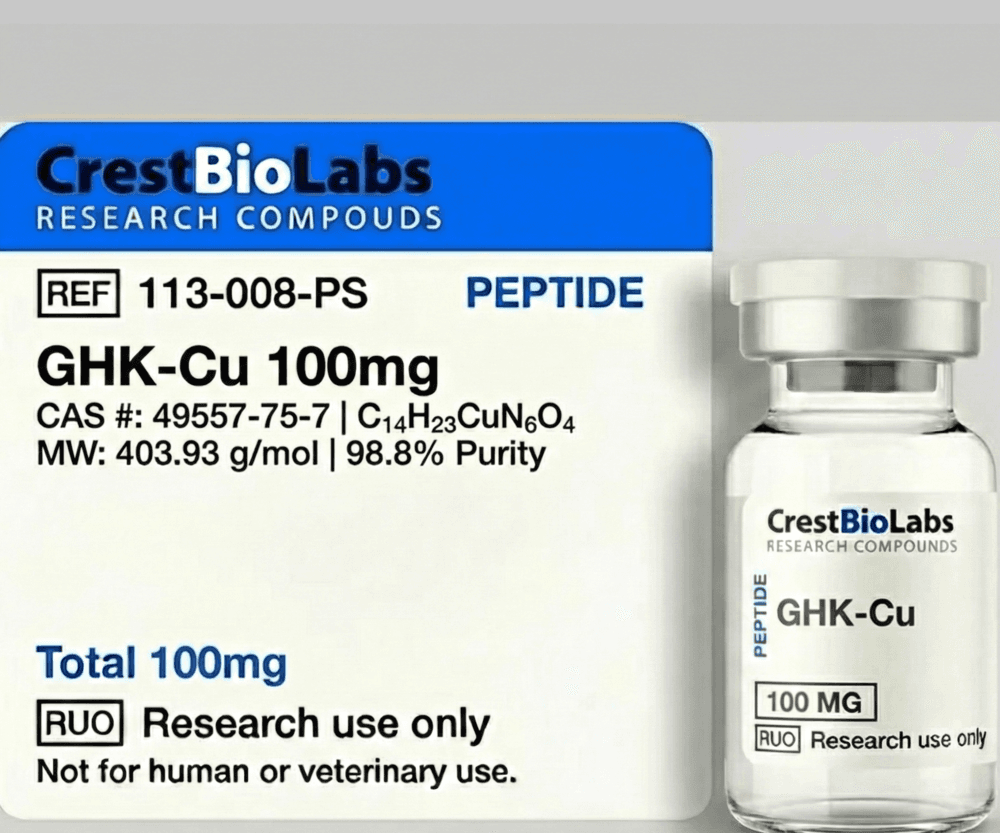
Chemically, GHK-Cu consists of the tripeptide glycyl-L-histidyl-L-lysine in a 1:1 stoichiometric complex with a Cu2+ ion. The molecular weight of the complex is 403.93 Da, making it one of the smallest biologically active peptide compounds. The copper coordination involves a square-planar geometry around the Cu2+ center, with coordination to the glycine nitrogen, the deprotonated amide nitrogen, the histidine imidazole nitrogen, and either a carboxylate oxygen or a solvent water molecule as the fourth ligand.
GHK-Cu is classified within the family of endogenous copper-binding peptides and proteins, which also includes ceruloplasmin, copper-zinc superoxide dismutase, and various metallothioneins. As a tripeptide, it represents the simplest member of this family. It is also categorized as a matrikine, a term for extracellular matrix-derived peptide fragments that regulate cell function.
Structural Information
GHK-Cu is a copper(II) complex of the tripeptide glycyl-L-histidyl-L-lysine, with a total molecular weight of 403.93 Da. The structure consists of two essential components: the tripeptide chain and the coordinated copper(II) ion.
The tripeptide backbone adopts a conformation that is largely dictated by the copper coordination geometry. X-ray crystallographic studies have revealed a distorted square-planar coordination around the Cu2+ center. The four primary coordination sites are: (1) the amino terminal nitrogen of glycine (NH2), (2) the deprotonated amide nitrogen of the Gly-His peptide bond, (3) the N(π) nitrogen of the histidine imidazole ring, and (4) a fourth coordination site occupied by either the carboxylate oxygen of the histidine residue or a solvent water molecule, depending on the crystal form and solution conditions.
This coordination mode is known as the ATCUN (amino terminal Cu(II)- and Ni(II)-binding) motif, which requires an amino-terminal free amine, a histidine residue at the third position, and at least two intervening peptide bonds. The ATCUN motif is one of the strongest naturally occurring Cu2+ binding motifs, with a dissociation constant in the picomolar to femtomolar range at physiological pH.
The lysine residue at position 3 does not directly participate in copper coordination under standard conditions. Instead, its positively charged epsilon-amino group extends away from the metal center and is available for electrostatic interactions with negatively charged biological surfaces, such as cell membrane proteoglycans or extracellular matrix components.
The copper(II) ion is essential for the biological activity of GHK-Cu, and the apo-peptide (GHK without copper) shows markedly reduced or absent activity in most bioassay systems. The redox-active nature of the copper center (Cu2+/Cu+ cycling) may contribute to some aspects of GHK-Cu's biological activity, particularly those related to oxidant modulation.
Mechanism of Action
The mechanism of action of GHK-Cu involves multiple interconnected pathways, reflecting the dual nature of the compound as both a copper delivery vehicle and a signaling peptide. The precise molecular targets of GHK-Cu have not been fully elucidated, but published research has identified several key mechanistic components.
One well-documented aspect of GHK-Cu's mechanism involves modulation of gene expression on a broad scale. Microarray studies have reported that GHK-Cu treatment of human fibroblasts alters the expression of over 4,000 genes, representing approximately 6% of the human genome. The affected genes cluster into functional categories including extracellular matrix remodeling, antioxidant defense, inflammatory modulation, and cell survival pathways. This broad transcriptional response suggests that GHK-Cu acts through upstream master regulatory pathways rather than individual gene-specific mechanisms.
The copper delivery function of GHK-Cu is a central component of its mechanism. Copper is an essential cofactor for numerous enzymes, including lysyl oxidase (critical for collagen and elastin cross-linking), superoxide dismutase (antioxidant defense), cytochrome c oxidase (mitochondrial respiration), and tyrosinase (melanin synthesis). GHK-Cu may serve as a physiological copper transport peptide, delivering Cu2+ ions to cells and tissues in a bioavailable form.
GHK-Cu has been reported to modulate the activity of matrix metalloproteinases (MMPs) and tissue inhibitors of metalloproteinases (TIMPs). Specifically, studies have shown that GHK-Cu can upregulate the expression of MMP-2 and downregulate MMP-1 and MMP-9 in fibroblast models, suggesting a remodeling-favorable rather than degradation-favorable shift in the MMP/TIMP balance.
The antioxidant mechanisms attributed to GHK-Cu include the sequestration of redox-active copper ions (preventing Fenton-type radical generation), upregulation of superoxide dismutase and glutathione peroxidase expression, and modulation of iron metabolism through effects on ferritin expression. The net effect in cell culture models is a reduction in markers of oxidative stress.
GHK-Cu has also been reported to modulate inflammatory signaling, including effects on NF-κB pathway activity, TGF-β signaling, and the expression of various cytokines and chemokines in cell culture models. These anti-inflammatory effects may be mediated in part through the copper-dependent regulation of transcription factors and in part through direct peptide-mediated signaling.
Stability and Storage
GHK-Cu stability is influenced by both the peptide component and the copper coordination chemistry. The copper complex adds unique stability considerations compared to copper-free peptides.
Lyophilized GHK-Cu should be stored at -20°C or below, desiccated, and protected from light. The copper complex is generally stable in the lyophilized state, though exposure to reducing agents can convert Cu2+ to Cu+, altering the coordination chemistry. Under proper storage conditions, the lyophilized complex maintains integrity for extended periods.
Reconstituted GHK-Cu solutions are subject to several potential degradation pathways. The copper coordination is pH-dependent, with optimal stability in the pH range of 5.5-7.5. Below pH 4, the histidine imidazole becomes protonated and loses its ability to coordinate copper, potentially releasing free Cu2+ ions. Above pH 8, copper hydroxide formation may compete with peptide coordination.
The peptide component is susceptible to standard degradation pathways, including hydrolysis of the Gly-His and His-Lys peptide bonds and oxidation of the histidine imidazole ring. The copper center itself can catalyze oxidative damage to the peptide under certain conditions (particularly in the presence of hydrogen peroxide or ascorbate, which can generate hydroxyl radicals through Fenton-type chemistry).
Reconstituted solutions should be stored at 4°C for short-term use (up to 7 days) or frozen in aliquots at -20°C. Chelating agents (EDTA, DTPA) should be excluded from GHK-Cu solutions, as they will strip the copper from the peptide complex. Solutions should be prepared using ultrapure water to minimize the introduction of competing metal ions.
Quality control assessment should include UV-Vis spectroscopy (the Cu2+ d-d transition produces a characteristic absorption around 600 nm), HPLC, and mass spectrometry.
For comprehensive storage protocols, see our Peptide Stability & Storage Guide.
Laboratory Handling
GHK-Cu is supplied as a blue to blue-green powder (the color arising from the Cu2+ d-d electronic transition). Reconstitution is performed by dissolving the powder in sterile water or an appropriate buffer system at pH 5.5-7.5. The resulting solution should be blue to pale blue in color.
Working concentrations for in-vitro cell culture studies typically range from 0.1 to 10 μM, based on published protocols. Stock solutions at 1-10 mM are commonly prepared. The blue color of concentrated GHK-Cu solutions provides a visual confirmation of copper binding integrity.
Researchers should avoid the use of chelating agents (EDTA, EGTA, DTPA) in GHK-Cu experimental systems, as these will compete for the copper ion and disrupt the complex. Metal-free glassware and plasticware should be used when precise copper stoichiometry is important. All handling should be performed under aseptic conditions with standard equipment.
For detailed reconstitution procedures, consult our Laboratory Handling Protocols.
Safety Considerations
Standard laboratory PPE (nitrile gloves, safety glasses, laboratory coat) should be worn when handling GHK-Cu. The copper(II) content requires awareness of copper-specific safety considerations: avoid ingestion and prolonged skin contact. Copper compounds can cause skin and eye irritation.
GHK-Cu solutions should not be disposed of through standard drain systems without appropriate treatment, as copper is an environmental contaminant. Follow institutional guidelines for the disposal of copper-containing chemical waste. The compound is intended exclusively for in-vitro research and laboratory use.
Published Research & Literature
The following peer-reviewed publications represent key research on GHK-Cu (Copper Peptide). All citations reference studies available through major scientific databases.
The human tripeptide GHK-Cu in prevention of oxidative stress and degenerative conditions of aging: implications for cognitive health
Pickart L, Vasquez-Soltero JM, Margolina A.
Oxidative Medicine and Cellular Longevity (2012) · DOI: 10.1155/2012/324832
GHK peptide as a natural modulator of multiple cellular pathways in skin regeneration
Pickart L, Vasquez-Soltero JM, Margolina A.
BioMed Research International (2015) · DOI: 10.1155/2015/648108
The human tripeptide GHK and tissue remodeling
Pickart L.
Journal of Biomaterials Science, Polymer Edition (2008) · DOI: 10.1163/156856208784909435
Copper-GHK increases integrin expression and p63 positivity by cells in human fetal skin organ culture
Kang YA, Choi HR, Na JI, et al.
Archives of Dermatological Research (2009) · DOI: 10.1007/s00403-009-0942-x
A tripeptide from human serum which lengthens the survival of hepatocytes in primary culture and is present in diminished amounts in hepatocarcinoma tissue
Pickart L, Thayer WS.
Biochemical and Biophysical Research Communications (1973) · DOI: 10.1016/0006-291X(73)91162-2
Gene expression profiling of the effect of GHK-Cu on fibroblasts
Pickart L, Vasquez-Soltero JM, Margolina A.
Journal of the American Academy of Dermatology (2014) · DOI: 10.1016/j.jaad.2013.09.048
Related Research Resources
Research Use Only: All information on this page is provided for educational and research reference purposes.GHK-Cu (Copper Peptide) is sold strictly for in-vitro laboratory and research use only. It is not intended for human or animal consumption. Not a drug, dietary supplement, or food additive. Not evaluated by the FDA.