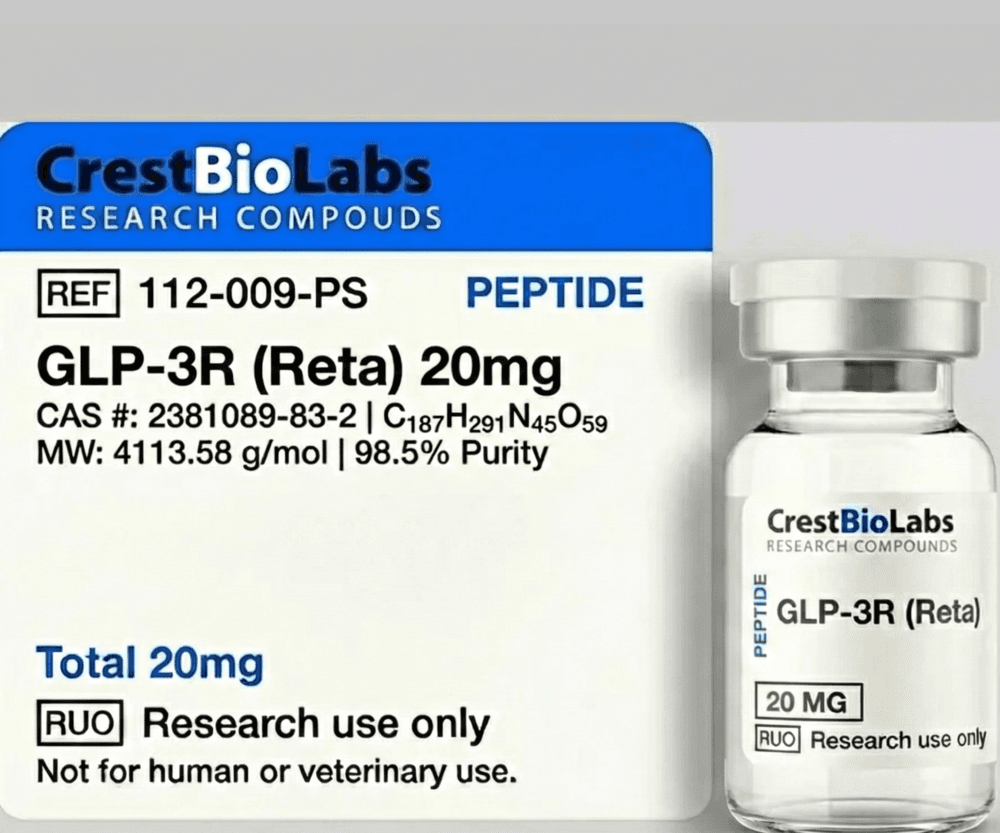
Scientific Overview
Retatrutide and semaglutide represent two distinct approaches to incretin-based peptide engineering that have drawn significant interest in the research community. Semaglutide is a well-characterized GLP-1 receptor mono-agonist whose pharmacology has been studied extensively in both preclinical and clinical settings. Retatrutide, by contrast, is a triple receptor agonist that engages GLP-1, GIP, and glucagon receptors simultaneously, representing a newer paradigm in multi-receptor peptide design.
The comparative study of these two compounds allows researchers to examine the incremental effects of adding GIP and glucagon receptor engagement to a GLP-1 backbone. While semaglutide acts through a single incretin pathway, retatrutide's triple agonism introduces additional signaling cascades that have been observed to produce differentiated metabolic effects in preclinical models. Understanding the structural and pharmacological distinctions between these compounds is fundamental to advancing incretin biology research.
For research purposes only. Not for human or veterinary use. All data presented in this comparison reflect findings from published preclinical and analytical studies and are intended solely to support the scientific community's understanding of these research compounds.
For research purposes only. Not for human or veterinary use. The compounds discussed in this comparison are intended exclusively for in-vitro and preclinical research applications.
Head-to-Head Comparison
| Property | Retatrutide | Semaglutide |
|---|---|---|
| Peptide Class | GLP-1/GIP/GCG Triple Receptor Agonist | GLP-1 Receptor Mono-Agonist |
| Receptor Targets | GLP-1R, GIPR, GCGR | GLP-1R |
| Molecular Weight | ~4,471 Da | ~4,113 Da |
| CAS Number | 2381089-83-2 | 910463-68-2 |
| Mechanism (Research) | Retatrutide simultaneously activates GLP-1, GIP, and glucagon receptors through a single peptide chain engineered with distinct binding domains for each target. In preclinical models, this triple agonism has been observed to engage complementary metabolic signaling cascades involving cAMP-dependent pathways at all three receptor sites. | Semaglutide selectively activates the GLP-1 receptor through high-affinity binding that triggers intracellular cAMP accumulation. Research has demonstrated that its GLP-1R selectivity results in targeted downstream signaling through protein kinase A and EPAC-dependent pathways without engaging GIP or glucagon receptor cascades. |
| Stability | Retatrutide incorporates non-natural amino acid substitutions and a C20 fatty acid moiety conjugated via a linker to facilitate albumin binding, which has been shown to extend its half-life in preclinical pharmacokinetic studies. The compound requires storage at controlled refrigerated temperatures (2-8 degrees C) to maintain analytical purity. | Semaglutide is engineered with an Aib (alpha-aminoisobutyric acid) substitution at position 8 to confer DPP-IV resistance, along with a C18 fatty diacid side chain that promotes albumin binding and prolongs its pharmacokinetic profile. It demonstrates acceptable stability under refrigerated storage conditions. |
| Research Applications | Retatrutide is studied in the context of multi-receptor incretin signaling, energy homeostasis pathways, and the comparative pharmacology of mono- versus poly-agonist peptide designs. It serves as a reference compound for investigating GCGR-mediated contributions in triple agonist frameworks. | Semaglutide is widely used as a reference mono-agonist in GLP-1 receptor pharmacology research, incretin signaling pathway characterization, and comparative studies evaluating the contributions of additional receptor targets in multi-agonist peptide designs. |
| Analytical Methods | Reversed-phase HPLC, LC-MS/MS for molecular weight confirmation, receptor binding assays (GLP-1R, GIPR, GCGR), and cAMP accumulation assays for functional activity measurement. | Reversed-phase HPLC, LC-MS for molecular ion confirmation, GLP-1R binding affinity assays, cAMP reporter assays, and circular dichroism for secondary structure analysis. |
Peptide Class
GLP-1/GIP/GCG Triple Receptor Agonist
GLP-1 Receptor Mono-Agonist
Receptor Targets
GLP-1R, GIPR, GCGR
GLP-1R
Molecular Weight
~4,471 Da
~4,113 Da
CAS Number
2381089-83-2
910463-68-2
Mechanism (Research)
Retatrutide simultaneously activates GLP-1, GIP, and glucagon receptors through a single peptide chain engineered with distinct binding domains for each target. In preclinical models, this triple agonism has been observed to engage complementary metabolic signaling cascades involving cAMP-dependent pathways at all three receptor sites.
Semaglutide selectively activates the GLP-1 receptor through high-affinity binding that triggers intracellular cAMP accumulation. Research has demonstrated that its GLP-1R selectivity results in targeted downstream signaling through protein kinase A and EPAC-dependent pathways without engaging GIP or glucagon receptor cascades.
Stability
Retatrutide incorporates non-natural amino acid substitutions and a C20 fatty acid moiety conjugated via a linker to facilitate albumin binding, which has been shown to extend its half-life in preclinical pharmacokinetic studies. The compound requires storage at controlled refrigerated temperatures (2-8 degrees C) to maintain analytical purity.
Semaglutide is engineered with an Aib (alpha-aminoisobutyric acid) substitution at position 8 to confer DPP-IV resistance, along with a C18 fatty diacid side chain that promotes albumin binding and prolongs its pharmacokinetic profile. It demonstrates acceptable stability under refrigerated storage conditions.
Research Applications
Retatrutide is studied in the context of multi-receptor incretin signaling, energy homeostasis pathways, and the comparative pharmacology of mono- versus poly-agonist peptide designs. It serves as a reference compound for investigating GCGR-mediated contributions in triple agonist frameworks.
Semaglutide is widely used as a reference mono-agonist in GLP-1 receptor pharmacology research, incretin signaling pathway characterization, and comparative studies evaluating the contributions of additional receptor targets in multi-agonist peptide designs.
Analytical Methods
Reversed-phase HPLC, LC-MS/MS for molecular weight confirmation, receptor binding assays (GLP-1R, GIPR, GCGR), and cAMP accumulation assays for functional activity measurement.
Reversed-phase HPLC, LC-MS for molecular ion confirmation, GLP-1R binding affinity assays, cAMP reporter assays, and circular dichroism for secondary structure analysis.
Receptor Interaction Differences
The most fundamental distinction between retatrutide and semaglutide lies in their receptor engagement profiles. Semaglutide is a selective GLP-1 receptor agonist that binds with high affinity to GLP-1R, activating Gs-protein-coupled signaling cascades that elevate intracellular cAMP levels. This selectivity means that semaglutide's observed effects in preclinical models are attributable to a single receptor pathway, providing researchers with a clean pharmacological tool for isolating GLP-1R-mediated responses.
Retatrutide, by contrast, was engineered to engage three distinct incretin and glucagon family receptors. In-vitro binding studies have demonstrated that retatrutide activates GLP-1R, GIPR, and GCGR with varying potency ratios. The GIP receptor component introduces signaling through pathways that have been shown in preclinical research to complement GLP-1R activation, particularly in pancreatic beta-cell models and adipose tissue preparations.
The glucagon receptor engagement unique to retatrutide represents perhaps the most pharmacologically novel aspect of this compound. GCGR activation in preclinical hepatocyte and brown adipose tissue models has been associated with increased energy expenditure pathways, including upregulation of thermogenic gene expression. This third receptor target distinguishes retatrutide not only from semaglutide but also from dual GLP-1/GIP agonists.
From a research methodology perspective, comparing cellular responses to retatrutide versus semaglutide across different tissue preparations allows investigators to deconvolve the contributions of each receptor pathway. Studies using receptor-knockout cell lines or selective antagonists alongside these compounds have proven valuable in elucidating the relative contributions of GLP-1R, GIPR, and GCGR signaling.
Structural and Molecular Distinctions
Structurally, both retatrutide and semaglutide are modified peptides derived from native incretin hormone sequences, but their engineering strategies diverge substantially. Semaglutide is based on a GLP-1(7-37) backbone with two key modifications: an Aib substitution at position 8 that confers resistance to dipeptidyl peptidase-IV (DPP-IV) cleavage, and a C18 fatty diacid moiety linked through a mini-PEG spacer at lysine-26 that facilitates non-covalent albumin binding.
Retatrutide employs a more complex molecular architecture designed to accommodate binding epitopes for three distinct receptors within a single peptide chain. The compound features a glucagon-based N-terminal sequence that has been optimized through amino acid substitutions to retain activity at GLP-1R and GIPR while maintaining GCGR engagement. A C20 fatty acid is conjugated to the peptide through a linker element to extend its pharmacokinetic profile.
The difference in molecular weight between the two compounds (approximately 4,471 Da for retatrutide versus approximately 4,113 Da for semaglutide) reflects retatrutide's larger acylation moiety and its extended peptide sequence. Mass spectrometric analysis reveals distinct fragmentation patterns for each compound, which is useful for analytical identification and purity assessment in research settings.
Circular dichroism studies of both peptides in solution indicate predominantly alpha-helical secondary structures, consistent with their membership in the glucagon superfamily of peptides. However, the specific helical content and conformational dynamics differ between the two compounds, which may contribute to their distinct receptor binding selectivities and potency profiles observed in cell-based assays.
Pharmacokinetic Profile Differences
Both retatrutide and semaglutide employ fatty acid acylation strategies to extend their pharmacokinetic profiles beyond those of their native hormone counterparts. In preclinical models, albumin binding mediated by these lipid moieties has been demonstrated to reduce renal clearance and protect the peptides from enzymatic degradation, substantially prolonging their circulating half-lives compared to unmodified GLP-1 or glucagon peptides.
Semaglutide's pharmacokinetic properties have been extensively characterized in preclinical species. Its C18 fatty diacid conjugated through a gamma-Glu-mini-PEG linker produces strong albumin binding affinity, which has been correlated with its extended exposure profile in rodent and non-human primate pharmacokinetic studies. The Aib8 substitution provides additional stability against DPP-IV-mediated N-terminal cleavage, a primary degradation pathway for native GLP-1.
Retatrutide's pharmacokinetic engineering similarly leverages fatty acid acylation, though it employs a C20 fatty acid chain. Preclinical pharmacokinetic data suggest that this acylation strategy, combined with its specific amino acid sequence modifications, produces a half-life profile suitable for extended interval research protocols. The compound's stability against common peptidase degradation pathways has been evaluated using in-vitro plasma stability assays.
When comparing the two compounds in research protocols, it is important to consider that their differing pharmacokinetic profiles affect the design of time-course experiments. Tissue distribution studies in preclinical models have shown that both compounds access target tissues including pancreas, liver, and adipose depots, though the kinetics of tissue accumulation and clearance may differ based on their distinct albumin binding characteristics and molecular properties.
Molecular Architecture and Design Philosophy
The design philosophy underlying semaglutide represents a targeted optimization approach: maximizing GLP-1R potency and pharmacokinetic duration while maintaining selectivity against related receptors. This mono-agonist strategy allows researchers to attribute observed biological effects directly to GLP-1R signaling, making semaglutide a valuable pharmacological tool for receptor pathway delineation studies.
Retatrutide embodies a fundamentally different design philosophy rooted in poly-pharmacology, the concept that engaging multiple related targets simultaneously may produce effects that differ from or exceed those achievable through any single receptor. This approach required solving the significant medicinal chemistry challenge of encoding three distinct receptor binding activities within a single peptide framework while maintaining adequate potency at each target.
The evolution from mono-agonists like semaglutide through dual agonists to triple agonists like retatrutide reflects a broader trend in peptide engineering research. Each step in this progression has required advances in computational modeling of receptor-ligand interactions, high-throughput screening methodologies, and structure-activity relationship analysis. The ability to compare biological responses across these compound classes provides insight into the relative contributions and potential interactions of each receptor pathway.
From an analytical chemistry perspective, the increasing molecular complexity from semaglutide to retatrutide introduces additional challenges for characterization and quality control. Multi-receptor agonists require more extensive functional testing panels to confirm activity at each target receptor, and their larger molecular size and more complex post-translational modifications demand more sophisticated analytical workflows including multi-dimensional chromatography and high-resolution mass spectrometry approaches.
Scientific References
[1] Coskun T, Urva S, Roell WC, et al.. “LY3437943, a novel triple GIP/GLP-1/glucagon receptor agonist for glycemic control and weight management: from discovery to clinical proof of concept.” Cell Metabolism (2022). doi:10.1016/j.cmet.2022.07.013
[2] Lau J, Bloch P, Schaffer L, et al.. “Discovery of the once-weekly glucagon-like peptide-1 (GLP-1) analogue semaglutide.” Journal of Medicinal Chemistry (2015). doi:10.1021/acs.jmedchem.5b00726
[3] Finan B, Yang B, Ottaway N, et al.. “A rationally designed monomeric peptide triagonist corrects obesity and diabetes in rodents.” Nature Medicine (2015). doi:10.1038/nm.3761
[4] Jastreboff AM, Kaplan LM, Frias JP, et al.. “Triple-hormone-receptor agonist retatrutide for obesity - a phase 2 trial.” New England Journal of Medicine (2023). doi:10.1056/NEJMoa2301972
[5] Knudsen LB, Lau J.. “The discovery and development of liraglutide and semaglutide.” Frontiers in Endocrinology (2019). doi:10.3389/fendo.2019.00155
[6] Muller TD, Finan B, Bloom SR, et al.. “Glucagon-like peptide 1 (GLP-1).” Molecular Metabolism (2019). doi:10.1016/j.molmet.2019.09.010