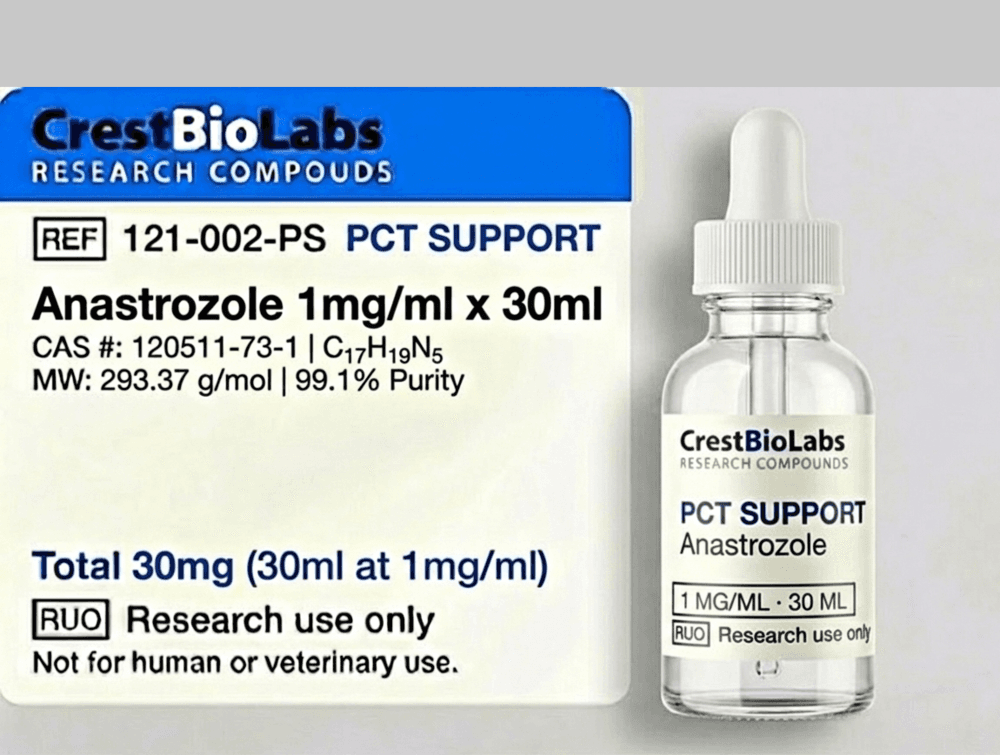
Overview
Anastrozole is a synthetic non-steroidal aromatase inhibitor (AI) that selectively and reversibly inhibits the cytochrome P450 enzyme CYP19A1 (aromatase), the enzyme responsible for the conversion of androgens to estrogens. Unlike the peptides in this catalog, anastrozole is a small molecule compound with a molecular weight of 293.37 Da, belonging to the class of triazole-based aromatase inhibitors. It was developed by AstraZeneca (originally ICI Pharmaceuticals) in the late 1980s and early 1990s.
The development of anastrozole arose from research into the aromatase enzyme system, which has been a subject of intensive investigation since the initial characterization of estrogen biosynthesis pathways in the 1960s and 1970s. The aromatase enzyme catalyzes the final and rate-limiting step in estrogen biosynthesis: the conversion of androstenedione to estrone and testosterone to estradiol through a three-step oxidation process involving sequential hydroxylation of the C19 methyl group of the androgen substrate.
The chemical design of anastrozole was guided by the understanding that aromatase contains a heme iron center (Fe3+) within its active site. The 1,2,4-triazole ring of anastrozole coordinates with this heme iron through a nitrogen lone pair, forming a reversible coordinate bond that blocks the active site and prevents substrate access. This mechanism of competitive inhibition at the heme iron distinguishes anastrozole from steroidal aromatase inhibitors (such as exemestane), which act as mechanism-based irreversible inactivators.
In the research literature, anastrozole has been extensively studied as a tool compound for investigating aromatase biochemistry, estrogen biosynthesis regulation, and the role of local estrogen production in various tissue contexts. The enzyme CYP19A1 is expressed not only in the gonads but also in adipose tissue, brain, bone, vascular endothelium, and other tissues, where local aromatization contributes to paracrine and intracrine estrogen signaling. Anastrozole's ability to inhibit aromatase across all tissue compartments has made it a valuable research tool for studying the consequences of estrogen deprivation in specific experimental systems.
The selectivity of anastrozole for CYP19A1 over other cytochrome P450 enzymes has been characterized through in-vitro enzyme inhibition studies. Published data demonstrate that anastrozole inhibits aromatase at concentrations that are orders of magnitude below those required to affect CYP1A2, CYP2C9, CYP2D6, CYP3A4, or other CYP450 isoforms. This selectivity is attributed to the complementary fit between anastrozole's two 2-cyanopropan-2-yl groups and the hydrophobic substrate access channel of aromatase, which has a distinct geometry from the active site channels of other CYP450 enzymes.
As a small molecule rather than a peptide, anastrozole presents different physicochemical properties from the other compounds in this catalog. It is orally bioavailable, crosses biological membranes freely, and does not require reconstitution from a lyophilized powder. Its inclusion alongside peptide research compounds reflects its use as an ancillary tool in research protocols that also employ peptide compounds for studying the interplay between peptide signaling pathways and steroid hormone biology.
The research significance of anastrozole extends to its role in understanding steroid hormone enzyme pharmacology. Studies using anastrozole have contributed to the characterization of aromatase tissue distribution, the elucidation of aromatase gene (CYP19A1) regulation by tissue-specific promoters, and the investigation of local estrogen production in tissues where aromatase expression was not previously appreciated.
Chemical Classification
Anastrozole is classified as a non-steroidal, competitive, reversible aromatase inhibitor (AI) belonging to the triazole chemical class. It is a small molecule pharmaceutical compound, not a peptide, distinguishing it from all other compounds in this catalog.
Chemically, anastrozole is 2,2'-[5-(1H-1,2,4-triazol-1-ylmethyl)-1,3-phenylene]bis(2-methylpropanenitrile), with a molecular weight of 293.37 Da and a molecular formula of C17H19N5. The compound consists of a central phenyl ring with a triazolylmethyl substituent at the 1-position and two 2-cyanopropan-2-yl groups at the 3 and 5 positions.
Within the classification of aromatase inhibitors, anastrozole belongs to the third-generation non-steroidal AIs, along with letrozole. This generation is distinguished by its high potency and selectivity for aromatase over other CYP450 enzymes. The classification as "reversible" indicates that enzyme activity is fully restored upon dissociation of the inhibitor, in contrast to irreversible (mechanism-based) inhibitors like exemestane that permanently modify the enzyme.
Structural Information
Anastrozole is a small organic molecule with a molecular weight of 293.37 Da and the molecular formula C17H19N5. Its structure is organized around a central 1,3,5-trisubstituted benzene ring.
The three substituents on the benzene ring are: (1) a 1,2,4-triazol-1-ylmethyl group at position 1, which provides the heme-coordinating pharmacophore, and (2,3) two identical 2-cyanopropan-2-yl groups at positions 3 and 5, which provide steric bulk and hydrophobic interactions within the aromatase active site.
The 1,2,4-triazole ring is the pharmacophoric element responsible for aromatase inhibition. The N-4 nitrogen of the triazole ring donates a lone pair of electrons to the ferric (Fe3+) heme iron at the aromatase active site, forming a coordinate bond that displaces the molecular oxygen normally required for the aromatization reaction. This coordination prevents the three sequential hydroxylation steps that aromatase performs on the C19 methyl group during androgen-to-estrogen conversion.
The two 2-cyanopropan-2-yl groups (also called alpha,alpha-dimethylcyanomethyl groups) are symmetric substituents that serve multiple structural functions. Their gem-dimethyl groups provide steric bulk that fills the hydrophobic substrate access channel of aromatase, contributing to binding affinity. The nitrile (CN) groups contribute additional polar interactions and may form hydrogen bonds with active site residues. The symmetric arrangement of these groups on the benzene ring creates a molecular geometry that complements the aromatase active site while being incompatible with the differently shaped active sites of other CYP450 enzymes, providing the structural basis for selectivity.
Unlike peptides, anastrozole does not have a backbone conformation or secondary structure. It is a rigid, planar molecule with limited conformational flexibility. The methylene bridge between the benzene ring and the triazole ring provides some rotational freedom, but the overall molecule maintains a relatively fixed spatial arrangement. X-ray crystallographic studies of aromatase-inhibitor complexes have confirmed the predicted binding mode with heme iron coordination.
Mechanism of Action
Anastrozole inhibits aromatase (CYP19A1) through a well-characterized competitive, reversible mechanism involving coordination to the active site heme iron. This mechanism has been elucidated through a combination of enzyme kinetics, spectroscopic studies, X-ray crystallography, and computational modeling.
The aromatase enzyme CYP19A1 catalyzes the conversion of C19 androgens (androstenedione, testosterone) to C18 estrogens (estrone, estradiol) through a three-step oxidation process. Each step requires molecular oxygen and NADPH (provided by the cytochrome P450 reductase partner enzyme). The reaction proceeds through sequential hydroxylation of the C19 methyl group: first to 19-hydroxy, then to 19-oxo (aldehyde), and finally the elimination of the C19 carbon as formic acid with concurrent aromatization of the A-ring to form the phenolic estrogen product.
Anastrozole inhibits this reaction by occupying the substrate binding pocket and coordinating its triazole nitrogen to the heme iron. The coordinate bond between the triazole N-4 and Fe3+ displaces the molecular oxygen that would normally bind to the heme iron for the hydroxylation reaction. Because this is a coordinate bond rather than a covalent modification, the inhibition is fully reversible: enzyme activity is restored upon anastrozole dissociation.
The binding affinity of anastrozole for aromatase reflects contributions from the heme coordination (triazole), hydrophobic contacts (dimethyl groups filling the substrate channel), and polar interactions (nitrile groups with active site residues). Published IC50 values for anastrozole inhibition of aromatase in various assay systems are typically in the low nanomolar range (approximately 2-15 nM, depending on the assay conditions and enzyme source).
The selectivity of anastrozole for CYP19A1 over other CYP450 enzymes is structurally determined. Each CYP450 has a uniquely shaped substrate access channel that determines substrate specificity. The symmetric arrangement of anastrozole's two bulky cyanopropyl groups provides an optimal fit for the aromatase channel while being sterically excluded from the differently shaped channels of CYP1A2, CYP2C9, CYP2D6, CYP3A4, and other CYP450 isoforms. Published studies have reported selectivity ratios of >1000-fold for aromatase over other CYP450 enzymes.
As a competitive inhibitor, anastrozole's effect is concentration-dependent and can be overcome by sufficiently high substrate concentrations. In research settings, this property allows researchers to modulate the degree of aromatase inhibition by adjusting anastrozole concentration, providing a titratable tool for studying the effects of graded estrogen reduction in experimental systems.
Stability and Storage
Anastrozole is a chemically stable small molecule that does not share the degradation vulnerabilities of peptides. Its stability profile is governed by standard organic chemistry considerations rather than the peptide-specific degradation pathways (deamidation, oxidation of specific residues, backbone hydrolysis) relevant to the peptide compounds in this catalog.
Anastrozole should be stored at room temperature (15-25°C) or refrigerated (2-8°C) in a sealed container protected from light and moisture. The compound is stable for extended periods under these conditions. Unlike lyophilized peptides, anastrozole does not require ultra-cold storage or desiccation for routine preservation.
In solution, anastrozole is stable across a wide pH range. The compound is supplied in solution form (typically in an appropriate vehicle) and maintains chemical integrity at room temperature. The primary stability consideration is protection from direct UV light, which can promote photodegradation of the triazole ring over extended periods.
Anastrozole is soluble in organic solvents (ethanol, methanol, DMSO, acetonitrile) and has limited aqueous solubility. Research-grade preparations are often supplied as solutions in a suitable vehicle to ensure accurate concentration and ease of use. These solutions should be stored according to the manufacturer's specifications.
Quality control assessment of anastrozole can be performed using standard analytical chemistry methods: HPLC for purity determination, mass spectrometry for identity confirmation, and UV spectroscopy for concentration measurement. The compound has a characteristic UV absorption profile that provides a convenient quantification method.
For comprehensive storage protocols, see our Peptide Stability & Storage Guide.
Laboratory Handling
Anastrozole is supplied as a solution (typically 1 mg/mL in a suitable vehicle) rather than as a lyophilized powder. This differs from the peptide compounds in this catalog and simplifies handling procedures.
For in-vitro research applications, anastrozole stock solutions can be prepared in DMSO at concentrations of 10-100 mM and diluted into cell culture media or assay buffers as needed. Working concentrations for aromatase inhibition studies are typically in the nanomolar to low micromolar range, depending on the specific assay system.
Due to anastrozole's limited aqueous solubility, the final DMSO concentration in experimental media should be minimized (typically less than 0.1% v/v) and appropriate vehicle controls should be included. The compound is compatible with standard cell culture media and buffer systems.
Standard laboratory PPE and handling procedures apply. Calibrated micropipettes should be used for accurate volume measurements of the concentrated solution.
For detailed reconstitution procedures, consult our Laboratory Handling Protocols.
Safety Considerations
Standard laboratory PPE (nitrile gloves, safety glasses, laboratory coat) should be worn when handling anastrozole. The compound is a pharmacologically active aromatase inhibitor. Avoid skin contact, ingestion, and inhalation. Work in a well-ventilated area.
Anastrozole should be handled with awareness of its biological activity as a potent inhibitor of estrogen biosynthesis. The compound is intended for in-vitro research and laboratory investigation. Follow institutional guidelines for the handling and disposal of pharmaceutical research compounds. Consult the Safety Data Sheet (SDS) for detailed hazard information and first aid procedures.
Published Research & Literature
The following peer-reviewed publications represent key research on Anastrozole. All citations reference studies available through major scientific databases.
Anastrozole, a potent and selective aromatase inhibitor
Plourde PV, Dyroff M, Dukes M.
Breast Cancer Research and Treatment (1994) · DOI: 10.1007/BF00666199
Crystal structure of human aromatase: insights into inhibitor binding and selectivity
Ghosh D, Griswold J, Erman M, Pangborn W.
Journal of Steroid Biochemistry and Molecular Biology (2009) · DOI: 10.1016/j.jsbmb.2009.09.004
Aromatase inhibitors: mechanism of action and role in the treatment of breast cancer
Brueggemeier RW, Hackett JC, Diaz-Cruz ES.
Endocrine Reviews (2005) · DOI: 10.1210/er.2004-0015
Structure of human aromatase: a key enzyme in estrogen biosynthesis
Ghosh D, Griswold J, Erman M, Pangborn W.
Acta Crystallographica Section D (2010) · DOI: 10.1107/S0907444909042573
Selectivity of anastrozole for inhibition of aromatase in human tissues
Buzdar AU.
Journal of Steroid Biochemistry and Molecular Biology (2003) · DOI: 10.1016/S0960-0760(03)00339-3
Cytochrome P450 19A1 (aromatase): a review of its role in the regulation of estrogen biosynthesis
Simpson ER, Clyne C, Rubin G, et al.
Annual Review of Physiology (2002) · DOI: 10.1146/annurev.physiol.64.081601.142413
Related Research Resources
Research Use Only: All information on this page is provided for educational and research reference purposes.Anastrozole is sold strictly for in-vitro laboratory and research use only. It is not intended for human or animal consumption. Not a drug, dietary supplement, or food additive. Not evaluated by the FDA.